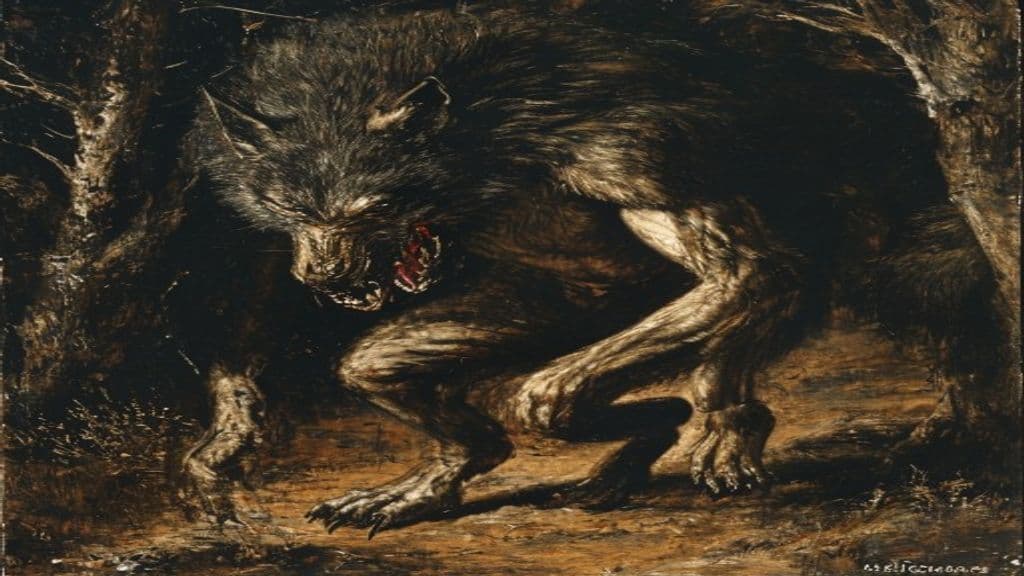
The term and motif have multiple layers of origin. The English word werewolf derives from Old English werwulf ('man-wolf'), and the learned term lycanthrope/lycanthropy comes from Ancient Greek lukánthrōpos / lukanthrōpía, where classical writers used the term in a clinical sense for people who imagined themselves to be wolves. In medieval and early modern Europe the motif of human–wolf transformation appears across Germanic, Slavic, Celtic and Romance languages, sometimes as a 'man-wolf' or as forms meaning 'wolf-haired' or 'wolf-clothed'. From Late Antiquity and through the Middle Ages the figure migrated into Christian-era moral and legal frameworks; notable historical dynamics include concentrated trials and accusations in areas of what is now Switzerland (Valais and Vaud) and prolonged persistence of belief in regions such as Bavaria and Austria. Over time the werewolf concept blended medical, folkloric and judicial interpretations and later became a major figure in Gothic and modern horror fiction.
Folkloric descriptions are variable rather than canonical: the werewolf is portrayed generally as a human who transforms into a wolf or a therianthropic wolf–human hybrid. Traditions and later fiction differ on whether the transformed form is a full wolf, a wolf wearing a human's skin or clothing, or an anthropomorphic hybrid; no single set of physical traits (fur color, exact size, fixed hybrid anatomy) is consistent across the main sources provided.
The defining capacity in the sources is shapeshifting between human and wolf or hybrid forms, either voluntarily or involuntarily (by curse or affliction). Classical Greek usage recorded a diagnostic/experiential form of 'lycanthropy' in which patients believed themselves to be wolves rather than undergoing literal metamorphosis. In the Christian medieval and early modern cultural frame, werewolves were often represented as socially dangerous and sometimes violently predatory, and accusations of lycanthropy occurred alongside witchcraft persecutions. Modern popular culture frequently adds motifs such as transformation tied to lunar phases and contagion by bite, but the supplied folkloric and historical summaries treat these features as later or variant elements rather than universal traditional attributes.

*Perkʷūnos
*Perkʷūnos is the reconstructed Proto-Indo-European thunder‑god hypothesized by comparative linguistics and mythology. Scholarly reconstructions portray him as a storm or thunder figure associated with fructifying rain and as the combatant who fights a multi‑headed water‑serpent to release life‑giving waters; no direct attestations from the Proto‑Indo‑European period survive and the figure is inferred from later Indo‑European traditions.
*Péh₂usōn (reconstructed)
Péh₂usōn is a hypothetical Proto‑Indo‑European pastoral guardian reconstructed by comparative scholars from parallels in Greek and Vedic traditions. Proposed as a Graeco‑Aryan ancestor‑figure, the reconstruction describes a protector of flocks, roads, and travellers rather than an attested historical cultic personality.
57 Mnemosyne
57 Mnemosyne is a large main-belt asteroid (S-type) discovered in 1859 and named after the Greek Titaness Mnemosyne. It is a non-sentient astronomical body studied for its orbital and rotational properties and has been used in dynamical measurements related to Jupiter.
Aba (disambiguation / name-form)
Aba is a polyvalent name-form attested across many unrelated contexts (place names, personal names, animal names, and brief mythological listings). The provided sources do not support a single, coherent supernatural entity called "Aba" and offer no descriptive or ritual material for such a being.
Abaddon
In Hebrew scripture Abaddon is primarily a noun meaning 'destruction' or a section/condition of the underworld paired with Sheol; in the New Testament Book of Revelation Abaddon is personified as an angelic figure (Greek Apollyon) described as the king of an army of locusts released from the abyss during the apocalypse.
Abadir
Abadir is a polysemous name attested in distinct cultural contexts: a legendary founding saint and clan ancestor in eastern Ethiopia (Sheikh Abadir Umar Al‑Rida / Aw Abadir), a term applied to cone‑shaped cult stones in Phoenician religious description, and a personal name of a martyr (Abadir/Apater) in the Coptic Synaxarium. The attestations are independent usages of the same name rather than a single supernatural being.
Abadiu of Antinoe
Abadiu of Antinoe was a fourth‑century bishop of Antinoe (Antinoopolis, in Roman Egypt) commemorated as a martyr and saint in the Coptic Orthodox Church, with a feast day on 26 December. Sources record that he was killed during a theological dispute with Arian opponents and reference him in collections of Egyptian martyrs.
Abagtha
Abagtha (Hebrew: אבגתא, ’Ǎḇaḡṯā) is a named human court official in the Hebrew Bible’s Book of Esther, listed among seven chamberlains who ministered before King Ahasuerus and were commanded to bring Queen Vashti before the king. He is attested only in Esther 1:10 and is presented as an institutional palace attendant rather than a supernatural being.
Aban Yasht
The Aban Yasht is a hymn from the Persian tradition that praises Anahita, a goddess associated with water, fertility, and wisdom. It consists of 132 stanzas and is part of the 21 Yashts collection. (Note: - Power tier should be "Primordial" or possibly "Cosmic", given that it's a hymn of great spiritual significance and associated with a goddess. - The article incorrectly states that Anahita is associa)
Abanoub
Abanoub is a 4th‑century Egyptian Christian child martyr venerated in the Coptic tradition. Remembered for his public confession of Christ, miraculous healings associated with his passion, and the translation and veneration of his relics, his feast is observed on July 31 (Epip 24) and his cult centers include Nehisa and Samanoud.
Abarbarea
Abarbarea is a name attested in classical Greek and Roman sources for freshwater nymphs (naiads). The name appears for at least two individual mythic figures — a naiad wife of Bucolion and a naiad counted among ancestors of the Tyrians — and Hesychius records plural forms that may indicate the name was also used as a class-name (Abarbareai / Abarbalaiai).
Abas
Abas (Ancient Greek: Ἄβας, gen.: Ἄβαντος) is not a single mythic being but a recurring personal name borne by multiple mortals and minor mythic figures in Greek epic and genealogical traditions — kings, founders, seers, warriors, attendants, a centaur, and a youth transformed by a goddess. The name is glossed in the sources as 'guileless' or 'good-hearted' and appears across Argive, Theban, Trojan, Euboean, and other local cycles.
Community Record
- [1]Werewolf — Wikipedia. Wikipedia contributors, 'Werewolf', Wikipedia, The Free Encyclopediawiki
- [2]werewolf — Wikidata entry Q9410. Wikidata: Q9410 'werewolf'wiki
- [3]Werewolf by Night (Earth-8648) — Marvunapp. Marvunapp entry on Werewolf by Night (used as example of modern fictional depiction)literary