
The Greek term vrykolakas (βρυκόλακας/βρικόλακας) is recorded as a loanword from the Slavic/Bulgarian lexeme vǎrkolak (originally meaning 'werewolf'); in regional folklore the lexical and conceptual boundaries between werewolf and vampire/revenant figures have shifted and mixed. Greek accounts treat the vrykolakas primarily as an undead/revenant whose return after death is attributed to social and moral causes in life (sacrilegious behavior, excommunication), to burial in unconsecrated ground, or to other culturally significant violations (as recorded in ethnographic summaries).
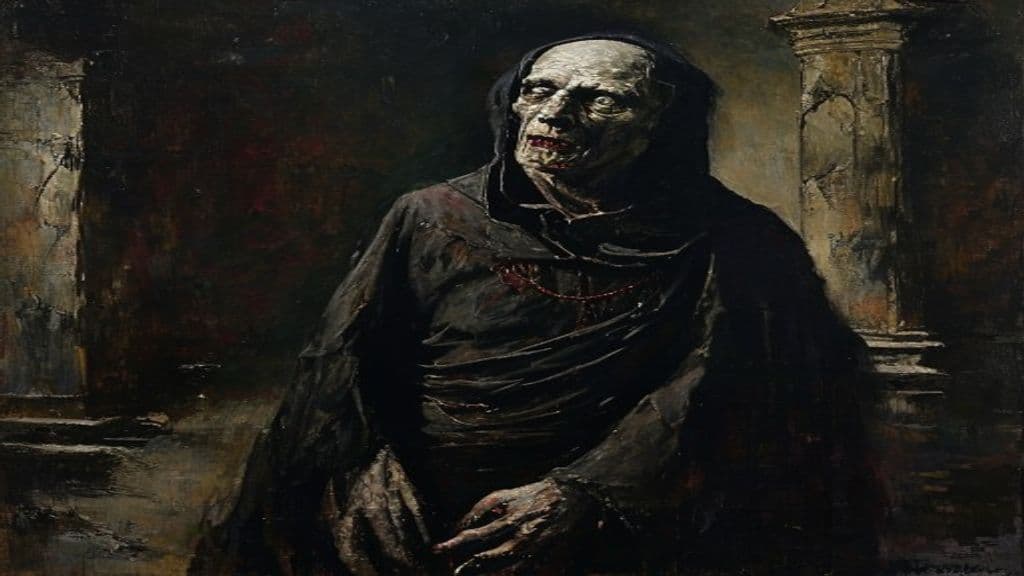
Sources report that suspected vrykolakas corpses may show poor decomposition or unusual corporeal signs: swelling or distention (described in some accounts as 'drum-like' or very large), a ruddy or 'fresh' complexion, and the appearance of being gorged with new blood. In accounts where a werewolf identity is implicated, retained features such as wolf-like fangs, hairy palms, or glowing eyes are sometimes said to remain. Regional folk beliefs noted in the sources also singled out certain physiognomies (for example, red hair and gray eyes in nearby regions) as culturally associated with vampiric suspicion, though such details are ethnographic markers rather than universal physical requirements.
The vrykolakas is reported to leave its grave and roam the community, engage in poltergeist-like disturbances, and be implicated in causing epidemics. Legends say it may knock on doors and call out residents' names; if someone answers (per the tradition recorded) that person may die a few days later and become a vrykolakas. It is also said to crush or suffocate sleepers by sitting on them (paralleling sleep‑paralysis-type phenomena and similar Balkan motifs) and to eat human flesh—with a particular taste for livers—making its behavior closer to cannibalistic revenant or ghoul-like activity than an exclusively blood-drinking vampire motif. The corpse is believed to become more dangerous the longer it is left undisturbed.
Weaknesses
- conditionProper burial in consecrated ground
- ritualExorcism or clerical rites (as recorded in local prescriptions)
- ritualImpalement of the corpse
- ritualBeheading the corpse
- ritualCutting the body into pieces
- ritualCremation of the corpse
- conditionPerforming destructive measures on Saturdays (reported in some accounts as the day when the vrykolakas rests)
Wards
- conditionInterment in church cemetery / consecrated ground
- otherCommunity vigilance and avoidance of answering the first knock (folk precaution)
- otherPreemptive beheading of corpses when burial in consecrated ground is impossible (recorded wartime practice)
*Péh₂usōn (reconstructed)
Péh₂usōn is a hypothetical Proto‑Indo‑European pastoral guardian reconstructed by comparative scholars from parallels in Greek and Vedic traditions. Proposed as a Graeco‑Aryan ancestor‑figure, the reconstruction describes a protector of flocks, roads, and travellers rather than an attested historical cultic personality.
Aba (disambiguation / name-form)
Aba is a polyvalent name-form attested across many unrelated contexts (place names, personal names, animal names, and brief mythological listings). The provided sources do not support a single, coherent supernatural entity called "Aba" and offer no descriptive or ritual material for such a being.
Abarbarea
Abarbarea is a name attested in classical Greek and Roman sources for freshwater nymphs (naiads). The name appears for at least two individual mythic figures — a naiad wife of Bucolion and a naiad counted among ancestors of the Tyrians — and Hesychius records plural forms that may indicate the name was also used as a class-name (Abarbareai / Abarbalaiai).
Abas
Abas (Ancient Greek: Ἄβας, gen.: Ἄβαντος) is not a single mythic being but a recurring personal name borne by multiple mortals and minor mythic figures in Greek epic and genealogical traditions — kings, founders, seers, warriors, attendants, a centaur, and a youth transformed by a goddess. The name is glossed in the sources as 'guileless' or 'good-hearted' and appears across Argive, Theban, Trojan, Euboean, and other local cycles.
Abderus
Abderus (Ancient Greek: Ἄβδηρος, romanized Ábdēros) is a mortal heroic figure in Greek myth closely associated with Heracles, remembered as the youth left in charge of the Mares of Diomedes who was killed by them. He functions as an eponymous local/divine-hero ancestor for the city of Abdera and received funerary commemoration and athletic agones at his tomb.
Abomination of Desolation
An apocalyptic prophetic phrase originating in the Book of Daniel designating a profaning thing or act that renders the Jerusalem Temple cult desolate; later reused in the Synoptic Gospels as an eschatological sign prompting urgent flight. The term denotes ritual/cultic impurity (Hebrew shiqquts) and is variously interpreted as pagan offerings or altar, a foreign cult statue, or (in some New Testament readings) an acting agent.
Absyrtus
Absyrtus (Ancient Greek: Ἄψυρτος) is a Colchian prince in the Greek Argonautic cycle, son of King Aeëtes and brother or half-brother of Medea. He appears in variant traditions either as a companion taken by Medea during her flight with Jason and murdered/dismembered to delay pursuit, or as a pursuer sent by Aeëtes who is overtaken and slain by Jason; his death functions as a key narrative device in the escape from Colchis.
Acacallis
Acacallis (Ancient Greek: Ἀκακαλλίς; also Acalle) is a mythological princess of Crete in Greek tradition, daughter of King Minos and Pasiphae. She functions primarily as a dynastic and etiological figure: in varying accounts she is mother, by gods such as Hermes (Mercury) or Apollo, of eponymous or founder-figures like Cydon (founder of Cydonia), Miletus, or Lydon/ Lydus.
Acacus
Acacus (Ancient Greek: Ἄκακος) is, in Arcadian Greek tradition, a mortal eponymous founder-king of Acacesium and is remembered as the foster-father who reared the infant Hermes (Mercury) in that local tradition. He is presented in genealogies as a son of Lycaon and functions as a local ancestral/onomastic figure rather than a supernatural spirit.
Academus
Academus (Greek: Akádemos / Hekádemos) is an Attic hero-eponym tied to a sacred grove (Akademeia) on the Cephissus near Athens. In myth he revealed where Helen was hidden to the Dioskouroi, an act said to have saved the city, and the place bearing his name became a long-lived sacred precinct, later the site of Plato's Academy.
Acamas
Acamas (Ancient Greek: Ἀκάμας) is a personal name recurrent in ancient Greek narrative traditions applied to multiple human characters (warriors, princes, suitors), once to a Cyclops, and once as a hound's name. Rather than a single supernatural entity, bearers of the name appear episodically across the Trojan War, Theseid, and Theban cycles as mortal actors whose deeds intersect with gods and fate.
Acantha
Acantha (Ancient Greek: Ἀκάνθα, 'thorn') is a late or secondary mythological figure known from modern retellings as a nymph transformed into the acanthus plant. The tale that she scratched Apollo and was changed into a spiny-leaved plant is not attested in surviving classical corpora and appears to be a modern compilation or invention rather than a firmly documented ancient myth.
Community Record
- [1]Vrykolakas. Wikipedia: Vrykolakas (summary of folklore, etymology, and practices)wiki
- [2]Vrykolakas (Wikidata). Wikidata entry for Vrykolakas (catalogue entry linking to related concepts)wiki
- [3]Episode 56 - Dirt's Just Sand! (podcast episode description referencing vrykolakas). Archive.org podcast episode description grouping vrykolakas among vampire-related figuresother
- [4]Vampires, burial, and death : folklore and reality (archive bibliographic entry). Archive bibliographic entry referencing vampire and burial topics and related folkloric phenomenaother
- [5]Episode 25: The Vampire Part 2 (podcast episode description referencing vrykolakas). Archive.org podcast episode description discussing vampire traditions including vrykolakasother