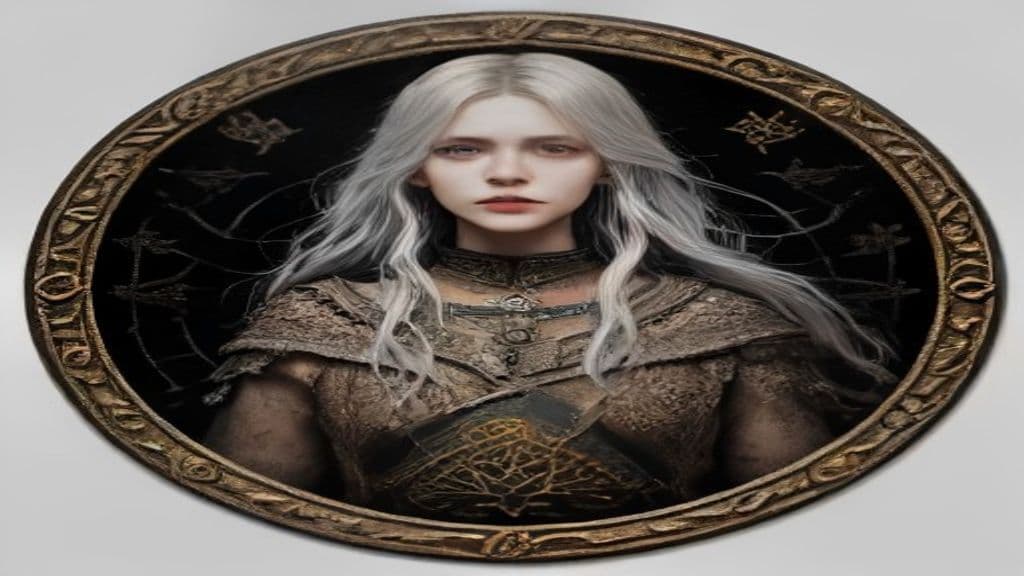
Böðvildr appears across Germanic sources as the daughter of a king named Níðuðr / Niðhad / Niðung. In the Poetic Edda poem Vǫlundarkviða Wayland (Völundr), imprisoned and hamstrung in the smithy, takes revenge by murdering the king's sons and fashioning objects from their remains; Böðvildr visits Wayland to have a broken ring mended, receives crafted tokens (a brooch made from teeth is mentioned) and is raped by Wayland before he departs. The Anglo‑Saxon Deor alludes to the murder of her brothers and explicitly references her rape. In the later prose Þiðrekssaga Wayland fathers a son by Böðvildr named Viðga; the saga reports a subsequent marriage and a peace settlement with the king’s successor, showing a redactional trajectory from tragic victim to political consort and mother.
The primary sources supply minimal sustained physical description. Böðvildr is identified by social markers: a royal daughter who possesses a gold ring made by Wayland and who, in Vǫlundarkviða, is given or associated with a brooch fashioned from her brothers' teeth. In Þiðrekssaga she is depicted as pregnant and later the mother of a son, Viðga. No detailed bodily or clothing descriptions are provided in the cited materials.
Böðvildr is presented as a mortal human with no supernatural powers in the cited sources. Her enacted roles vary by tradition: in the poetic tradition she seeks Wayland as a client to repair a broken ring (a socially normative action), and serves narratively as the recipient of Wayland's vengeful acts (the murder of her kin and her rape, attested in Vǫlundarkviða and Deor). In Þiðrekssaga she becomes mother to Wayland's son Viðga and later his wife after political reconciliation, participating in dynastic resolution rather than displaying agency through supernatural ability.
Abdiel
Abdiel (Hebrew עֲבְדִּיאֵל) is primarily a theophoric Hebrew personal name meaning "servant of El/servant of God," attested once in the Hebrew Bible (1 Chronicles 5:15). In later literature—most notably John Milton's Paradise Lost—Abdiel is reimagined as a faithful seraph who opposes Satan's revolt. The provided sources do not treat Abdiel as an autonomous folkloric spirit type or record rituals or wards associated with the name.
Abiel
Abiel is attested in the supplied sources only as a male given name — borne by several historical American individuals and listed as two minor biblical figures. The provided materials contain no evidence presenting Abiel as a supernatural, mythological, or folkloric entity.
Abigail
Abigail is a female figure in the Hebrew Bible portrayed in 1 Samuel 25 as the intelligent and beautiful wife of Nabal who intervenes to prevent David from committing violence; later tradition regards her as one of the Tanakh's seven female prophets and as a model of beauty and wisdom.
Abraun
Abraun is an attested name in German-language plant-legend scholarship (Der abraun, ein beitrag zur pflanzensagenkunde, 1916) and a short database entry (Wikidata) labels it as a spirit from German mythology. Surviving accessible documentation is extremely limited: the principal academic treatment is a 1916 contribution to pflanzensagenkunde (plant-saga studies), but the excerpts available here contain only bibliographic metadata and do not record tales, descriptions, or rituals.
Accolon
Accolon is a mortal knight of the Arthurian court, presented in the Post-Vulgate Merlin tradition and Malory's Le Morte d'Arthur as Morgan le Fay's paramour and instrument in a plot to supplant King Arthur; his tale centers on enchanted weapons (Excalibur and its scabbard), love-manipulation, and a tragic duel with Arthur.
Adils
Adils (Old Norse Aðils; also Eadgils, Adillus, Athisl, Adhel) is a semi‑legendary sixth‑century Swedish king attested in Old Norse saga material and later medieval traditions. He appears in saga episodes as a storied royal figure involved in warfare, court acts, and marriage suits rather than as a supernatural being.
Adsullata
Adsullata is attested as a Continental Celtic river goddess associated with the River Savus (modern Sava) in the Roman province of Noricum. Later traditions record her presence in Brittany as a goddess of hot springs and present her as an antecedent or origin-form of the Anglo‑Celtic sun goddess Sul.
Afaon fab Taliesin
Afaon fab Taliesin is a medieval Welsh warrior-counsellor, named as a son of the bard Taliesin and recorded among Arthur’s retinue in Welsh tradition. He appears in the Welsh Triads and in the tale Breuddwyd Rhonabwy (The Dream of Rhonabwy) as a notable martial figure and proverb-speaker rather than as a supernatural being.
Agilaz (Egil)
Agilaz (reconstructed Proto-Germanic) — commonly recorded in medieval sources as Egil or Ægil — is a legendary archer attested in Germanic heroic tradition. He appears as the brother of Völund (Wayland/Weland) in the Old Norse poem Völundarkviða and in the Thidreks saga, and his name is also inscribed on early medieval objects (Franks Casket, Pforzen buckle). The attested material presents him as a named heroic human archer within saga and inscriptional contexts rather than as a recurrent supernatural species.
Aglovale
Aglovale (also Agloval, Aglovan, Aglovaus, Acglavael) is a human knight of Arthurian romance, presented as the eldest legitimate son of King Pellinore and a Knight of the Round Table in the Vulgate/Post‑Vulgate cycles, Malory, and later adaptations. He brings his long‑lost brother Perceval to Camelot, takes part in military actions (including slaying Agrippa in one account), and his death is related in varying ways across traditions (accidental at Gawain's hand, deliberate murder by Orkney kin, or killed during Lancelot's rescue of Guinevere).
Agnarr Geirröðsson
Agnarr Geirröðsson is a mortal prince attested only in the Poetic Edda poem Grímnismál; he aids Odin (disguised as Grímnir) during Geirröðr's torture and, after Odin reveals himself and King Geirröðr dies, Agnarr succeeds as king.
Agne
Agne (also attested Agni, Hogne, Agni Skjálfarbondi) is a semi-legendary king of Sweden in Old Norse saga tradition, preserved in the Ynglingatal corpus and prose expansions such as Snorri Sturluson's Ynglinga saga. He is portrayed as a mighty and famous warrior-king whose campaign in Finland, marriage to Skjalf, and death by hanging form a remembered episode connected to local place-names and a burial mound.
Community Record
- [1]Böðvildr — Wikipedia. Wikipedia, 'Böðvildr' article (summary and etymology)wiki
- [2]Vǫlundarkviða (Volundarkvida) — Poetic Edda. Poetic Edda: Vǫlundarkviða (translation and summary of smithy episode, ring repair visit, murder of sons, crafted tokens, rape)literary
- [3]Völundarkviða — Wikipedia. Wikipedia summary of Vǫlundarkviða narrativewiki
- [4]Deor (Anglo‑Saxon poem). Deor (Anglo‑Saxon poem) — references to murder of her brothers and the poet's allusion to her rapeliterary
- [5]Þiðrekssaga (summary references). Þiðrekssaga summary — later prose account reporting Wayland's son Viðga by Böðvildr and their marriage after settlementliterary
- [6]Beadohilde's Barrow — local English tradition (Berkshire Downs excavation 1850). Local toponymic tradition: 'Beadohilde's Barrow' on the Berkshire Downs and the 1850 excavation (noted in summaries of the Böðvildr tradition)folk
- [7]Wikidata entry: Böðvildr. Wikidata classification as a female character of heroic legendother