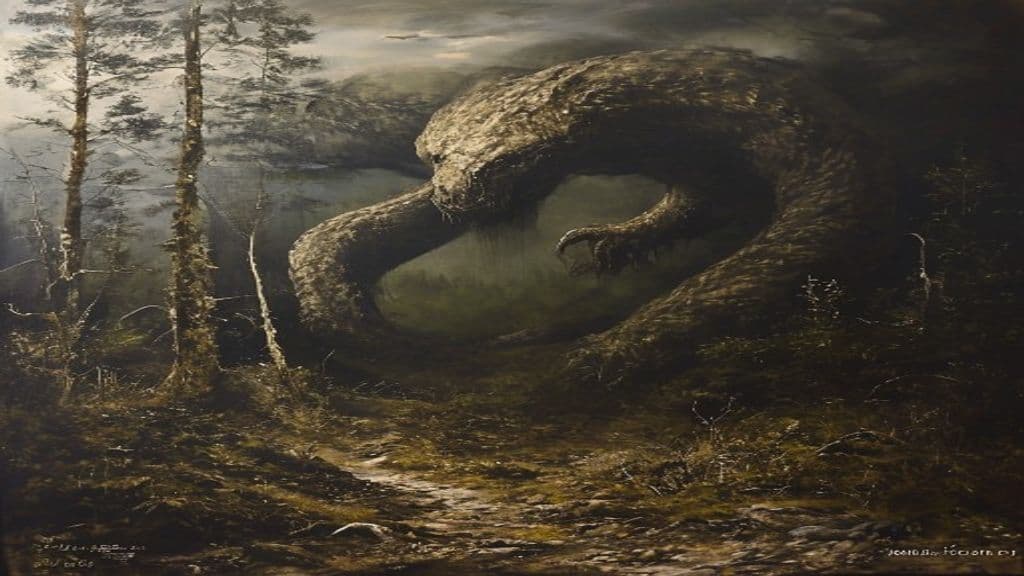
The sources do not preserve a single origin myth for the Bøyg. Folkloric summaries and modern reference entries place the Bøyg in the family of troll-figures of Norway and localize notable examples to Telemark and Gudbrandsdalen (including epithets such as the "Great Bøyg of Etnedal"). Later literary appropriation (most prominently Ibsen's Peer Gynt) adapts the figure as a narrative obstacle, but primary source material does not provide a traditional genealogy or creation story; speculative modern genealogies linking it to serpent-lineage monsters (e.g., Midgard Serpent offspring or linnorms) appear only in later, non-traditional reconstructions.
Descriptions in the available sources are varied but cohere around an image of a large, obstructive, often serpentine creature. The principal folkloric description in reference summaries calls the Bøyg a "giant, slimy serpent" and also classifies it among troll-like beings. Some modern or derivative accounts give alternate images (gnome-like, or hybrid humanoid-with-serpent-tail forms), but these variants are attested in secondary or modern reconstructions rather than in the core traditional summaries; therefore the most consistently documented appearance is that of a great, wet/oozing, bending/curved being that physically occupies and obstructs paths.
The defining function attested across sources is obstruction: the Bøyg stands as a hindrance to travellers, blocking or forcing a change of course on paths and in the wild. In literary treatment (Ibsen's Peer Gynt and some retellings based on that episode) the encounter is dramatized and sometimes given dialogic features — e.g., the Bøyg addressing the traveller or speaking in riddles in modern audio retellings — but traditional material emphasizes its role as an embodied impediment rather than enumerating magical powers. Modern mythic reconstructions attribute greater monstrous lineage or capabilities, but those claims are speculative and not part of the primary folkloric record.
Weaknesses
- otherNo documented traditional weaknesses
Wards
- otherNo documented traditional wards or preventive rituals specific to the Bøyg

Troll (Germanic Tradition)
In Germanic folklore, a troll is a being that dwells in isolated areas of rocks, mountains, or caves, living together in small family units and rarely interacting with humans. (Note: - Power tier should be changed from Primordial to Ancient (trolls' origins from primordial forces don't necessarily imply cosmic-level power). - Ability description is not entirely accurate; it's stat)
Lindworm
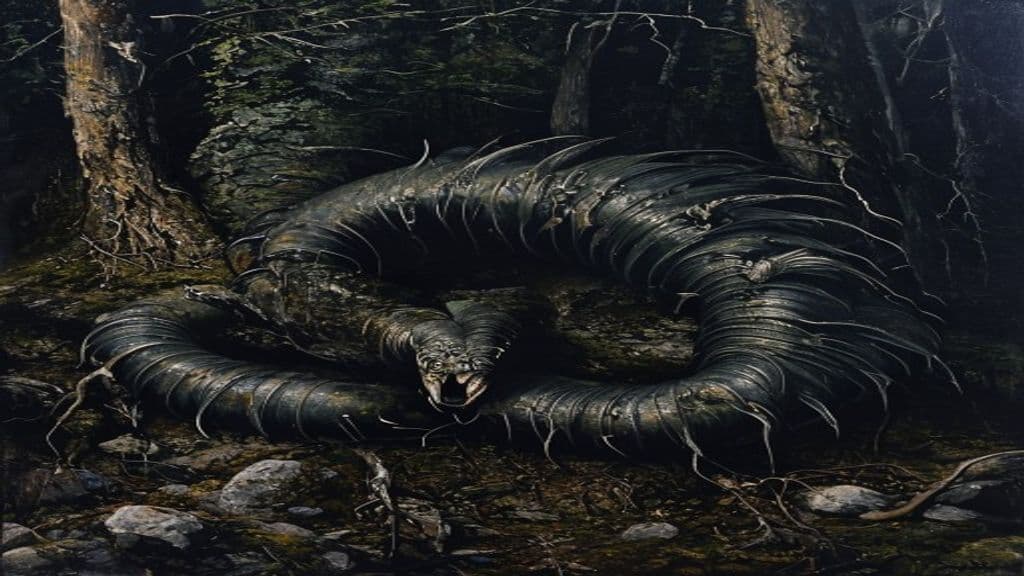
The lindworm is a European serpent/dragon‑like monster attested across Northern, Western and Central Europe. Varieties range from limbless giant forest serpents in Scandinavian lore to two‑limbed or winged dragonic forms in Central European art and legend; it appears in both treasure‑guardian and cursed‑bridegroom narrative cycles.
Adils
Adils (Old Norse Aðils; also Eadgils, Adillus, Athisl, Adhel) is a semi‑legendary sixth‑century Swedish king attested in Old Norse saga material and later medieval traditions. He appears in saga episodes as a storied royal figure involved in warfare, court acts, and marriage suits rather than as a supernatural being.
Agilaz (Egil)
Agilaz (reconstructed Proto-Germanic) — commonly recorded in medieval sources as Egil or Ægil — is a legendary archer attested in Germanic heroic tradition. He appears as the brother of Völund (Wayland/Weland) in the Old Norse poem Völundarkviða and in the Thidreks saga, and his name is also inscribed on early medieval objects (Franks Casket, Pforzen buckle). The attested material presents him as a named heroic human archer within saga and inscriptional contexts rather than as a recurrent supernatural species.
Agnarr Geirröðsson
Agnarr Geirröðsson is a mortal prince attested only in the Poetic Edda poem Grímnismál; he aids Odin (disguised as Grímnir) during Geirröðr's torture and, after Odin reveals himself and King Geirröðr dies, Agnarr succeeds as king.
Agne
Agne (also attested Agni, Hogne, Agni Skjálfarbondi) is a semi-legendary king of Sweden in Old Norse saga tradition, preserved in the Ynglingatal corpus and prose expansions such as Snorri Sturluson's Ynglinga saga. He is portrayed as a mighty and famous warrior-king whose campaign in Finland, marriage to Skjalf, and death by hanging form a remembered episode connected to local place-names and a burial mound.
Alf and Alfhild
Alf and Alfhild are legendary human figures from Old Norse/early Scandinavian narrative tradition preserved principally in Saxo Grammaticus' Gesta Danorum. The tale presents Alf as a Danish prince and Alfhild as a Geatish princess who becomes a shieldmaiden and leader of a fleet of female raiders; their story includes combat, recognition, marriage, and later dynastic conflict.
Algaut
Algaut (also rendered Algöt or Algaut Gautreksson) is a semi-legendary Geatish king of West Götaland recorded in Scandinavian saga and genealogical tradition. Saga summaries (via Snorri Sturluson's Heimskringla as reported in later compilations) record that he was the father of Gauthild and was burnt to death by his son-in-law, the Swedish king Ingjald Ill-ruler.
Almáttki áss
Almáttki áss is an epithet-attested divine figure invoked in an Icelandic legal oath recorded in Landnámabók (Hauksbók 268). In the sole attestation the phrase functions as an invoked áss (god) described with the adjective almáttki ('almighty') and serves as the divine guarantor or witness for an oath sworn on a temple ring. Scholarly sources debate whether the epithet refers to a named Norse god (Thor, Ullr, Odin, or Týr) or is a Christianizing formulation by a later author.
Alrek and Eirík
Alrek and Eirík (also rendered Alaric and Eric) are legendary Swedish kings from the Old Norse saga tradition who are presented as joint rulers and as members of the Ynglinga royal genealogies. They appear in saga narratives as sons and heirs of King Agni, famed for martial and athletic prowess, and as hosts who receive the hero Starkaðr after the sacrificial death of Vikar.
Alvaldi
Alvaldi (Old Norse: Alvaldi / Ölvaldi) is a jötunn in Norse mythic genealogies, attested chiefly as the father of the notable jötunn Þjazi and described in one source as exceedingly rich in gold. He survives in the record mainly as a familial antecedent and an etiological figure rather than as an active participant in preserved narratives.
Alvíss
Alvíss (Old Norse: 'All‑Wise') is a dwarf in Norse mythology who appears in the Poetic Edda poem Alvíssmál as a prospective husband for Thor's daughter Þrúðr. In the surviving narrative Thor tests Alvíss's wisdom through a lengthy question-and-answer session that lasts until sunrise, whereupon the dwarf is petrified by exposure to sunlight.
Amleth
Amleth (Old Norse: Amlóði; Latinized Amlethus) is a legendary medieval Scandinavian prince and saga-hero best known from Saxo Grammaticus' Gesta Danorum. He is a human protagonist whose story centers on feigned madness, cunning survival, exile to Britain, marriage, wealth-gathering, and eventual vengeance against his father's murderer; the tale later inspired the character of Shakespeare's Hamlet and numerous adaptations.
Ancient Kings of Finland
In early literary sources, the Ancient Kings of Finland are described as hypothetical or mythical monarchic systems associated with ancient Finland. (Note: 1. Power tier: Lower to Primordial (given the lack of specific abilities and behaviors) 2. Abilities and behaviors are described as 'generally vague', so this section should be reworded or removed 3. )
Community Record
- [1]Bøyg. Wikipedia: 'Bøyg' article, describing the creature as a gnome-like creature and a great troll; notes serpentine, obstructive character and regional associations.wiki
- [2]Bøyg (Wikidata). Wikidata entry classifying the Bøyg as a troll in Scandinavian folklore.wiki
- [3]Peer Gynt, II, 7 (stage business). Logos Virtual Library: Ibsen stage direction and dialogue showing Peer attempting to force a passage and striking against something ('Who are you?'), evidence of the narrative encounter.literary
- [4]GRIEG: Peer Gynt (complete) / 'Scene with the Bøyg' (track listings). Archive recordings and track lists for Edvard Grieg's incidental music to Peer Gynt, which include a 'Scene with the Bøyg', confirming the creature's role in the play's dramatic sequence.other
- [5]Peer Gynt. Wikipedia: article on Peer Gynt noting the folktale source and the inclusion of the Bøyg episode in Ibsen's play.wiki
- [6]Storynory: 'Peer Gynt. The Bøyg'. Storynory retelling of the Peer Gynt episode which dramatizes the Bøyg speaking in riddles to Peer (literary/retelling source).folk
- [7]Böyg (Norse monster for BECMI / Pandius). Pandius page giving modern/roleplaying-oriented reconstructions (hybrid forms, speculative lineages); used only as a modern secondary source and noted as non-traditional.other
- [8]Bøyg | Cryptid Wiki | Fandom. Cryptid/fandom summary listing variant spellings and appearance variants; treated as a modern compilation rather than primary traditional source.other