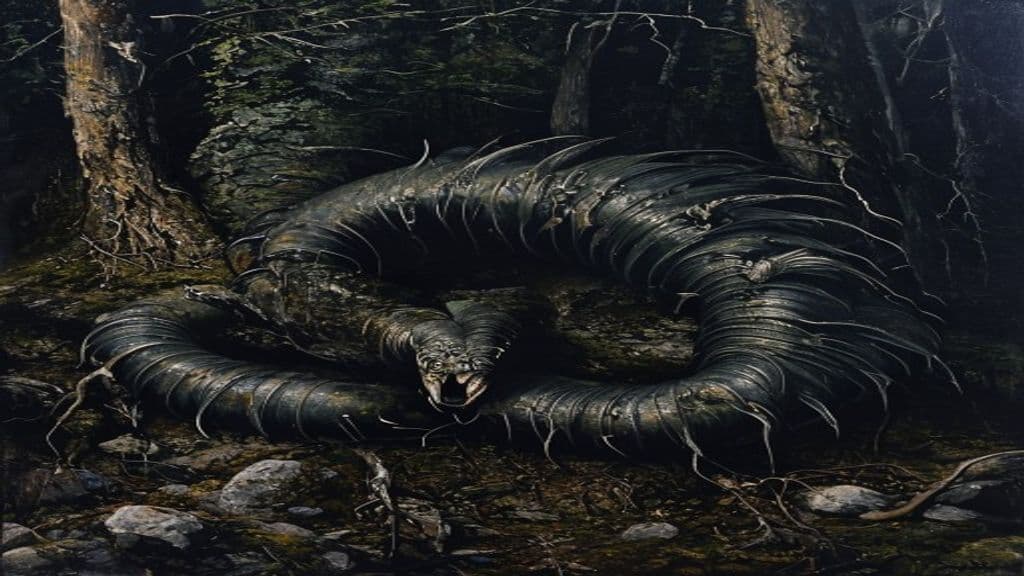
The term appears in medieval Germanic languages (Middle High German lintrache in the Nibelungenlied; Middle Low German lintworm; Old Norse linnormr) and thereafter in vernacular traditions. Sources treat the lindworm as part of the broader European dragon/serpent cosmology rather than a single origin myth; continental and Nordic forms represent regional continuations and variations of a dragon/serpent motif rather than a single continuous biography. The prefix element lind- is uncertain in origin, with scholarly suggestions including Proto‑Germanic *linþia‑ 'flexible', Old Danish/Saxon lithi or Old High German lindi 'soft, mild', Old English liðe 'lithe', or Old Swedish linde/ linda 'to wind', but the sources stress that this uncertainty persists.
Descriptions vary by region. In Swedish/Nordic accounts the lindworm is typically a very large, dark, limbless forest serpent with a brighter underside and along its spine either fish‑like dorsal fins or a horse‑like mane; eggs are said in Swedish lore to be laid under the bark of linden trees. Central European representations more commonly show a scaly serpentine body with a dragon's head and two clawed forelimbs, sometimes with wings and occasionally hindlimbs; artistic depictions such as civic statues (e.g., the Lindwurm Fountain in Klagenfurt) display four‑limbed, winged forms, while narrative descriptions emphasize slithering movement.
Folkloric abilities and behaviors include brooding over treasure (a traditional belief that 'that which lies under a lindworm will grow at the rate of the snake'), high mobility (limbless forms may swallow their tails and roll at speed; limbed forms slither using forelimbs for traction), and offensive defenses attested in Swedish lore such as spitting a foul, milk‑like substance that can blind enemies. In folktales the lindworm appears both as a man‑eating monster and as an enchanted or cursed human (e.g., bridegroom‑transformation motifs like the King Lindworm tale). Nineteenth‑century Swedish popular reports recorded belief in actual giant serpents in the landscape.
Weaknesses
- otheroutwitted or slain by heroes (folktale motif)
Wards
None recorded.

Abandinus
Abandinus is a locally attested Romano‑Celtic theonym known from a single inscribed bronze feather (votive object) dedicated at Godmanchester (the Roman fort Durovigutum) in Cambridgeshire. Scholars interpret him as a local god or male spirit tied to a specific place and possibly associated with a nearby spring or stream; this association is tentative and based on etymological readings of the name.
Abarta (Ábartach)
Abarta (also Ábartach) is a figure of Irish myth who, in surviving accounts, tricks Fionn mac Cumhaill's warriors by giving them a supernatural grey horse that bears them into the Otherworld. Sources variably identify him as a member of the Tuatha Dé Danann or as a Fomorian; after the incident he is compelled to release the captured warriors and is refused entry to the Fianna.
Abcán (Abhcán)
Abcán (modern spelling Abhcán) is a named dwarf poet and musician of the Tuatha Dé Danann in Irish myth. He appears in a small number of narratives as a musician whose art has soporific power and as the ferryman who brings the goddess Ruad from the Otherworld to the human world.
Abhean
Abhean is a named poet of the Tuatha Dé Danann in medieval Irish literature, described as a poet in particular of Lugh and recorded as having been killed by Óengus before Midir in a poem by Fland Mainistreach preserved in the Lebor Gabála Érenn.
Abnoba
Abnoba is a Gaulish theonym and toponym attested in Roman-era sources and inscriptions: a localized deity associated with woods, springs and the sources of rivers (notably the Danube) and simultaneously the name applied to a mountain or mountain range in the Black Forest/Baar/Odenwald region. Roman altars equate her with Diana, reflecting syncretic cult practice in frontier provinces.
Abraun
Abraun is an attested name in German-language plant-legend scholarship (Der abraun, ein beitrag zur pflanzensagenkunde, 1916) and a short database entry (Wikidata) labels it as a spirit from German mythology. Surviving accessible documentation is extremely limited: the principal academic treatment is a 1916 contribution to pflanzensagenkunde (plant-saga studies), but the excerpts available here contain only bibliographic metadata and do not record tales, descriptions, or rituals.
Accolon
Accolon is a mortal knight of the Arthurian court, presented in the Post-Vulgate Merlin tradition and Malory's Le Morte d'Arthur as Morgan le Fay's paramour and instrument in a plot to supplant King Arthur; his tale centers on enchanted weapons (Excalibur and its scabbard), love-manipulation, and a tragic duel with Arthur.
Achall
Achall is an eponymous mortal woman in the Ulster Cycle of early Irish literature whose grief-induced death is given as the origin of the hill-name Achall (identified with the modern Hill of Skryne). She appears as a genealogical and etiological figure tied to Tara and later legendary events at the hill, rather than as a recurring supernatural agent.
Achtland
Achtland is a figure from Irish tradition who, according to the surviving account, was a mortal woman famed for rejecting mortal suitors who married a member of the Tuatha Dé Danann and crossed into the síde to become immortal as his wife.
Adar Llwch Gwin
Legendary large, intelligent birds from Welsh tradition said to understand human speech and obey their master's commands; best known for tearing their master Drudwas ap Tryffin to pieces when bound by a literal order in an Arthurian battle narrative. The term later came to be applied to raptors and metaphorically to brave men in medieval Welsh poetry.
Adar Rhiannon
Adar Rhiannon ('birds of Rhiannon') are a set of three magical birds in medieval Welsh narrative (the Mabinogi) whose song can 'wake the dead and lull the living to sleep.' They appear as otherworldly song‑beings tied to the figure Rhiannon and function within tales as providers of enchanted music that sustains and consoles characters.
Aderyn y Corff
Aderyn y Corff (literally 'bird of the corpse') is a bird-like death-porter in Welsh folklore said to call outside the door of a person about to die. Described as an avian portent that may lack feathers or wings and as existing on another plane when not manifesting, it is treated in Welsh ghost lore and sometimes naturalized as a screech owl in modern accounts.
Community Record
- [1]Lindworm (Wikipedia). Wikipedia contributors, 'Lindworm', Wikipedia, The Free Encyclopediawiki
- [2]Lindworm (Wikidata). Wikidata entry Q287065other
- [3]The Lindworm (archive item). Archive text on the lindworm (collection entry)other
- [4]King Lindworm (Wikipedia). Wikipedia contributors, 'King Lindworm', Wikipedia, The Free Encyclopediawiki