
In the broad folkloric cosmology presented in the sources, various nonhuman peoples (fairies, trolls, nereids, demons and similar groups) interact with human families and sometimes abduct humans—especially infants—and leave one of their own or an enchanted object in the human's place. The substitution may serve multiple motives attributed in the traditions: to obtain servants, to have human children raised by the otherworld, out of malice, or because human beauty or other desirable traits attract otherworldly attention. The changeling thus arises as an exchange enacted by those nonhuman communities within domestic life.
Accounts vary by region. Changelings are generally human-like but often sickly and failing to grow at a normal rate; Irish legends mention beards or long teeth and uncanny intelligence. German names such as Kielkopf or Dickkopf point to reports of unusually large heads or necks. In some stories the replacement is not a living creature but an enchanted object (a 'stock' or log) or an elderly otherworldly person left in place of an infant. Appearance therefore ranges from infantile-but-failing-to-thrive, to oddly aged, to physically deviant in small ways.
Changelings typically display behaviors and traits that mark them as other: failure to thrive or normal growth, ravenous appetite, unusual or uncanny intelligence and perceptiveness, and behavior that may reveal its nature when it believes itself unobserved (jumping, dancing, or playing instruments in Irish and Scottish accounts). Some changelings forget their nonhuman origin and live within human families; others may remember and return to their own people, leaving the human family. The phenomenon is presented functionally as substitution rather than as a defined set of magical powers.
Weaknesses
- conditionBaptism (regional - medieval Scandinavia)
- otherVigilant human watchfulness over the infant
Wards
- symbolIron left open (e.g., open iron scissors placed where the child sleeps)
- otherAn inverted coat placed where the child sleeps
- ritualPassing the suspected changeling through Mên-an-Tol (Cornwall)
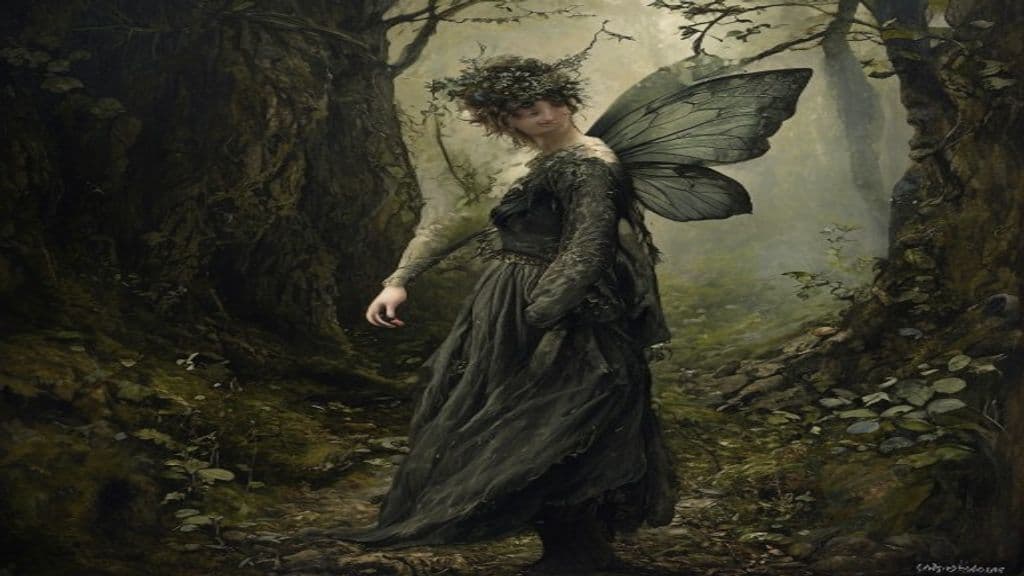
Fairy
A class of anthropomorphic supernatural beings found across multiple European folk traditions, fairies are magical, liminal entities variously described as spirits, an older race, or enchanted people; their depiction ranges from human-sized to diminutive and their attributes and moral alignment vary by region and period.

Troll (Germanic Tradition)
In Germanic folklore, a troll is a being that dwells in isolated areas of rocks, mountains, or caves, living together in small family units and rarely interacting with humans. (Note: - Power tier should be changed from Primordial to Ancient (trolls' origins from primordial forces don't necessarily imply cosmic-level power). - Ability description is not entirely accurate; it's stat)
*Perkʷūnos
*Perkʷūnos is the reconstructed Proto-Indo-European thunder‑god hypothesized by comparative linguistics and mythology. Scholarly reconstructions portray him as a storm or thunder figure associated with fructifying rain and as the combatant who fights a multi‑headed water‑serpent to release life‑giving waters; no direct attestations from the Proto‑Indo‑European period survive and the figure is inferred from later Indo‑European traditions.
*Péh₂usōn (reconstructed)
Péh₂usōn is a hypothetical Proto‑Indo‑European pastoral guardian reconstructed by comparative scholars from parallels in Greek and Vedic traditions. Proposed as a Graeco‑Aryan ancestor‑figure, the reconstruction describes a protector of flocks, roads, and travellers rather than an attested historical cultic personality.
57 Mnemosyne
57 Mnemosyne is a large main-belt asteroid (S-type) discovered in 1859 and named after the Greek Titaness Mnemosyne. It is a non-sentient astronomical body studied for its orbital and rotational properties and has been used in dynamical measurements related to Jupiter.
Abaddon
In Hebrew scripture Abaddon is primarily a noun meaning 'destruction' or a section/condition of the underworld paired with Sheol; in the New Testament Book of Revelation Abaddon is personified as an angelic figure (Greek Apollyon) described as the king of an army of locusts released from the abyss during the apocalypse.
Aban Yasht
The Aban Yasht is a hymn from the Persian tradition that praises Anahita, a goddess associated with water, fertility, and wisdom. It consists of 132 stanzas and is part of the 21 Yashts collection. (Note: - Power tier should be "Primordial" or possibly "Cosmic", given that it's a hymn of great spiritual significance and associated with a goddess. - The article incorrectly states that Anahita is associa)
Abandinus
Abandinus is a locally attested Romano‑Celtic theonym known from a single inscribed bronze feather (votive object) dedicated at Godmanchester (the Roman fort Durovigutum) in Cambridgeshire. Scholars interpret him as a local god or male spirit tied to a specific place and possibly associated with a nearby spring or stream; this association is tentative and based on etymological readings of the name.
Abarta (Ábartach)
Abarta (also Ábartach) is a figure of Irish myth who, in surviving accounts, tricks Fionn mac Cumhaill's warriors by giving them a supernatural grey horse that bears them into the Otherworld. Sources variably identify him as a member of the Tuatha Dé Danann or as a Fomorian; after the incident he is compelled to release the captured warriors and is refused entry to the Fianna.
Abath
No corroborated folkloric entity named "Abath" is documented in the provided sources. The string appears in the supplied material only as a surname/personal name in Aruban/Dutch-Caribbean archival records and as an unrelated taxonomic or encyclopedic hit; no mythic attributes, origin stories, rituals, or apotropaic practices for an entity called Abath are present in the documents reviewed.
Abatur
Abatur is an uthra (celestial emanation) in Mandaeism described as the 'father of the Uthras' and called the Ancient (ʿattīqā). He resides on the boundary between the World of Light and lower regions, functions as a judge who weighs souls (Abatur Muzania), and supplies instructions and materials to the demiurgic uthra Ptahil in accounts from the Diwan (Scroll) of Abatur.
Abatwa (Twa / Batwa)
Abatwa (also recorded as Twa, Batwa, Mutwa; singular forms Barhwa or Murhwa in some transcriptions) are indigenous hunter‑gatherer peoples of the Great Lakes region of Central Africa, historically identified as some of the earliest inhabitants of the area. The available sources treat them as human ethnic groups whose livelihoods, lands, and populations have been severely affected by conservation policies and modern violence.
Abcán (Abhcán)
Abcán (modern spelling Abhcán) is a named dwarf poet and musician of the Tuatha Dé Danann in Irish myth. He appears in a small number of narratives as a musician whose art has soporific power and as the ferryman who brings the goddess Ruad from the Otherworld to the human world.
Abdiel
Abdiel (Hebrew עֲבְדִּיאֵל) is primarily a theophoric Hebrew personal name meaning "servant of El/servant of God," attested once in the Hebrew Bible (1 Chronicles 5:15). In later literature—most notably John Milton's Paradise Lost—Abdiel is reimagined as a faithful seraph who opposes Satan's revolt. The provided sources do not treat Abdiel as an autonomous folkloric spirit type or record rituals or wards associated with the name.
Community Record
- [1]Changeling - Wikipedia. Wikipedia: 'Changeling' article (excerpted material supplied in research notes)wiki
- [2]Archive: Episode 33 - The Changeling. Audio episode referenced in research notesother
- [3]Archive: Show Primer, Canadian Myths and Listener Q & A. Audio archive referenced in research notesother
- [4]D. L. Ashliman — scholarly commentary quoted in source. Quoted folklorist D. L. Ashliman as cited in the provided material regarding ravenous appetite and social-historical interpretationacademic