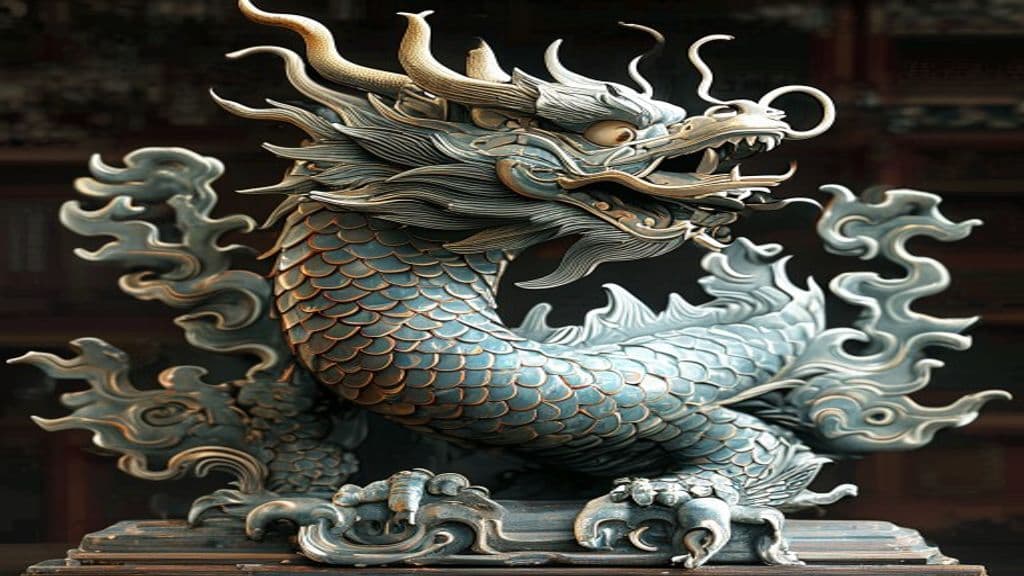
Chiwen appears in two intertwined registers in Chinese sources: as one of the Nine Sons of the Dragon (a named dragon‑child figure) and as a long‑attested roof ornament. The motif is archaeologically and visually attested from Han dynasty tomb models and murals through Tang glazed examples; Song‑era building treatises (Yingzao Fashi) formalize construction terminology; later Ming and Qing examples show stylistic elaboration. Sources treat the creature‑name and the ridge‑end ornament together, with older birdlike antecedents (chiwei) evolving into the fish‑dragon forms recorded in later periods.
Iconography commonly shows a dragon head combined with a fishlike body, often with an enlarged wide mouth as if swallowing roof beams; earlier antecedents retain birdlike features (wings or bird heads). Chiwen ornaments are placed at both ends of roof ridges and are commonly made in glazed ceramics (green/blue glazes from the Tang onward), pottery, or colored glass. Song dynasty forms trend more dragonlike, while Ming and Qing examples become more ornate with inward‑turning bodies/tails and regional stylistic variation.
In folklore and architectural symbolism Chiwen 'likes to swallow things' and is placed at ridge ends to 'swallow all evil influences'—a protective attribution quoted in Ming sources. As an architectural element it serves symbolic protective roles against fire, floods and typhoons and may perform practical functions analogous to a waterspout or finial (some sources note the motif 'can spray waves and rain' and compare it functionally to Western gargoyles). Sources do not describe independent supernatural agency beyond these symbolic and practical functions.
Weaknesses
- othernone recorded in provided sources
Wards
- otherinstallation of chiwen on roof ridge ends (architectural placement as preventive measure)

Shachihoko
A Japanese mythic sea-creature and roof-ornament (shibi) combining a predator head (dragon or tiger) with a carp body. In Japanese architectural and folkloric contexts it functions as an apotropaic roof guardian believed to store water and control rain, used primarily to protect wooden buildings from fire and as a status emblem.
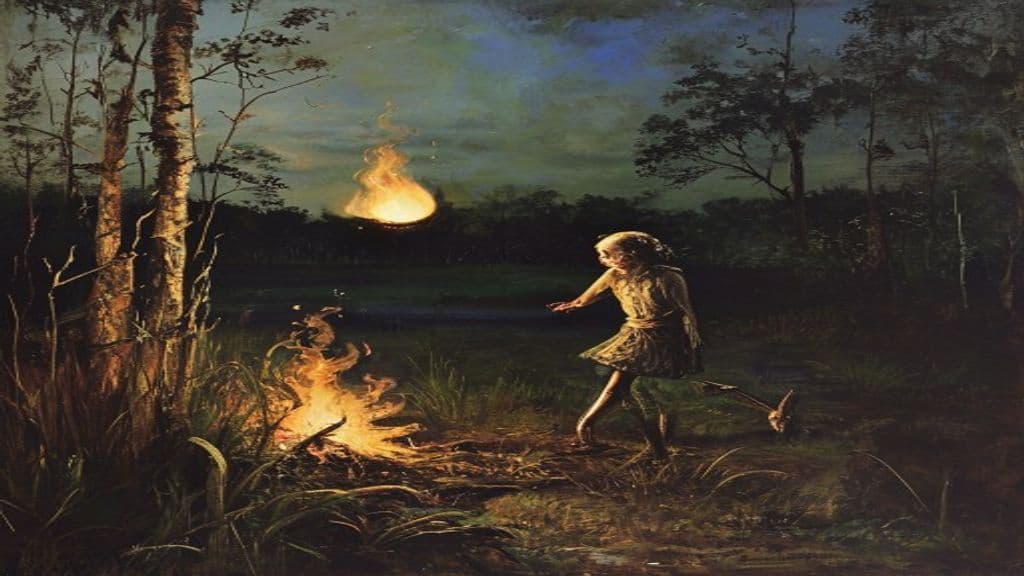
Will-o'-the-wisp
An atmospheric 'ghost light' — a small, mobile, lamp-like light seen at night over marshes, bogs, wet ground, or graveyards. In many cultures the phenomenon is interpreted as a supernatural being or manifestation (wandering nature-spirit, soul of the dead, transformed witch, or treasure-indicator); modern science offers chemiluminescent explanations for some occurrences.
Akshobhya
Akshobhya is a transcendent buddha of Mahāyāna and Vajrayāna Buddhism, one of the Five Wisdom (Dhyāni) Buddhas. He personifies 'mirror knowledge' (ādarśa-jñāna), is conventionally placed in the East, and is lord of the eastern Pure Land Abhirati; in esoteric texts he is associated with the eastern Vajra division and invoked in mantra/mandala ritual contexts.
Amitābha Buddha
Amitābha is a principal Mahayana Buddha who presides over the Western Pure Land (the Land of Ultimate Bliss). Devotional practices—most centrally recitation of his name and chanting of Pure Land sutras—are presented in sources as the means by which Amitābha welcomes practitioners for rebirth in his hindrance-free realm.
Anantacāritra
Anantacāritra (Sanskrit: अनन्तचारित्र) is a bodhisattva figure in the Lotus Sūtra, identified as one of the four great perfected bodhisattvas who attend Gautama Buddha. The name is glossed as "Boundless Practice" and, in Tiantai commentary, is read as representing eternity.
Ao Guang (Dragon King of the East Sea)
Ao Guang is the Dragon King (Dragon God) who presides over the East Sea (Dōng Hǎi) in Chinese mythology, literature, and folk-religion. He is presented in sources as a regional aquatic deity associated with water and weather and appears as a named supernatural figure in classical vernacular novels such as Journey to the West and Fengshen Yanyi.
Ao Kuang
Ao Kuang (also attested as Ao Guang) is the Dragon King of the East Sea in Chinese mythology and folk religion, one of a quartet of sea-dragon sovereigns associated in folklore with the cardinal seas. He appears in classical literature and later popular media as a ruler of maritime waters whose favor or displeasure is connected to tides, rain, floods and storms.
Arhat
An arhat (Sanskrit: arhat; Pāli: arahant) is in Buddhist traditions a human practitioner who has gained insight into the true nature of existence, attained nirvāṇa, and been liberated from the cycle of rebirth. The status and valuation of arhatship vary by school: some traditions equate it with full liberation, while others treat it as distinct from or inferior to the bodhisattva/buddha ideal.
Ashina Buzhen
Ashina Buzhen (Chinese: 阿史那步真) was a 7th-century member of the Ashina ruling house of the Western Turks who acted as a military and political claimant to khaganate authority on the Tang frontier. Recorded in Tang-era sources and modern summaries, he engaged in inter-elite rivalry, participated in Tang military campaigns, received an imperial-bestowed khagan title from Emperor Gaozong, and died in 667.
Ashina Helu
Ashina Helu (阿史那賀魯 / 阿史那贺鲁, āshǐnà hèlǔ) was a mid‑7th century member of the Ashina clan who claimed the title qaγan (khagan) of the Western Turkic polity. Active as a tribal shad and later self‑declared khagan, he contested Tang authority, was defeated by General Su Dingfang in 657, handed over by Chach, spared by Emperor Gaozong, and spent his remaining years in Chang'an.
Ashina Mishe
Ashina Mishe (Chinese: 阿史那彌射; ?–662) was a mid-7th century member of the Ashina clan installed and recognized by the Tang court as a khagan and frontier protector-general over portions of the former Western Turkic territories. His career illustrates Tang imperial practices of using titled Turkic elites as intermediaries to administer and pacify western protectorates; his death in 662 following an intrafamilial rivalry weakened Tang influence in the region.
Ashina Nishufu
Ashina Nishufu was a member of the Ashina clan proclaimed qaghan in a short-lived Göktürk revolt against the Tang dynasty (679–680 CE). Declared by Turkic leaders Ashide Wenfu and Ashide Fengzhi, his uprising was defeated by Tang general Pei Xingjian; he was killed by his own men and the revolt’s leaders and many Göktürks were executed in Chang'an.
Ashina She'er
Ashina She'er (阿史那社爾) is a historical Turkic prince of the Ashina house who became a Tang dynasty general in the 7th century. Chronicle summaries record his roles as claimant to parts of the Western Turkic Khaganate, his submission to Tang in 635, marriage into the imperial family, major western campaigns (including Kucha, 648), and his burial alongside Emperor Taizong.
Ashina Shibobi
Ashina Shibobi (c. 603–631), regnal name Tolis (Töles) Khagan, was a member of the Ashina clan who served as a lesser khagan and military leader of the eastern wing of the Eastern Turkic Khaganate in the early 7th century CE. He held offices such as Nipu shad and Tolis khagan, participated in raids against Tang China, suffered internal punishment after military setbacks, and ultimately submitted to Emperor Taizong of Tang in 629.
Community Record
- [1]Chiwen - Wikipedia. Wikipedia: Chiwen (entry summarizing Chiwen as roof ornament and dragon‑son; quotes Ming Wuzazu; discusses iconography and protective function)wiki
- [2]Wikidata: Chiwen (Q758019). Wikidata summary noting sculptural form: 'dragon heads and fish bodies' at roof endsother
- [3]ninesons.txt — Nine Sons of the Dragon catalogue. Catalogue and discussion of the Nine Sons of the Dragon listing Chiwen among the set and noting architectural rolesother
- [4]Samim — Chiwen description (architectural component at ridge ends). Online compilation describing chiwen as animal‑shaped ridge components at both ends of roofsother
- [5]Rhabdophis chiwen (species note). Notes modern taxonomic use of the name 'chiwen' for a snake species; distinct from the mythic/architectural creaturewiki
- [6]Zoomorphic Ornaments / architectural literature. Discussion of zoomorphic roof ornaments and comparisons (notes waterspout/finial functions and cross‑cultural parallels)other