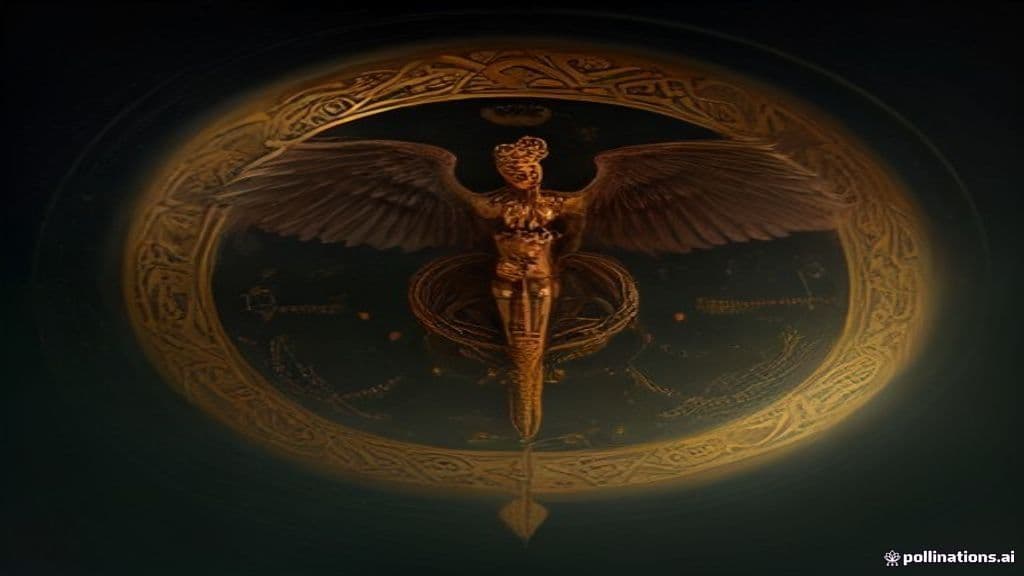
As attested in Egyptian religious art, the motif Kneph/Kmeph functions as a vehicle for representing divinity rather than as a single personal mythic biography. In Egyptian contexts it is represented variably — as a winged egg, as a globe surrounded by serpents, or as Amun in serpentine form called Kematef — indicating its use as a convertible symbol of divine power. In Late Antiquity this Egyptian motif was taken up into Greco‑Roman magical and gnostic milieus under the Greek theonym Chnuphis, where it appears as a hybrid lion‑headed serpent on magical artifacts and is—by proxy in gnostic symbolic systems—associated with the Demiurge. Some modern Theosophical writers later attempted further syncretisms with deities such as Khnum, Agathos Daimon, Serapis, and Pluto, but those identifications are later interpretive layers rather than attestations from the original Egyptian corpus.
In Egyptian iconography Kneph/Kmeph is variously depicted as a winged egg, as a globe encircled by one or more serpents, or as a serpent-form of the god Amun known as Kematef; these variants appear in religious art as symbolic representations of divinity. In Late Antique magical contexts, under the Greek name Chnuphis, the motif is depicted more concretely as a leontoeidic (lion‑headed) creature with a serpent's body—a form that is particularly common on magical gemstones, amulets, and other artifacts of the period.
The sourced material does not ascribe discrete, narrative powers or behaviors to Kneph/Chnuphis beyond its role as a motif of divinity and a symbol employed within magical and gnostic iconographies. Late Antique usages on magical artifacts indicate it functioned within symbolic systems that could convey protective, authoritative, or cosmological meanings; some gnostic materials associate the figure by proxy with the Demiurge. Specific active abilities, agency, or feats are not recorded in the cited sources.
57 Mnemosyne
57 Mnemosyne is a large main-belt asteroid (S-type) discovered in 1859 and named after the Greek Titaness Mnemosyne. It is a non-sentient astronomical body studied for its orbital and rotational properties and has been used in dynamical measurements related to Jupiter.
Aamon
Aamon (also Amon) is a named spirit in early modern Western grimoire tradition (Pseudomonarchia Daemonum; the Ars Goetia / Lesser Key of Solomon). He is presented as a high-ranking infernal officer (Marquis/Prince) who governs forty legions and is credited with knowledge of past and future and with affecting human relationships (reconciling or procuring feuds and favor).
Aani
Aani (ancient Egyptian jꜥnr) is the lexical term for the baboon in ancient Egyptian language and functions in religious contexts as an animal icon and theophoric epithet. Attested repeatedly in Egyptian texts and images, the baboon image is used to represent or denote aspects of gods such as Thoth, Hapy, Khonsu, and Osiris rather than implying the animal itself is an independent deity.
Aati
Aati (also rendered Ati) is one of the 42 judges of the dead in ancient Egyptian funerary literature, attested in the Book of the Dead tradition (notably the Papyrus of Nebsemy). Described as originating 'from Heliopolis', Aati's documented function is to question the deceased about a specific moral accusation during the Duat judgment; the funerary texts supply a formulaic denial the soul must recite.
Abaddon
In Hebrew scripture Abaddon is primarily a noun meaning 'destruction' or a section/condition of the underworld paired with Sheol; in the New Testament Book of Revelation Abaddon is personified as an angelic figure (Greek Apollyon) described as the king of an army of locusts released from the abyss during the apocalypse.
Abadir
Abadir is a polysemous name attested in distinct cultural contexts: a legendary founding saint and clan ancestor in eastern Ethiopia (Sheikh Abadir Umar Al‑Rida / Aw Abadir), a term applied to cone‑shaped cult stones in Phoenician religious description, and a personal name of a martyr (Abadir/Apater) in the Coptic Synaxarium. The attestations are independent usages of the same name rather than a single supernatural being.
Abadiu of Antinoe
Abadiu of Antinoe was a fourth‑century bishop of Antinoe (Antinoopolis, in Roman Egypt) commemorated as a martyr and saint in the Coptic Orthodox Church, with a feast day on 26 December. Sources record that he was killed during a theological dispute with Arian opponents and reference him in collections of Egyptian martyrs.
Abagtha
Abagtha (Hebrew: אבגתא, ’Ǎḇaḡṯā) is a named human court official in the Hebrew Bible’s Book of Esther, listed among seven chamberlains who ministered before King Ahasuerus and were commanded to bring Queen Vashti before the king. He is attested only in Esther 1:10 and is presented as an institutional palace attendant rather than a supernatural being.
Abanoub
Abanoub is a 4th‑century Egyptian Christian child martyr venerated in the Coptic tradition. Remembered for his public confession of Christ, miraculous healings associated with his passion, and the translation and veneration of his relics, his feast is observed on July 31 (Epip 24) and his cult centers include Nehisa and Samanoud.
Abaset
Abaset is a localized ancient Egyptian goddess attested in tomb decoration at El‑Bawiti in the Bahariya Oasis during the 26th Dynasty. She is depicted anthropomorphically with a hedgehog motif incorporated into her headdress and appears on the walls of Qarat Qasr Salim, including twice in the Tomb of Bannentiu. No cult texts, myth narratives, or ritual prescriptions for her are recorded in the cited corpus.
Abaskhiron the Soldier
A Coptic Orthodox martyr venerated for refusing imperial idolatry during the Diocletian persecution; reputedly healed by the Archangel Michael, preserved in monastery relics, and commemorated on 14 June (7 Paoni).
Abdel Messih El-Makari
Abdel Messih El-Makari (1892–1963) was a Coptic Orthodox monk and priest venerated as a 20th‑century Coptic saint. Associated with the Monastery of Saint Samuel the Confessor and the Monastery of Saint Macarius (Scetes/Wadi El‑Natrun), he is remembered for humility, asceticism, charity, and reported spiritual gifts such as prescience, discerning of spirits, and healing.
Community Record
- [1]Kneph (Wikipedia). Wikipedia contributors, 'Kneph', Wikipedia, The Free Encyclopediawiki
- [2]Kneph (Wikidata). Wikidata entry Q6421966, 'Kneph'other