
According to collected legends, Chuhaister was once an ordinary person who "did something very bad to his neighbor" and as a result was cursed to live in the forest for the rest of his life and not be able to die. Over time his clothing wore out and he is said to go about naked; accounts vary and present him either as a singular named figure or as a small-number class of forest beings.
Accounts vary. He is usually presented as a giant — reported at heights from about two to seven meters — with long hair and a white beard; his body may be covered with white or black fur, or he may appear naked. Other reported traits include blue or "frog-like" eyes, toothless and lisping speech, claws on his feet or hooves, and sometimes being "dressed in white clothes." Folklore also records non-corporeal or alternate forms: a strong wind or whirlwind that tears through the forest, appearance as a wolf, and occasional representations of him coiled near a fire.
Chuhaister is described as cursed not to die and condemned to wander the forest and mountains alone. He is associated with wind, whirlwinds, rain, thunder, hail and abnormal lunar movement; such weather phenomena can signal his presence. He is said to hunt and kill mavkas (forest mermaid-like spirits), ripping them apart and eating them, and to protect working people in forests by removing those harmful spirits. Animals such as foxes and wolves serve him (e.g., fetching water). He may warm himself at human campfires, talk with people, play the flute, and his dance can be so violent that it ruins footwear. One account specifies a method for making hail: freezing a lake, grinding the ice into pieces and throwing them where he wishes.
Weaknesses
None recorded.
Wards
- conditioncampfire hospitality (keeping a fire)
- conditionuse of euphemistic/kinship names (e.g., 'grandfather')

Mavka (Nyavka)
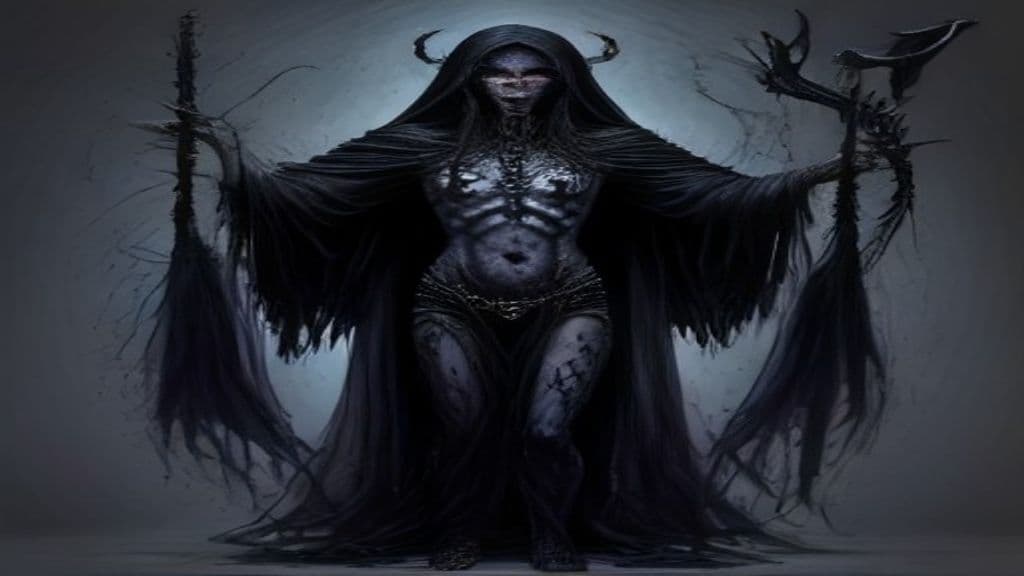
A female forest spirit in Ukrainian folklore, the mavka (also nyavka) represents the soul of a girl who died prematurely or unnaturally. Mavkas are ambivalent: various accounts portray them as alluring, dangerous seductresses who may lure men to death, while other local beliefs credit them with tending cattle and protecting flocks.
Ghoul
A ghoul is a demon-like or monstrous humanoid originating in pre-Islamic Arabian religion, traditionally associated with graveyards and the consumption of human flesh. The concept later entered broader folklore and has been widely reused and transformed in modern fiction and popular culture.
Adže / Adze
No folkloric entity named 'Adže' is documented in the provided sources. The string appears in heterogeneous, non-folkloric contexts (a Bosnian village name, an English woodworking tool entry, a performer pen name, a CIA document fragment) and one modern podcast episode list that mentions 'the Adze' among other vampire-like beings; none of these supply an ethnographic description of a supernatural being called 'Adže'.
Ala
A female weather-being in South Slavic folk cosmology (Bulgaria, Serbia, North Macedonia) associated with hail, destructive storms, and voracious appetite; she is said to lead hail-producing clouds to destroy crops and is sometimes blamed for eclipses by attempting to devour the Sun or Moon.
Alatyr
A sacred world-stone in East Slavic and wider Slavic folklore, described as the "father to all stones" and the "navel of the earth." Located at the world's center (often on Buyan island), it is associated with a miraculous spring, sacred letters, healing properties, and liminality between the human world and other realms.
Albanian paganism (traditional/customary beliefs)
A persistent stratum of pre-Christian Albanian religious and cosmological notions—ancestor veneration, animism, and totemic identifications—embedded in oral tradition and customary law (the Kanun) and surviving particularly in mountainous, rural Albanian-speaking regions and diasporas.
Alkonost
The Alkonost is a legendary woman-headed bird of East Slavic folklore, depicted as an individual mythic avian figure who lives in the underworld alongside her counterpart Sirin. Her song enchants listeners into forgetfulness or bliss, she is said to bless fruit during the Apple Feast of the Saviour, and her reproductive actions are causally linked in lore to sudden storms at sea.
Alyosha Popovich
Alyosha Popovich (Алёша Попович / Олешко Попович) is a named human hero (bogatyr) of the East Slavic byliny tradition, remembered as the youngest member of the canonical trio of Kievan Rus' warriors. He is chiefly characterized by slyness, mockery, and trickery, and defeats foes by craft often aided by pious petition rather than mere brute strength.
Andrew the Apostle
Andrew the Apostle (Greek Ἀνδρέας, Latin Andreas) is one of the Twelve Apostles in the New Testament, a fisherman from Bethsaida, the brother of Simon Peter, described as the “first-called” who introduced others to Jesus. Post-biblical traditions depict him as an early missionary and founder of Christian communities (notably claims of missions to Thrace, Scythia, and founding the see of Byzantium) and as a martyr crucified at Patras.
Aq Bars
Aq Bars (Tatar: Ак Барс, 'White Leopard') is an ancient Bulgar tribal totem and heraldic emblem historically used in Volga Bulgaria and the Khanate of Kazan and adopted in the modern era as the official symbol of the Republic of Tatarstan (formally since 7 February 1992). It functions as a dynastic/tribal mark of identity (derived from the Barsil tribe) and as a political-state emblem rather than a personal supernatural being.
August curse
A modern cultural concept in Russia describing a perceived clustering of severe disasters, attacks, and adverse events during the month of August. Treated in sources as an explanatory frame combining statistical observation, seasonal and political factors, and occasional astrological or supernatural interpretation.
Aventinus of Alba Longa
Aventinus of Alba Longa is a legendary king in the Alban/Latial regnal tradition, presented in ancient commentators and later summaries as an eponymous figure whose burial or shrine on the Aventine Hill provided an etiological explanation for that place-name. He appears in king-lists as a successor in the line purportedly descending from Aeneas and is variously dated in later regnal chronologies to the 9th–8th centuries BC.
Azovka (Azov Girl)
Azovka, often called the Azov Girl in English summaries, is a female supernatural figure named in Pavel Bazhov’s Ural skaz tale "Beloved Name." The supplied sources identify her as a character from Ural-region folklore as represented in Bazhov’s miners’ tales but provide no detailed description or independent folkloric tradition beyond that tale reference.
Baba Marta
Baba Marta (Bulgarian: Баба Марта, 'Granny March') is a Bulgarian folkloric personification of the transition from winter to spring. Celebrated on March 1, she is pictured as a feisty grandmother whose mood is said to affect late-winter weather; communal customs (martenitsi) exchanged on her day symbolize health and good fortune.
Community Record
- [1]Chuhaister — Wikipedia. Wikipedia contributors. "Chuhaister." Wikipedia, The Free Encyclopedia. https://en.wikipedia.org/wiki/Chuhaisterwiki
- [2]Chuhaister — Wikidata. Wikidata entry Q4517523: Chuhaister. http://www.wikidata.org/entity/Q4517523wiki