
Regional accounts attribute the church grim's origin to practices or beliefs that bind a guardian to a church site. In English and Scandinavian traditions folklorists record a remembered custom of interring an animal beneath a church foundation or altar (England commonly cited a dog; Scandinavia commonly cited a lamb, boar, pig or horse) so that its spirit would serve as the building's protector. Scottish variants alternatively present the guardian as the spirit of the person most recently buried in the churchyard, charged with watching until succeeded by the next burial (the graveyard watch, faire chlaidh). Sources present these as attested folk explanations rather than a single uniform mythic origin.
Appearance varies by region. The English church grim is most commonly described as a large black dog with red eyes but may take other animal forms in some tales. Scandinavian accounts often describe a bound church-animal—frequently a lamb (sometimes said to have three legs) or other farm animals; specific ghost-animals such as a 'grave-sow' appear in local tales. Scottish descriptions include non-canine forms for graveyard watchers, e.g., a moving flame in some accounts of the faire chlaidh.
Primary function is protective custodianship of a particular church and its churchyard: keeping order, punishing profanation, and defending consecrated ground from thieves, vandals, witches and hostile spirits. Scandinavian tales record the grim fighting hostile sea-spirits (Strand-varsler) that attempt to enter the churchyard. The grim is also reported as an omen in some English strands (e.g., tolling the bell before a death; appearing during funerals with interpretable aspect). It dwells at the church (tower or other concealment) and patrols the grounds day and night, and is implicated in divinatory contexts in Sweden (adversary of the year-walker/Årsgång).
Weaknesses
- otherno documented folkloric weaknesses
Wards
- ritualfoundation animal burial (preventative substitution)
- conditionrespect for sanctity of church and avoidance of profanation
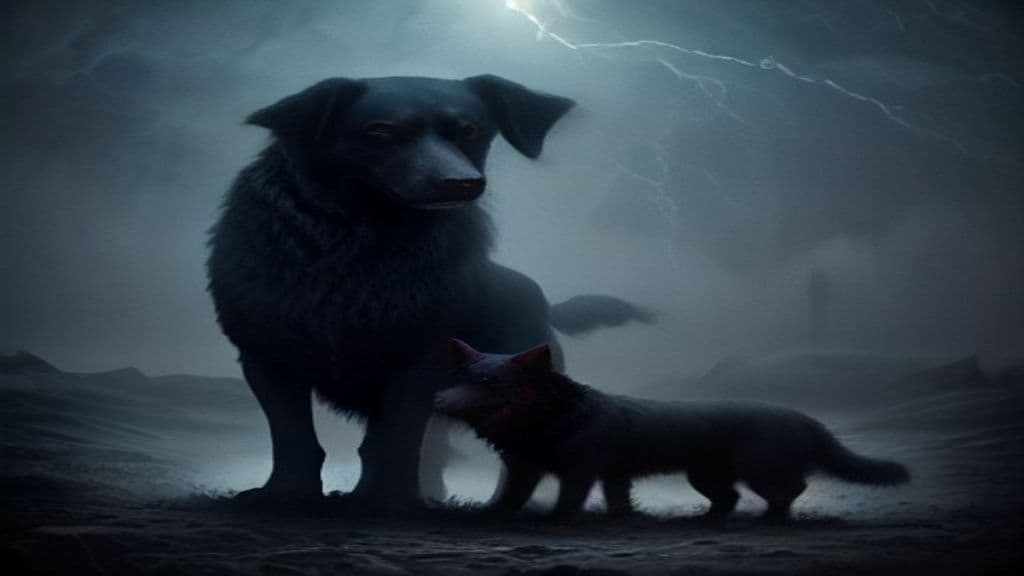
Black Shuck
A spectral black dog of East Anglian legend, with glowing red or green eyes. Its appearance is an omen of death. Its howl has been heard on clifftops during storms for centuries.
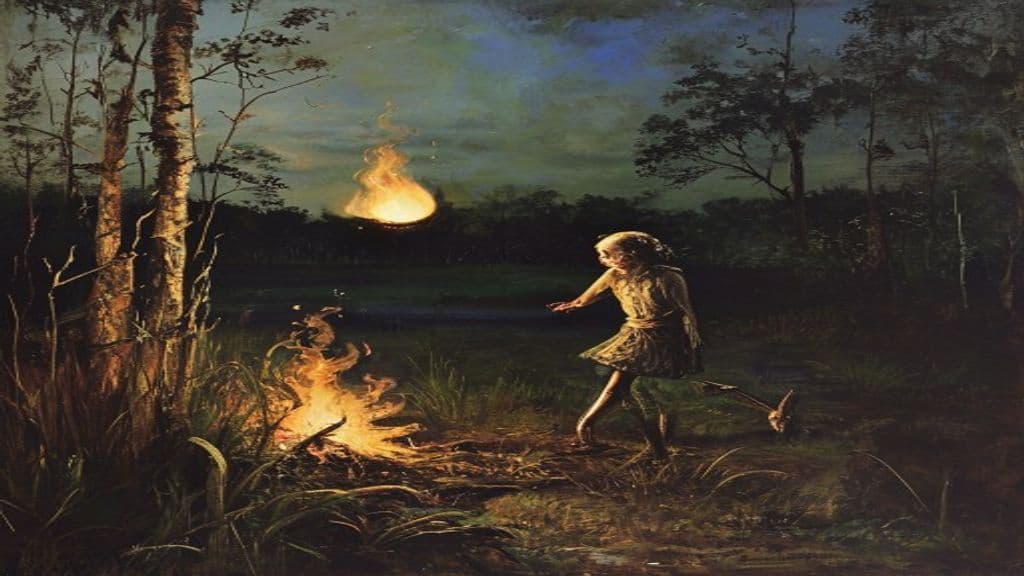
Will-o'-the-wisp
An atmospheric 'ghost light' — a small, mobile, lamp-like light seen at night over marshes, bogs, wet ground, or graveyards. In many cultures the phenomenon is interpreted as a supernatural being or manifestation (wandering nature-spirit, soul of the dead, transformed witch, or treasure-indicator); modern science offers chemiluminescent explanations for some occurrences.
*Perkʷūnos
*Perkʷūnos is the reconstructed Proto-Indo-European thunder‑god hypothesized by comparative linguistics and mythology. Scholarly reconstructions portray him as a storm or thunder figure associated with fructifying rain and as the combatant who fights a multi‑headed water‑serpent to release life‑giving waters; no direct attestations from the Proto‑Indo‑European period survive and the figure is inferred from later Indo‑European traditions.
*Péh₂usōn (reconstructed)
Péh₂usōn is a hypothetical Proto‑Indo‑European pastoral guardian reconstructed by comparative scholars from parallels in Greek and Vedic traditions. Proposed as a Graeco‑Aryan ancestor‑figure, the reconstruction describes a protector of flocks, roads, and travellers rather than an attested historical cultic personality.
57 Mnemosyne
57 Mnemosyne is a large main-belt asteroid (S-type) discovered in 1859 and named after the Greek Titaness Mnemosyne. It is a non-sentient astronomical body studied for its orbital and rotational properties and has been used in dynamical measurements related to Jupiter.
Abaddon
In Hebrew scripture Abaddon is primarily a noun meaning 'destruction' or a section/condition of the underworld paired with Sheol; in the New Testament Book of Revelation Abaddon is personified as an angelic figure (Greek Apollyon) described as the king of an army of locusts released from the abyss during the apocalypse.
Aban Yasht
The Aban Yasht is a hymn from the Persian tradition that praises Anahita, a goddess associated with water, fertility, and wisdom. It consists of 132 stanzas and is part of the 21 Yashts collection. (Note: - Power tier should be "Primordial" or possibly "Cosmic", given that it's a hymn of great spiritual significance and associated with a goddess. - The article incorrectly states that Anahita is associa)
Abandinus
Abandinus is a locally attested Romano‑Celtic theonym known from a single inscribed bronze feather (votive object) dedicated at Godmanchester (the Roman fort Durovigutum) in Cambridgeshire. Scholars interpret him as a local god or male spirit tied to a specific place and possibly associated with a nearby spring or stream; this association is tentative and based on etymological readings of the name.
Abarta (Ábartach)
Abarta (also Ábartach) is a figure of Irish myth who, in surviving accounts, tricks Fionn mac Cumhaill's warriors by giving them a supernatural grey horse that bears them into the Otherworld. Sources variably identify him as a member of the Tuatha Dé Danann or as a Fomorian; after the incident he is compelled to release the captured warriors and is refused entry to the Fianna.
Abath
No corroborated folkloric entity named "Abath" is documented in the provided sources. The string appears in the supplied material only as a surname/personal name in Aruban/Dutch-Caribbean archival records and as an unrelated taxonomic or encyclopedic hit; no mythic attributes, origin stories, rituals, or apotropaic practices for an entity called Abath are present in the documents reviewed.
Abatur
Abatur is an uthra (celestial emanation) in Mandaeism described as the 'father of the Uthras' and called the Ancient (ʿattīqā). He resides on the boundary between the World of Light and lower regions, functions as a judge who weighs souls (Abatur Muzania), and supplies instructions and materials to the demiurgic uthra Ptahil in accounts from the Diwan (Scroll) of Abatur.
Abatwa (Twa / Batwa)
Abatwa (also recorded as Twa, Batwa, Mutwa; singular forms Barhwa or Murhwa in some transcriptions) are indigenous hunter‑gatherer peoples of the Great Lakes region of Central Africa, historically identified as some of the earliest inhabitants of the area. The available sources treat them as human ethnic groups whose livelihoods, lands, and populations have been severely affected by conservation policies and modern violence.
Abcán (Abhcán)
Abcán (modern spelling Abhcán) is a named dwarf poet and musician of the Tuatha Dé Danann in Irish myth. He appears in a small number of narratives as a musician whose art has soporific power and as the ferryman who brings the goddess Ruad from the Otherworld to the human world.
Abdiel
Abdiel (Hebrew עֲבְדִּיאֵל) is primarily a theophoric Hebrew personal name meaning "servant of El/servant of God," attested once in the Hebrew Bible (1 Chronicles 5:15). In later literature—most notably John Milton's Paradise Lost—Abdiel is reimagined as a faithful seraph who opposes Satan's revolt. The provided sources do not treat Abdiel as an autonomous folkloric spirit type or record rituals or wards associated with the name.
Community Record
- [1]Church grim. Wikipedia: 'Church grim' article summarizing English, Scottish and Scandinavian traditionswiki
- [2]Wikidata: Church grim. Wikidata entry summarizing church-grim motifwiki
- [3]Bestiary Friday: The Church Grim | Fairy Tale Review. Fairy Tale Review summary and discussion of the church grim motifother