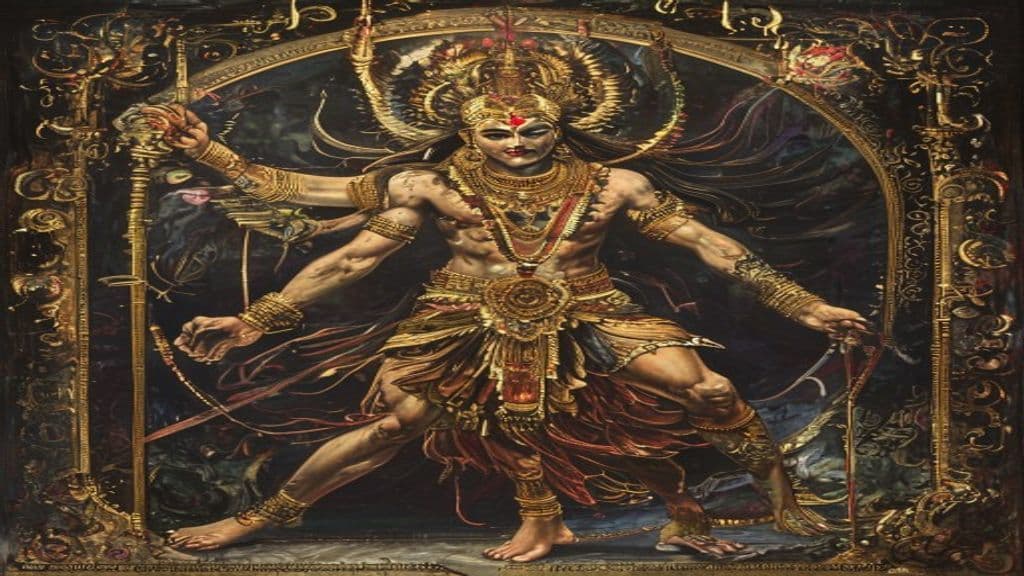
According to purāṇic genealogies summarized in the sources, Kaśyapa married sisters Aditi and Diti; Aditi gave birth to the āditya/deva classes, while Diti is the progenitress of the Daityas. The term literally marks descent from Diti. Purāṇic episodes present individual Daityas (Hiraṇyaksha, Hiraṇyakashipu, Mahabāli, Holikā, Prahlāda, etc.) as arising from that lineage and acting collectively in mythic ages to challenge the cosmic order, requiring Viṣṇu's avatāras for their overthrow (as recorded in purāṇic summaries).
The supplied purāṇic and summary sources emphasize genealogy, deeds, and narrative roles rather than a standardized morphology. Individual named Daityas receive descriptive treatment in episodes (for example, narratives of combat or flight into the ocean), but there is no consistent, class-wide physical description in the provided materials.
As a class Daityas are portrayed as powerful, martial, and politically active: several prominent Daityas 'overran the earth' and mounted cosmic challenges to the devas, prompting Viṣṇu-avatāras for containment or defeat. Individual members display extraordinary potency within their stories (e.g., causing cosmic disorder, resisting gods). Interpretive commentaries summarized in the sources also treat Daityas symbolically as embodiments of 'separative consciousness' or titanic, divisive psychic forces rather than merely moral evil.
Weaknesses
- othervanquished by Viṣṇu avatāras
- conditionsubject to ethical/spiritual transformation (soteriological submission in interpretive readings)
Wards
- otherdivine intervention (recourse to Viṣṇu's avatāras as the mythic means of protection/defeat)
- conditioncultivation of sattva / ascetic discipline (Manusmṛti classification implies spiritual disciplines as normative counters to daityic tendencies)
*Péh₂usōn (reconstructed)
Péh₂usōn is a hypothetical Proto‑Indo‑European pastoral guardian reconstructed by comparative scholars from parallels in Greek and Vedic traditions. Proposed as a Graeco‑Aryan ancestor‑figure, the reconstruction describes a protector of flocks, roads, and travellers rather than an attested historical cultic personality.
3-D Man
3-D Man is a Marvel Comics superhero identity associated with a 1950s-era origin in which the body of Chuck Chandler can materialize in three-dimensional existence when activated by his brother Hal via a pair of glasses. The mantle was later assumed by Delroy Garrett (formerly Triathlon) in modern continuity.
5 Ronin
5 Ronin is a 2011 Marvel Comics five-issue limited series that reimagines five Marvel superhero archetypes as rōnin (masterless samurai) in a fictionalized post‑Sekigahara feudal Japan. The work places Wolverine, Hulk, Punisher, Psylocke, and Deadpool analogues into period roles to explore displacement, revenge, and identity in an era of political upheaval.
58 Concordia
58 Concordia is a fairly large main-belt asteroid orbiting the Sun, discovered in 1860 and named after the Roman goddess Concordia. Astronomical sources classify it as a C-type (carbonaceous) body with a multi-year orbital period and measurable rotation and pole orientations.
9MOTHER9HORSE9EYES9
An anonymous Reddit screen name and online persona used by the author of the Interface series, a multipart speculative-horror narrative posted in short installments across Reddit in 2016. The name functions as the signature of an authorial identity and as a focal label for a fandom that created archives, a subreddit, and a wiki documenting the story and its fictional phenomena (notably entities called "flesh interfaces").
A.R.G.U.S.
A.R.G.U.S. is a fictional clandestine United States government agency in the DC Comics universe that investigates, contains, and manages superhuman, meta-human, and supernatural incidents and assets. Introduced in The New 52 continuity, it functions as an institutional actor providing intelligence, logistical support, covert task forces (notably Task Force X / the Suicide Squad), and a dedicated magic division across comics and media adaptations.
Abena Mansa
A name attested in a single contemporary Ghanaian blog anecdote as a 'mysterious being'; available sources do not establish Abena Mansa as a coherent, traditional supernatural figure or provide corroborating ethnographic detail.
Abhimanyu
Abhimanyu is a youthful Kuru/Pandava warrior-hero in the Sanskrit epic Mahābhārata. Son of Arjuna and Subhadra, he is famed for entering the Chakravyuha battle formation on the thirteenth day of the Kurukshetra War and dying at age sixteen; his posthumous son Parikshit continues the Kuru line.
Abin Sur
Abin Sur is a fictional extraterrestrial Green Lantern from the planet Ungara in DC Comics. A former history professor turned Green Lantern of Space Sector 2814, he discovered and investigated a prophecy tied to the "Blackest Night," died wounded on Earth and chose Hal Jordan as his ring-successor, and was later reanimated as a Black Lantern in the Blackest Night storyline.
Abishai
Abishai is a personal name attested in several distinct sources: a biblical individual described as the eldest son of Zeruiah (sister of King David); a Semitic chief named in an inscription at Beni-Hasan in Middle Egypt; and modern cultural uses including a named monster in Dungeons & Dragons and as an artist/stage name. The supplied materials do not present Abishai as a supernatural being within a living cosmology.
Abraham Cornelius
Abraham Cornelius is a fictional human scientist in Marvel Comics, a senior Weapon X technician who helped develop the technique to bond adamantium to bone and who features in Wolverine's origin and later storylines, including Death of Wolverine.
Absorbing Man
A fictional Marvel Comics character (Carl "Crusher" Creel) whose body acquires the physical properties of materials or energies he touches. Debuting in Journey into Mystery #114 (March 1965), created by Stan Lee and Jack Kirby, he is presented as a mortal supervillain/occasional antihero who challenges heroes such as Thor, Hulk, Spider-Man, and the Avengers.
Community Record
- [1]Daitya — Wikipedia. Wikipedia article 'Daitya' (access provided in research notes).wiki
- [2]Daitya — Wikidata. Wikidata entry for Daitya (referenced in research notes).wiki
- [3]Srimad Bhagavatam: Canto 7 - Chapter 5 (excerpt). Srimad Bhāgavatam episode cited in research notes; archive recording excerpt (Madan Mohan) also provided.literary
- [4]Archive: madan-mohan-prabhu-alachua-florida-december-2-2016-sb-3-18-1-2. Audio archive of Srimad Bhāgavatam passage referenced in research notes.literary
- [5]Pankaj Oudhia film indexes (archive listings). Ethnobotanical/film archive items indexed in research notes that list 'daitya' among terms but do not provide ritual detail.other
- [6]Daitya Sudan Temple — Wikipedia. Wikipedia entry for a temple named using 'Daitya' (local/topographical evidence of term usage).wiki
- [7]Harivamsha Purāṇa summary (as cited). Purāṇic genealogical summary (Harivamsha) referenced within the Wikipedia article cited in research notes.literary
- [8]StackExchange discussion (classification questions). Community discussion cited in research notes illustrating classification debates (Daitya vs Danava, etc.).other
- [9]HollowOrbs — Daitya (folk retellings). Online retellings and folk-variant narratives referenced in research notes (treated as narrative variants).folk