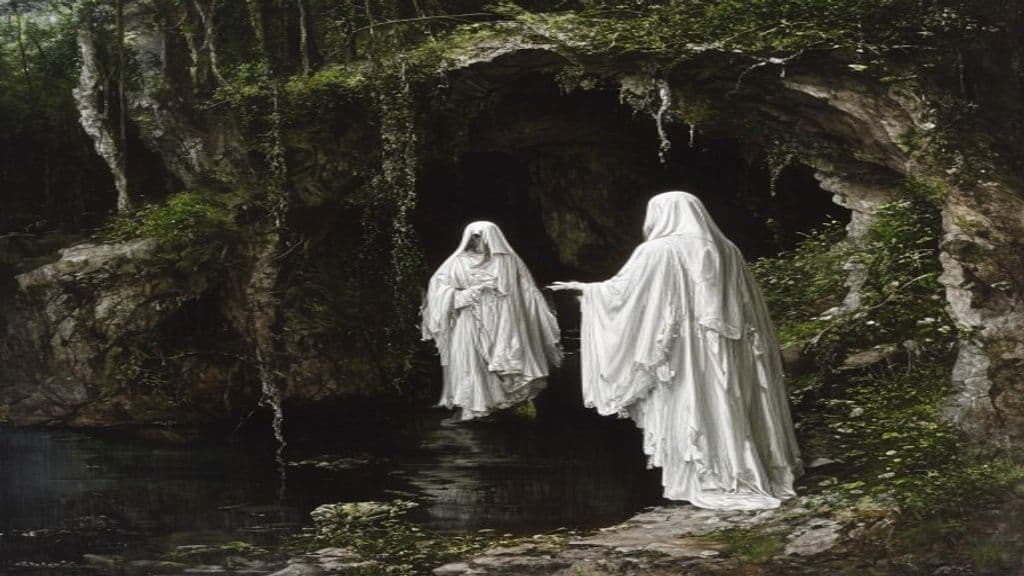
There is no single origin myth in the supplied sources; scholarly commentary and folkloristic comparison locate the Dames blanches within a long interpretive frame. J. A. MacCulloch (reported in secondary summaries) suggests they may be recharacterizations of pre-Christian household/guardian female figures (Matres/Dominæ) based on epigraphic survivals, while Thomas Keightley classifies them as a type of fée in Normandy. Archive program summaries trace the motif's evolution through localized fairy and washer-at-night traditions and link it by function and appearance to sibling 'white lady' figures across Europe; these proposals are presented as scholarly and folkloric interpretations rather than a single traditional origin story.
Across the cited sources the Dames blanches are consistently described as female figures visually associated with whiteness—typically dressed in white robes or garments—and appearing at liminal landscape features such as bridges, ravines, caves and forest paths. Specific local accounts name figures like La Dame d'Apringy (Bayeux ravine) and the Dame of Pont d'Angot (Falaise bridge) but provide no extensive physiognomic detail beyond femininity and white dress. Related Lavandières de Nuit accounts contribute occasional additional traits (for example, a cited archival summary reports one account describing 'yeux brillants et des cheveux sombres'), but those details are from night-washerwomen traditions and are not presented as universal characteristics of all Dames blanches in the sources.
The sources separate two related but distinct behavioral clusters. In Keightley's Normandy accounts, Dames blanches lurk in narrow places (ravines, forests, bridges) and attempt to attract the attention of passersby; they may require the traveler to join in a dance or to perform an act of deference (e.g., going on their knees) to be allowed passage, after which the spirit courteously vanishes. Refusal to comply is reported to bring harm: the recalcitrant are said to be thrown into thistles and briars or to be tormented by attendant creatures (lutins, cats, owls) who assist the Dame. Separately, the Lavandières de Nuit (night washerwomen) motif, which the archival program links to the dame blanche family, describes nocturnal women who wash or beat linen—sometimes described as corpses of infants—and who function as messengers or announcers of death; those washerwomen can seize or beat observers who watch or disturb them. The supplied sources treat the Dames blanches and Lavandières as related motifs with overlapping functions (liminal female presences and death-omens) but attribute specific behaviors to each set of accounts.
Weaknesses
- conditioncompliance with request (dance or deference)
- conditionnon-observation / non-disturbance (avoid watching or interrupting)
Wards
- ritualdancing or kneeling to the Dame (local behavioral ward)
- conditionavoidance of observing or disturbing night washerwomen (Lavandières)

Accolon
Accolon is a mortal knight of the Arthurian court, presented in the Post-Vulgate Merlin tradition and Malory's Le Morte d'Arthur as Morgan le Fay's paramour and instrument in a plot to supplant King Arthur; his tale centers on enchanted weapons (Excalibur and its scabbard), love-manipulation, and a tragic duel with Arthur.
Acionna
Acionna is a local Gallo-Roman water goddess attested by a single votive inscription found at a spring in the Orléanais region. The inscription, discovered by Jollois in 1822 and datable by style to the 2nd century CE, dedicates a portico and ornaments "AUG(ustae) ACIONNAE" and was recovered from the Fontaine de l'Étuvée in Orléans; archaeological work in 2007 uncovered remains of a Gallo-Roman temple and a section of an aqueduct at the site.
Adils
Adils (Old Norse Aðils; also Eadgils, Adillus, Athisl, Adhel) is a semi‑legendary sixth‑century Swedish king attested in Old Norse saga material and later medieval traditions. He appears in saga episodes as a storied royal figure involved in warfare, court acts, and marriage suits rather than as a supernatural being.
Adsullata
Adsullata is attested as a Continental Celtic river goddess associated with the River Savus (modern Sava) in the Roman province of Noricum. Later traditions record her presence in Brittany as a goddess of hot springs and present her as an antecedent or origin-form of the Anglo‑Celtic sun goddess Sul.
Agilaz (Egil)
Agilaz (reconstructed Proto-Germanic) — commonly recorded in medieval sources as Egil or Ægil — is a legendary archer attested in Germanic heroic tradition. He appears as the brother of Völund (Wayland/Weland) in the Old Norse poem Völundarkviða and in the Thidreks saga, and his name is also inscribed on early medieval objects (Franks Casket, Pforzen buckle). The attested material presents him as a named heroic human archer within saga and inscriptional contexts rather than as a recurrent supernatural species.
Aglovale
Aglovale (also Agloval, Aglovan, Aglovaus, Acglavael) is a human knight of Arthurian romance, presented as the eldest legitimate son of King Pellinore and a Knight of the Round Table in the Vulgate/Post‑Vulgate cycles, Malory, and later adaptations. He brings his long‑lost brother Perceval to Camelot, takes part in military actions (including slaying Agrippa in one account), and his death is related in varying ways across traditions (accidental at Gawain's hand, deliberate murder by Orkney kin, or killed during Lancelot's rescue of Guinevere).
Agnarr Geirröðsson
Agnarr Geirröðsson is a mortal prince attested only in the Poetic Edda poem Grímnismál; he aids Odin (disguised as Grímnir) during Geirröðr's torture and, after Odin reveals himself and King Geirröðr dies, Agnarr succeeds as king.
Agne
Agne (also attested Agni, Hogne, Agni Skjálfarbondi) is a semi-legendary king of Sweden in Old Norse saga tradition, preserved in the Ynglingatal corpus and prose expansions such as Snorri Sturluson's Ynglinga saga. He is portrayed as a mighty and famous warrior-king whose campaign in Finland, marriage to Skjalf, and death by hanging form a remembered episode connected to local place-names and a burial mound.
Agolant
Agolant is a literary Saracen king who appears as a recurring antagonist in medieval and Renaissance epic cycles (Matter of France). He functions as a human royal opponent to Charlemagne and his peers, supplying martial episodes, genealogical connections, and the transfer of legendary arms and horses in chansons de geste and later Italian romances.
Agravain
Agravain is a literary knight of Arthurian romance cycles: one of the sons of King Lot of Orkney, a member of the Round Table, and a recurring figure in French and English medieval prose and verse. He is portrayed as a skilled but morally problematic courtly knight whose jealousy, malice, and intra-familial violence drive key narrative conflicts (notably the slaying of Lamorak and the exposure of Guinevere).
Agrestes
Agrestes is a legendary pagan king of Camelot appearing in accounts of the 13th‑century Arthurian Vulgate Cycle. Presented as a human antagonist to the Christian mission associated with Joseph of Arimathea (or his son Josephus), his violent persecution of converts is followed by madness, self‑destruction, and the subsequent consolidation of Christianity in Camelot.
Alf and Alfhild
Alf and Alfhild are legendary human figures from Old Norse/early Scandinavian narrative tradition preserved principally in Saxo Grammaticus' Gesta Danorum. The tale presents Alf as a Danish prince and Alfhild as a Geatish princess who becomes a shieldmaiden and leader of a fleet of female raiders; their story includes combat, recognition, marriage, and later dynastic conflict.
Community Record
- [1]Dames blanches. Wikipedia: 'Dames blanches' article (summary and citations including Keightley, MacCulloch and comparative material)wiki
- [2]Dames Blanches (Wikidata). Wikidata entry for Dames Blanches (identifier and linked data)other
- [3]Les Dames Blanches - Histoire de Fantôme (archive video). Archive video summary: Les Dames Blanches — programmatic discussion linking dame blanche motif to European 'white lady' figures and to death-omen traditionsfolk
- [4]Les Lavandières de Nuit - Histoire de Fantôme (archive video). Archive video: Lavandières de Nuit — accounts of night washerwomen, quoted George Sand passage, and discussion of their role as messengers of death; linked in the supplied research notes to the dame blanche motiffolk
- [5]Blood & Honey (archive bibliographic entry). Bibliographic/archive entry cited in the supplied notes (listed among sources consulted in the research notes)other
- [6]Thomas Keightley (1870) (as cited in summaries). Keightley, cited in the Wikipedia article: Normandy accounts describing Dames blanches as a type of fée 'of a less benevolent character' and providing examples (La Dame d'Apringy, Pont d'Angot)folk