
In traditional Buddhist cosmology Dīpaṅkara is narrated as one of the Buddhas of the past who attained full awakening in a remote age; sources place his life and awakening at the temporal remove of "four asankheyyas and one hundred thousand kalpas ago." In the best‑known narrative, the bodhisattva Sumedha meets Dīpaṅkara and performs an act of devotion (laying his hair or body on the ground); Dīpaṅkara gives Sumedha a niyatha vivaraṇa — a definite prediction — that he will in a future age become a Buddha called Gautama. Traditional accounts also locate Dīpaṅkara's parinirvana at Nandarama, where a stupa was said to have been erected.
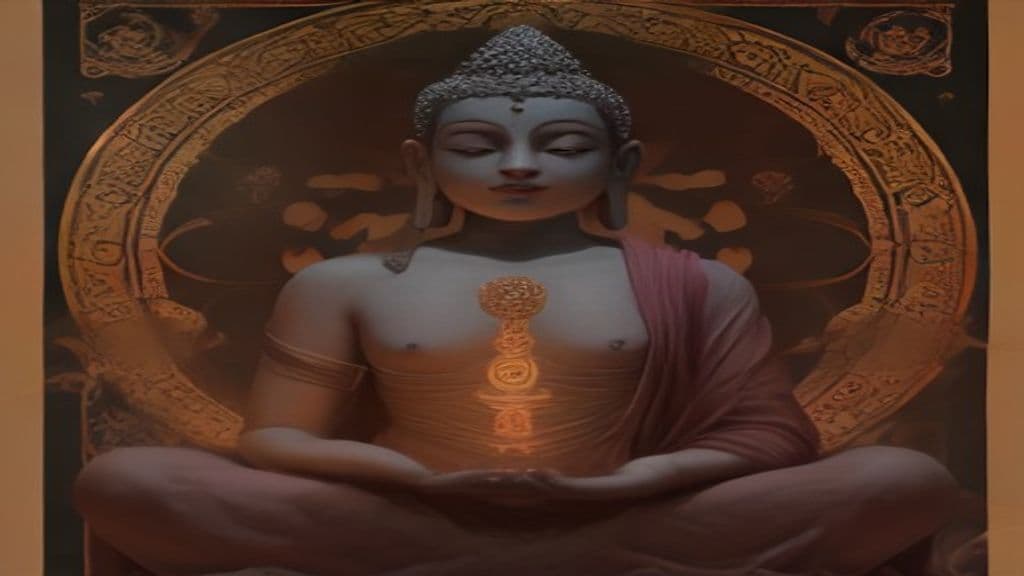
In iconography Dīpaṅkara is generally represented as a Buddha, commonly seated but also frequently shown standing in regions such as China, Thailand, and Nepal. Typical gesture associations include the right hand in the abhaya mudrā (gesture of protection and reassurance); some regional images show both hands forming protective gestures. Descriptive texts (e.g., commentarial sources on the Flower Adornment) emphasize his great radiance — he is described as "radiantly bright." He is rarely depicted alone and is often accompanied in reliefs and statuary by bodhisattvas such as Mañjuśrī and Vajrapāṇi (noted in Java), or Avalokiteśvara and Vajrapāṇi (noted in Sri Lanka), and sometimes shown in triads with Buddhas who come after him (Gautama, Maitreya).
Sources portray Dīpaṅkara's principal role as recognitive and prophetic: he identifies and prophesies the future awakening of a bodhisattva (the Sumedha episode), thereby initiating the long path toward Buddhahood. As a past Buddha he functions as an exemplar whose radiance and awakened presence inspire the cultivation of the perfections. In later, regional devotional contexts (attested by the 17th century in Nepalese materials) he is also reverenced as a protector figure for particular social groups (for example, merchants and sailors) through votive images placed where protection is desired, though this patronal role is a vernacular development rather than a canonical power list.
Acala
Acala (Sanskrit: अचल, 'The Immovable') is a wrathful protective deity (dharmapala) in Vajrayāna and East Asian esoteric Buddhism, classed among the Wisdom Kings (Vidyārāja). He functions as a ritual focus for visualization and mantra practice intended to remove obstacles and bind or destroy hostile forces.
Acalanātha (Acala / Achala)
Acalanātha (also Acala or Achala) is a wrathful deity and dharmapāla — a protector of the Dharma — prominent in Vajrayana and East Asian Mahayana Buddhist contexts. Presented as a fierce, non‑human or semi‑divine protector-figure, Acalanātha functions to defend the teaching and practitioners by removing obstacles and confronting threats to the transmission and practice of Buddhism.
Agni
Agni is the Vedic personification of fire in Hindu tradition: a sacred, mediating principle that manifests as terrestrial fire, atmospheric lightning, and celestial sun, and that receives and conveys sacrificial offerings. Prominent in the Rigvedic corpus, Agni functions as sanctifier, witness of rites of passage, and a transformational inner principle in later Upanishadic literature.
Aizen Myō-ō (Rāgarāja)
Aizen Myō-ō corresponds to the deity Rāgarāja, a wrathful/transformation-oriented figure venerated in Esoteric and Vajrayāna Buddhist traditions. The figure is especially revered in Chinese Esoteric Buddhism in Chinese communities and in the Japanese Esoteric schools Shingon and Tendai.
Akhu Tönpa
A Tibetan trickster figure, sent by Chenrezig to teach the art of being shrewd and witty, while championing the common man against social hierarchies. (Note: - Power tier should be Lesser or Minor Spirit, not Ancient, as it's more aligned with local spirit level of trickster figures. - The ability to outwit those in positions of power suggests Greater or P)
Akshobhya
Akshobhya is a transcendent buddha of Mahāyāna and Vajrayāna Buddhism, one of the Five Wisdom (Dhyāni) Buddhas. He personifies 'mirror knowledge' (ādarśa-jñāna), is conventionally placed in the East, and is lord of the eastern Pure Land Abhirati; in esoteric texts he is associated with the eastern Vajra division and invoked in mantra/mandala ritual contexts.
Akuma
Akuma (悪魔/あくま) in Japanese sources is an evil spirit, devil, or demon associated with misfortune and mental disturbance. The term appears in Buddhist texts and Heian-period literature and was later used to translate the Christian figure of Satan, as well as the Buddhist Mara.
Amanojaku
Amanojaku (天邪鬼 / あまのじゃく) is a Japanese yōkai-type being portrayed as a contrarian, heart-reading trickster. Treated in different contexts as a small ogre (ko-oni), a wicked demon (jaki) in Buddhist iconography, and a folkloric spirit that provokes human vice, it appears across regional tales with variable roles from malicious kidnapper to household oddity.
Amida Nyorai
Amida Nyorai (Amitābha / Amitāyus) is a principal Mahayana Buddha venerated across East Asia as the embodiment of Infinite Light and Infinite Life who presides over a Western Pure Land and is invoked as the savior who receives the dying into rebirth there.
Amitābha
Amitābha is a central celestial Buddha of Mahayana Buddhism who presides over the western Pure Land called Sukhāvatī. Devotional practices invoking his 'measureless' light and life (nianfo/nembutsu) are presented in Pure Land traditions as a path by which beings may be reborn in his buddhafield and quickly attain Buddhahood.
Amitābha Buddha
Amitābha is a principal Mahayana Buddha who presides over the Western Pure Land (the Land of Ultimate Bliss). Devotional practices—most centrally recitation of his name and chanting of Pure Land sutras—are presented in sources as the means by which Amitābha welcomes practitioners for rebirth in his hindrance-free realm.
Amoghapāśa
Amoghapāśa is recorded in the supplied sources as a named manifestation or form of the bodhisattva Avalokiteśvara/Lokeśvara attested in Mahāyāna and Vajrayāna contexts. The evidence in the provided material is archival and bibliographic (sūtra/dhāraṇī/maṇḍala filenames and database entries) rather than descriptive narrative or doctrinal exposition.
Community Record
- [1]Dipankara (Wikipedia). Wikipedia, 'Dipankara' entrywiki
- [2]Dīpankara Buddha (Wikidata). Wikidata entry for Dīpankara Buddhaother
- [3]Dipankara Buddha predicts Buddhahood for Sumedha. Wisdom Library, 'Dipankara Buddha predicts Buddhahood for Sumedha' (Apadāna/Commentary material)literary
- [4]The Flower Adornment Sutra with Commentary 13 (City of 10,000 Buddhas). Flower Adornment commentary (descriptive reference to Dipankara as 'radiantly bright')literary
- [5]Bodhipathapradīpaḥ (बोधिपथप्रदीपः) — A Lamp that Illuminates the Path to Awakening. Archive copy of Bodhipathapradīpaḥ, text by Atiśa Dīpaṅkara Śrījñāna (title demonstrates usage of the name)literary
- [6]Daw Dīpaṅkara Theri. Archive material related to Dīpaṅkara name use in monastic contextsother
- [7]MN143, a talk by Sayalay Dipankara - AV - Discuss & Discover. SuttaCentral forum reference to modern monastic using the name Dipankaraother
- [8]Gandhāran art and archaeological references (Classical Art Research Centre / Archaeopress). Art‑historical material noting Gandhāran representations connected with former Buddhas including Dipankaraacademic
- [9]Sumedha (Wikipedia). Wikipedia entry on Sumedha (bodhisattva who received Dīpaṅkara's prediction)wiki