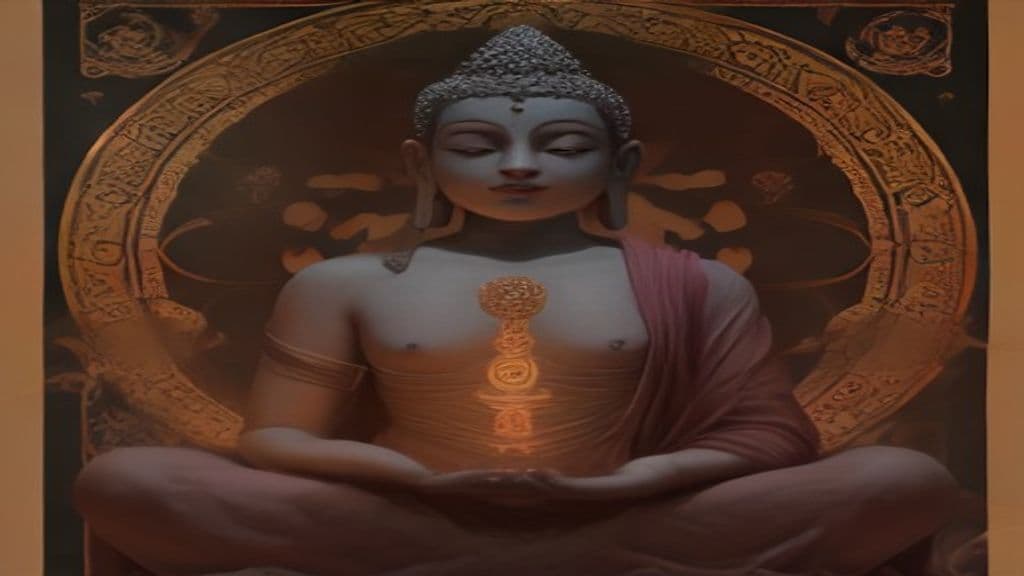
Classical Buddhist texts and chronicles depict Maitreya as a bodhisattva who, having perfected the perfections over vast kalpic time, currently dwells in Tushita heaven awaiting his final rebirth as the future Buddha who will succeed Gautama (Shakyamuni) and restore the Dharma when it has decayed. This future-Buddha schema appears across Pāli and Sanskrit traditions and is reflected in multiple sutras and later chronicle literature that treat him as the next (often numbered as the successor in the current eon) Buddha. Separately, late 19th–20th century Theosophical sources reframe Maitreya as a high-ranking member of a hidden spiritual hierarchy (the Masters of the Ancient Wisdom), a distinct metaphysical reinterpretation that the classical Buddhist corpus does not entail.
Canonical textual excerpts supplied do not preserve a single, authoritative physical description; rather, Maitreya has long been a major focus of Buddhist iconography and visualization literature. From the early centuries CE he is frequently represented in Gandharan, Mathura, and other South Asian and Central Asian art—thus there are standard iconographic motifs in devotional practice and representation, and Mahāyāna visualization sutras (e.g., sutras on the visualization of Maitreya’s ascending birth in Tuṣita) provide meditative imagery used in cultic contexts. The sources provided do not quote a definitive canonical bodily description in narrative form.
Buddhist traditions portray Maitreya primarily in soteriological and prophetic terms: as a future Buddha who will be reborn on earth to teach and re-establish the Dharma when Gautama’s teachings have declined. Mahāyāna sutras depict him as a teacher and revealer who appears in sutras, preaches, and serves as the object of devotional and visualization practices; some traditions and commentators recount visionary encounters or claimed revelations attributed to him. Theosophical sources recast him as an advanced spiritual entity and a senior teacher within a hidden hierarchy guiding human spiritual evolution; these modern esoteric claims are a separate framing rather than a simple extension of canonical Buddhist accounts.
57 Mnemosyne
57 Mnemosyne is a large main-belt asteroid (S-type) discovered in 1859 and named after the Greek Titaness Mnemosyne. It is a non-sentient astronomical body studied for its orbital and rotational properties and has been used in dynamical measurements related to Jupiter.
Aamon
Aamon (also Amon) is a named spirit in early modern Western grimoire tradition (Pseudomonarchia Daemonum; the Ars Goetia / Lesser Key of Solomon). He is presented as a high-ranking infernal officer (Marquis/Prince) who governs forty legions and is credited with knowledge of past and future and with affecting human relationships (reconciling or procuring feuds and favor).
Abrahel
Abrahel is a demonological entity attested in early modern sources (notably Nicholas Rémy's Demonolatria as summarized in modern reference) portrayed as a female sexual spirit who seduced a man in 1581, induced him to kill his son, then restored the child to life in exchange for worship; the revival produced a diminished, foul-smelling corpse that later died again.
Abraxas
Abraxas (Abrasax) is a late‑antique Gnostic and magical name attested as a high-ranking cosmic power in heresiological summaries and as a potent name engraved on amulets (so-called Abraxas stones) in the Greco‑Roman magical milieu. Heresiologists associate Abraxas with rulership of 365 heavens and note the name's numerological value, while archaeological and papyrological contexts show its use as an amuletic formula.
Acala
Acala (Sanskrit: अचल, 'The Immovable') is a wrathful protective deity (dharmapala) in Vajrayāna and East Asian esoteric Buddhism, classed among the Wisdom Kings (Vidyārāja). He functions as a ritual focus for visualization and mantra practice intended to remove obstacles and bind or destroy hostile forces.
Acalanātha (Acala / Achala)
Acalanātha (also Acala or Achala) is a wrathful deity and dharmapāla — a protector of the Dharma — prominent in Vajrayana and East Asian Mahayana Buddhist contexts. Presented as a fierce, non‑human or semi‑divine protector-figure, Acalanātha functions to defend the teaching and practitioners by removing obstacles and confronting threats to the transmission and practice of Buddhism.
Achamōth
Achamōth is a feminine emanational figure in certain Gnostic systems, attested as a daughter or subordinate aspect of the divine Wisdom, Sophia. She appears in ophitic/Naassene mythic genealogies where she is named as motherly/filial to lower, problematic figures such as Ilda‑Baoth; beyond this genealogical role the supplied sources record little concrete description or ritual material specific to her.
Adam Kadmon
Adam Kadmon (Hebrew: אָדָם קַדְמוֹן) is the Kabbalistic Primordial Man: a supra‑human, archetypal pattern or persona projected at the first stage of creation after God's contraction (tzimtzum). It is a metaphysical template corresponding to the highest aspect of divine intention and the sefirotic structure rather than a historical, corporeal individual.
Aedesia
Aedesia is a proper name attested in the supplied sources with three distinct referents: a fifth‑century Neoplatonic woman philosopher of Alexandria, a modern botanical genus (Aedesia O.Hoffm.) native to parts of West and Central Tropical Africa, and a reused toponym/moon name in a speculative fiction setting. None of the provided materials portray Aedesia as a supernatural being or attribute spiritlike powers to the name.
Aeon (Gnosticism)
In Gnostic religious systems an Aeon is a divine emanation or hypostasis that issues from the supreme divine source and together with other Aeons composes the Pleroma, the realm or fullness of divine reality. Aeons function as personified principles or powers (e.g., Nous, Sophia) that mediate between the ultimate One and lower levels of existence; their names, numbers, and relationships vary across Gnostic schools (Valentinian, Basilidian, Sethian, etc.).
Agaliarept
A named high-ranking spirit from post-medieval grimoire tradition, presented in the Grimoirium Verum and the Grand Grimoire as a commanding officer in a hierarchical host of spirits; credited with revealing secrets and commanding a legion, and cited in later printed occult imprints and modern fiction.
Agares
Agares is a named, ranked spirit in the European grimoire tradition. Frequently presented as an elderly man associated with the eastern quarter, he is credited in multiple grimoires with teaching languages, stopping or retrieving runaway persons, causing earthquakes, and granting noble titles, and is invoked in evocations and object-binding experiments.
Community Record
- [1]Maitreya - Wikipedia. Wikipedia, 'Maitreya' article (publicly accessible encyclopedic summary)wiki
- [2]Maitreya (Theosophy) - Wikipedia. Wikipedia, 'Maitreya (Theosophy)' article (summary of Theosophical framing)wiki
- [3]Maitreya (Theosophy) - Alchetron. Alchetron summary of Theosophical presentations of Maitreyaother
- [4]Archive materials referencing modern claimants and popular sources. Archive collection and modern publications reporting contemporary interpretations and claimantsother