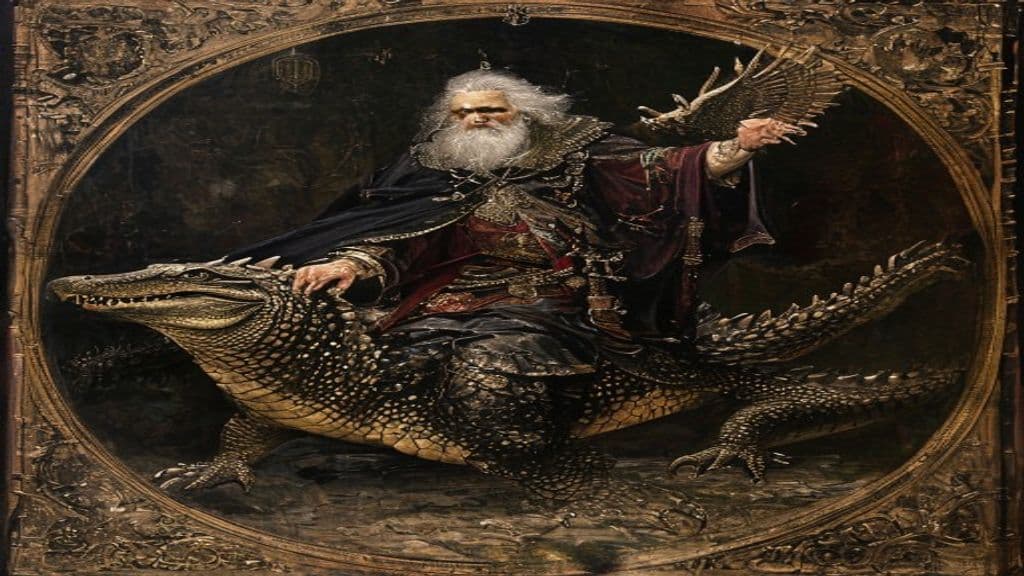
Agares does not have a single mythic origin narrated in the supplied materials; rather he is attested across multiple historical grimoire compilations where he appears as a catalogued operative in a ceremonial magical cosmology. He is listed among the named spirits in authorities such as the Pseudomonarchia Daemonum and the Lemegeton/Lesser Key of Solomon, appears in the Livre des Esperitz and Book of the Office of Spirits, is mentioned in the Grimoire of Pope Honorius and the Grand Grimoire (in which he is sometimes placed under different superiors), and features throughout manuscript collections such as Sloane MS 3824. In these sources he is assigned a rank (commonly a titled noble such as a duke), a directional jurisdiction (commonly the east / Oriens), and a commanded following of legions; those manuscript traditions collectively create his role as a named, serviceable spirit within the grimoire corpus rather than a single biographical origin tale.
Across the grimoire tradition Agares is most commonly described as an old man. Many compendia (notably the Lemegeton/Lesser Key and Pseudomonarchia Daemonum as summarized in reference works) add distinctive accoutrements: he is depicted riding upon a crocodile and bearing a hawk on his fist. Variant manuscripts alter these details: the Book of the Office of Spirits describes him riding a cockatrice (and omits the hawk), while the Grimoire of Pope Honorius and the Livre des Esperitz present briefer descriptions that omit the animal mount and reduce him simply to an old man. The supplied sources therefore record a stable core (an elderly male figure) with manuscript-dependent variations in mount and attendant bird of prey.
The grimoires as summarized in the supplied materials attribute a cluster of practical and disruptive functions to Agares. He is named as a spirit who teaches languages; who stops, locates, and retrieves runaway persons; who causes earthquakes; and who can grant noble titles. Legion counts attributed to him vary by source (the Lemegeton/Goetia and Pseudomonarchia give 31 legions, while the Livre des Esperitz gives 36), and some manuscripts connect him to treasure-guarding invocations. Sloane MS 3824 specifically references an "Experiment of Agares," a procedure intended to draw or bind him into a crystal, attesting to practices of invoking and containing him in material objects. Thomas Rudd’s schema (as reported) pairs Agares with the Shem HaMephorash angel Jelial as an oppositional correspondence in an angel–spirit balancing system.
Weaknesses
- ritualbinding and commanding via grimoire conjurations
- ritualoppositional angelic names (Shem HaMephorash correspondence: Jelial) — attested in Thomas Rudd's pairing
Wards
- ritualstandard ceremonial protections of grimoire evocation (circles, conjurations, sigils) — implied by grimoire context
- ritualcontainment in a material vessel (e.g., the Sloane MS 3824 "Experiment of Agares" to draw him into a crystal)
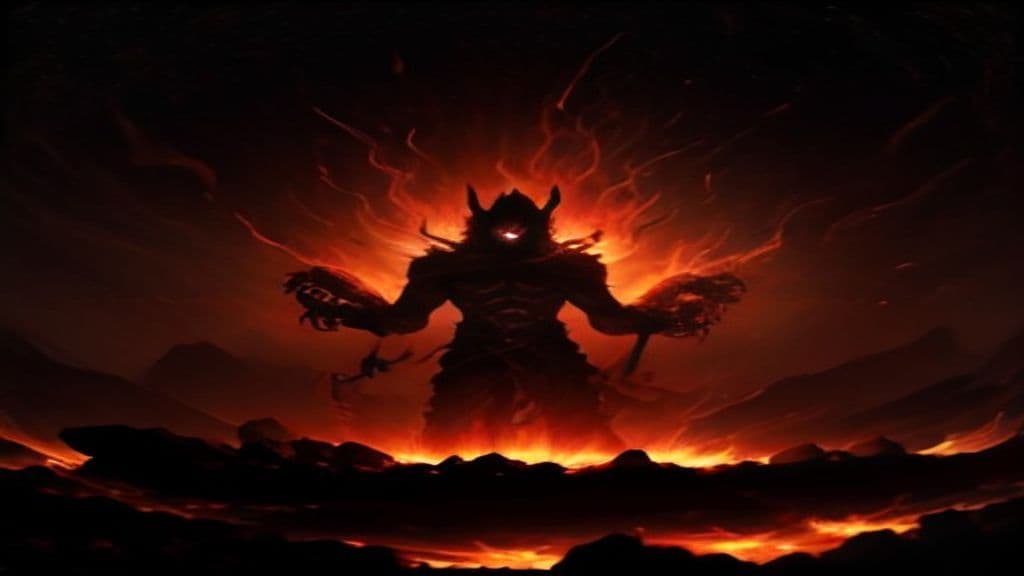
Ifrit
One of the most powerful classes of jinn in Islamic and pre-Islamic Arab tradition — a fire-born being of immense strength and cunning, capable of great works of engineering and terrible violence.
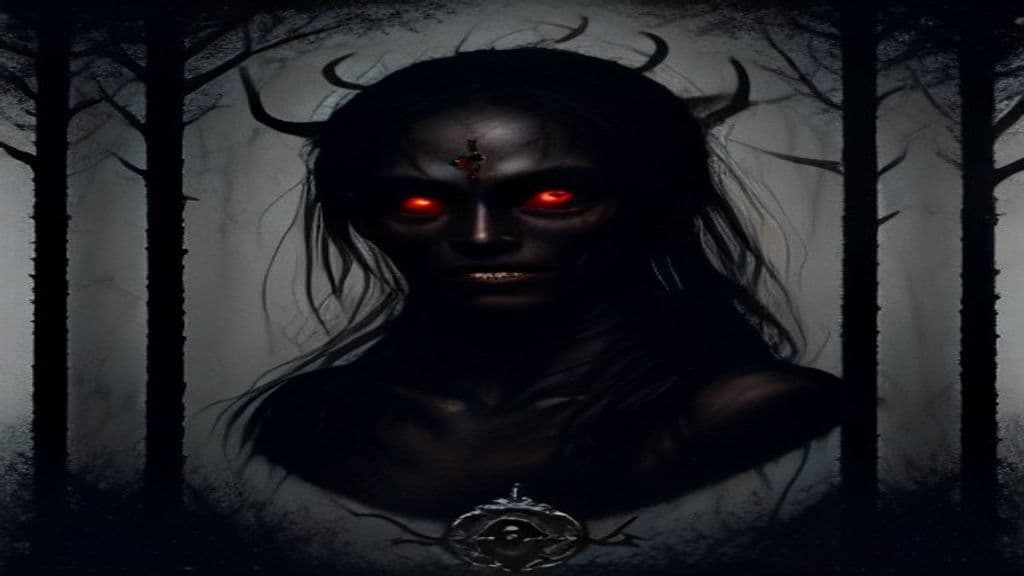
Pishacha
Flesh-eating spirits of Hindu mythology that haunt cremation grounds and are associated with disease, madness, and possession. The lowest class of demon in the Vedic hierarchy.

Pishach
Among the oldest classified demon-types in Hindu tradition — flesh-eating entities of the cremation ground first named in the Atharva Veda. The Pishach inhabits fresh corpses and possesses the living, causing the specific Ayurvedic condition of 'pishachabadha': madness, speaking in unknown languages, consuming impure things.
Strigoi
The vampire of Romanian folklore — either a living witch (strigoi viu) or an undead blood-drinker (strigoi mort). The source tradition from which the literary vampire emerged.

Banshee
A female spirit of Irish and Scottish folklore whose wail heralds an impending death in a family of Gaelic descent. Not a cause of death — a witness to it.
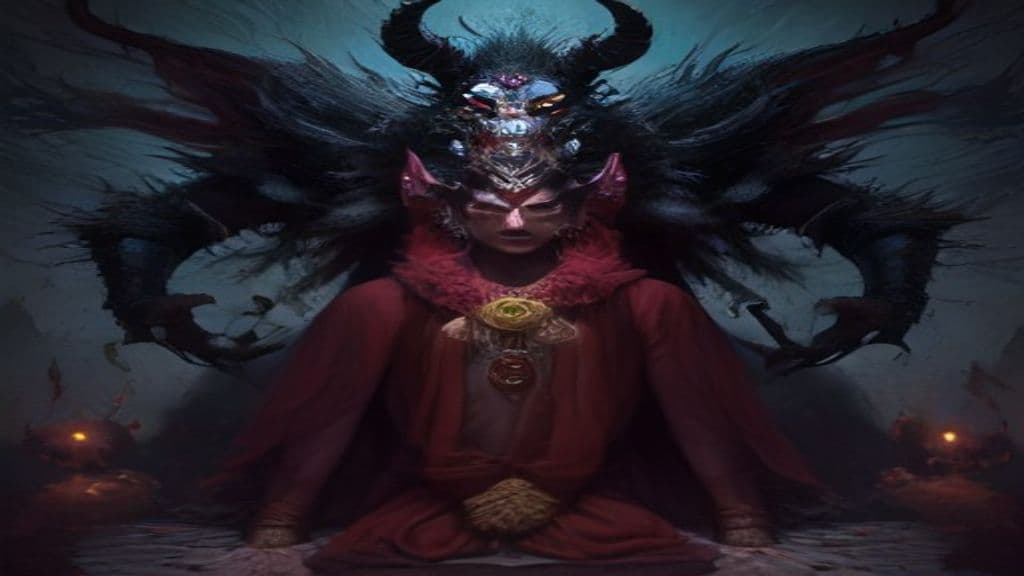
Rakshasa (Himalayan variants)
A Himalayan reception of the pan-Indian rakshasa motif: hostile or disruptive non‑human beings known from Sanskrit epic and Puranic literature, here noted where Himalayan sources and discussions intersect with the broader epic tradition. The supplied sources do not document distinct, well‑attested Himalayan folklore variants; the entry therefore presents primarily the epic/legendary profile as transmitted into Himalayan contexts in general references.
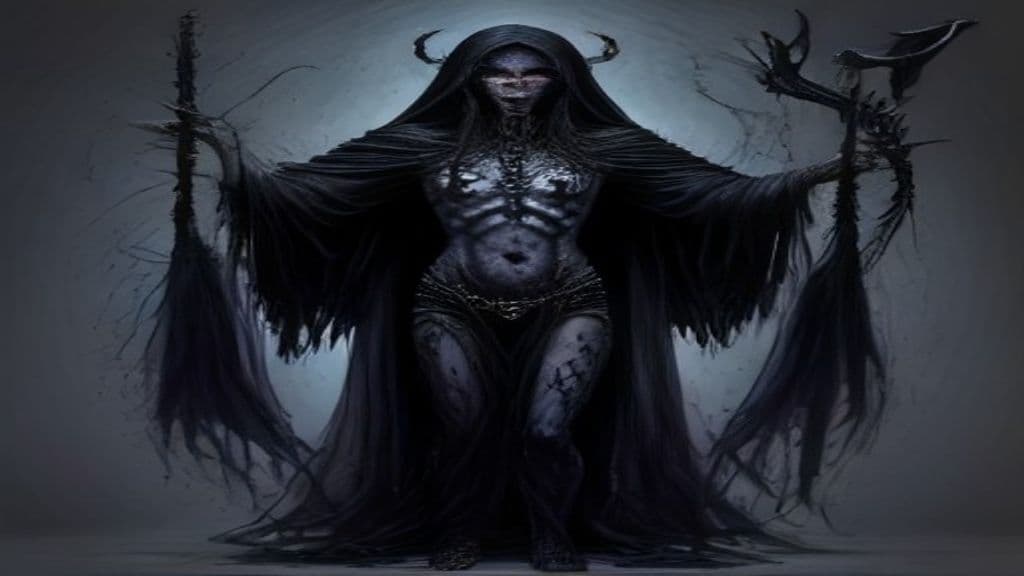
Ghoul
A ghoul is a demon-like or monstrous humanoid originating in pre-Islamic Arabian religion, traditionally associated with graveyards and the consumption of human flesh. The concept later entered broader folklore and has been widely reused and transformed in modern fiction and popular culture.

Baba Yaga
Baba Yaga is an ambivalent female figure of East Slavic folktale tradition, depicted variously as a fearsome, child-eating crone or as a helpful, maternal donor. She is associated with the deep forest, a hut described as standing on chicken legs, and the motific accoutrements of a mortar and pestle.
57 Mnemosyne
57 Mnemosyne is a large main-belt asteroid (S-type) discovered in 1859 and named after the Greek Titaness Mnemosyne. It is a non-sentient astronomical body studied for its orbital and rotational properties and has been used in dynamical measurements related to Jupiter.
Aamon
Aamon (also Amon) is a named spirit in early modern Western grimoire tradition (Pseudomonarchia Daemonum; the Ars Goetia / Lesser Key of Solomon). He is presented as a high-ranking infernal officer (Marquis/Prince) who governs forty legions and is credited with knowledge of past and future and with affecting human relationships (reconciling or procuring feuds and favor).
Abrahel
Abrahel is a demonological entity attested in early modern sources (notably Nicholas Rémy's Demonolatria as summarized in modern reference) portrayed as a female sexual spirit who seduced a man in 1581, induced him to kill his son, then restored the child to life in exchange for worship; the revival produced a diminished, foul-smelling corpse that later died again.
Abraxas
Abraxas (Abrasax) is a late‑antique Gnostic and magical name attested as a high-ranking cosmic power in heresiological summaries and as a potent name engraved on amulets (so-called Abraxas stones) in the Greco‑Roman magical milieu. Heresiologists associate Abraxas with rulership of 365 heavens and note the name's numerological value, while archaeological and papyrological contexts show its use as an amuletic formula.
Achamōth
Achamōth is a feminine emanational figure in certain Gnostic systems, attested as a daughter or subordinate aspect of the divine Wisdom, Sophia. She appears in ophitic/Naassene mythic genealogies where she is named as motherly/filial to lower, problematic figures such as Ilda‑Baoth; beyond this genealogical role the supplied sources record little concrete description or ritual material specific to her.
Adam Kadmon
Adam Kadmon (Hebrew: אָדָם קַדְמוֹן) is the Kabbalistic Primordial Man: a supra‑human, archetypal pattern or persona projected at the first stage of creation after God's contraction (tzimtzum). It is a metaphysical template corresponding to the highest aspect of divine intention and the sefirotic structure rather than a historical, corporeal individual.
Aedesia
Aedesia is a proper name attested in the supplied sources with three distinct referents: a fifth‑century Neoplatonic woman philosopher of Alexandria, a modern botanical genus (Aedesia O.Hoffm.) native to parts of West and Central Tropical Africa, and a reused toponym/moon name in a speculative fiction setting. None of the provided materials portray Aedesia as a supernatural being or attribute spiritlike powers to the name.
Aeon (Gnosticism)
In Gnostic religious systems an Aeon is a divine emanation or hypostasis that issues from the supreme divine source and together with other Aeons composes the Pleroma, the realm or fullness of divine reality. Aeons function as personified principles or powers (e.g., Nous, Sophia) that mediate between the ultimate One and lower levels of existence; their names, numbers, and relationships vary across Gnostic schools (Valentinian, Basilidian, Sethian, etc.).
Agaliarept
A named high-ranking spirit from post-medieval grimoire tradition, presented in the Grimoirium Verum and the Grand Grimoire as a commanding officer in a hierarchical host of spirits; credited with revealing secrets and commanding a legion, and cited in later printed occult imprints and modern fiction.
Agathos Daimon (Agathodaemon)
A beneficent household and civic daemon attested in classical Greek and Graeco‑Egyptian religion. In domestic Greece it is a household spirit honored with post‑meal libations; in Ptolemaic Alexandria it appears prominently in serpentine civic and household forms and is syncretised with various Egyptian protective and fate deities in late antiquity.
Agrippa
Agrippa is a polyvalent Latin personal name attested across Roman myth (a legendary king of Alba Longa), multiple historical figures (e.g., Marcus Vipsanius Agrippa, Agrippa Postumus, Herod Agrippa I & II), and a Renaissance occult author (Heinrich/Heinrich Cornelius Agrippa). The supplied sources treat Agrippa primarily as an onomastic label rather than a single, consistent supernatural entity.
Aiwass
Aiwass is the name given by Aleister Crowley to a discarnate intelligence that he reported as audibly dictating Liber AL vel Legis during three days in Cairo in April 1904. Crowley presents Aiwass as an objectively separate revelatory being, variously called the minister of Hoor‑paar‑kraat and later identified by Crowley with his Holy Guardian Angel.
Community Record
- [1]Agares — Wikipedia. Wikipedia entry summarizing grimoire attestations and variant manuscript descriptionswiki
- [2]Pseudomonarchia Daemonum / Lemegeton (summaries cited). Summarized entries for Agares in Pseudomonarchia Daemonum and the Lemegeton / Lesser Key of Solomon as reported in source notes (legion counts, appearance, functions).other
- [3]Livre des Esperitz / Book of the Office of Spirits (manuscript variants). Referenced manuscript variants describing Agares (e.g., Agarat, old man; cockatrice mount variant) as summarized in the supplied materials.other
- [4]Grimoire of Pope Honorius (entry: Agarus). Mentioned as a source that presents a briefer description omitting animal attributes and limiting functions.other
- [5]Sloane MS 3824 (Experiment of Agares). Manuscript noted to contain invocations for treasure-guarding spirits and an 'Experiment of Agares' to draw him into a crystal; cited in the supplied research notes.other
- [6]Grand Grimoire (hierarchical placement). Referenced as placing Agares as subordinate to Lucifuge Rofocale in that work's hierarchy (noted in the supplied materials).other
- [7]Thomas Rudd correspondence (angelic opposition: Jelial). Reported pairing of Agares with the Shem HaMephorash angel Jelial in Rudd's schema, as cited in the research notes.other
- [8]DuQuette & Hyatt — Aleister Crowley's Illustrated Goetia (modern commentary). Modern occult commentary treating Goetic spirits; listed among supplied sources though specific conjurations are not reproduced in the research notes.other