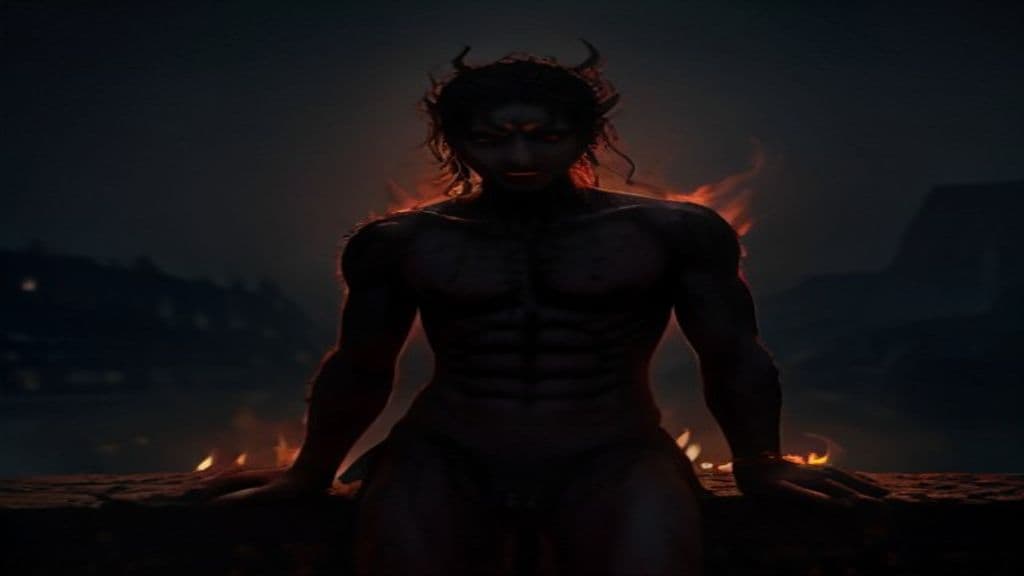
The Pishacha is one of the oldest classified supernatural entities in South Asian tradition, named in the Atharva Veda (c. 1200–1000 BCE) and receiving systematic treatment in the Mahabharata, which lists them alongside Rakshasas, Yakshas, and Gandharvas as one of the four major classes of supernatural being with distinct characteristics, territories, and relationships to humans.
In Ayurvedic medical tradition, 'pishachabadha' is a recognised clinical category — a form of severe mental disturbance caused by Pishacha possession, with specific symptoms, diagnostic criteria, and treatment protocols. The Charaka Samhita and Sushruta Samhita both describe pishachabadha, which positions the Pishach as simultaneously a supernatural and a medical entity — perhaps the earliest example of a being classified in both registers.
The Manu Smriti names 'pishachavivaah' as the worst of the eight forms of marriage — defined as intercourse with a sleeping or unconscious woman — giving the Pishach a specific association with violation of consciousness and will.
The Pishach is described in classical texts as dark, gaunt, with protruding ribs, blood-red or pale eyes, long matted hair, and skin the colour of ash or deep bruise. It feeds on flesh — particularly at cremation grounds — and is described as visible in firelight at the edge of pyres.
In folk tradition it is associated with specific sensory signatures: the sound of bones cracking with no visible source, a gurgling that resembles but is not quite human speech, and a smell that witnesses describe as rotting flowers — organic sweetness beneath decay.
The Pishach possesses people who are sleeping, unconscious, or in states of reduced volition. Ayurvedic texts describe pishachabadha symptoms with clinical precision: wild laughter alternating with violent rage, sudden dramatic changes in facial expression, speaking in unknown languages or in voices different from the patient's own, eating impure or dangerous things, attacking people without cause, and — notably — an inability to recognise family members.
The Pishach can also inhabit recently deceased bodies, causing them to show signs of continued activity. The Pishach Mochan tank in Varanasi — one of the oldest sacred sites in the city — is named for its function as a site where this entity's hold can be broken.
Weaknesses
- ritualPishachamocha Stotra recitation
- substanceSesame and mustard burned near the afflicted person
Wards
- ritualRitual bath at Pishach Mochan tank, Varanasi
- substanceWearing iron on the person, particularly when visiting cremation grounds
*Péh₂usōn (reconstructed)
Péh₂usōn is a hypothetical Proto‑Indo‑European pastoral guardian reconstructed by comparative scholars from parallels in Greek and Vedic traditions. Proposed as a Graeco‑Aryan ancestor‑figure, the reconstruction describes a protector of flocks, roads, and travellers rather than an attested historical cultic personality.
Aba (disambiguation / name-form)
Aba is a polyvalent name-form attested across many unrelated contexts (place names, personal names, animal names, and brief mythological listings). The provided sources do not support a single, coherent supernatural entity called "Aba" and offer no descriptive or ritual material for such a being.
Abandinus
Abandinus is a locally attested Romano‑Celtic theonym known from a single inscribed bronze feather (votive object) dedicated at Godmanchester (the Roman fort Durovigutum) in Cambridgeshire. Scholars interpret him as a local god or male spirit tied to a specific place and possibly associated with a nearby spring or stream; this association is tentative and based on etymological readings of the name.
Abarbarea
Abarbarea is a name attested in classical Greek and Roman sources for freshwater nymphs (naiads). The name appears for at least two individual mythic figures — a naiad wife of Bucolion and a naiad counted among ancestors of the Tyrians — and Hesychius records plural forms that may indicate the name was also used as a class-name (Abarbareai / Abarbalaiai).
Abas
Abas (Ancient Greek: Ἄβας, gen.: Ἄβαντος) is not a single mythic being but a recurring personal name borne by multiple mortals and minor mythic figures in Greek epic and genealogical traditions — kings, founders, seers, warriors, attendants, a centaur, and a youth transformed by a goddess. The name is glossed in the sources as 'guileless' or 'good-hearted' and appears across Argive, Theban, Trojan, Euboean, and other local cycles.
Abderus
Abderus (Ancient Greek: Ἄβδηρος, romanized Ábdēros) is a mortal heroic figure in Greek myth closely associated with Heracles, remembered as the youth left in charge of the Mares of Diomedes who was killed by them. He functions as an eponymous local/divine-hero ancestor for the city of Abdera and received funerary commemoration and athletic agones at his tomb.
Abellio
Abellio is a theonym attested in Roman‑period inscriptions from the Comminges area of the Pyrenees and reported as worshipped in the Garonne Valley of ancient Gallia Aquitania. Surviving evidence is limited to a small number of inscriptions; scholars have variously hypothesized solar or arboreal associations and compared the name to forms of Apollo or to Celtic Belenus, but the deity's precise role in local cosmology remains uncertain.
Abhimanyu
Abhimanyu is a youthful Kuru/Pandava warrior-hero in the Sanskrit epic Mahābhārata. Son of Arjuna and Subhadra, he is famed for entering the Chakravyuha battle formation on the thirteenth day of the Kurukshetra War and dying at age sixteen; his posthumous son Parikshit continues the Kuru line.
Abnoba
Abnoba is a Gaulish theonym and toponym attested in Roman-era sources and inscriptions: a localized deity associated with woods, springs and the sources of rivers (notably the Danube) and simultaneously the name applied to a mountain or mountain range in the Black Forest/Baar/Odenwald region. Roman altars equate her with Diana, reflecting syncretic cult practice in frontier provinces.
Abomination of Desolation
An apocalyptic prophetic phrase originating in the Book of Daniel designating a profaning thing or act that renders the Jerusalem Temple cult desolate; later reused in the Synoptic Gospels as an eschatological sign prompting urgent flight. The term denotes ritual/cultic impurity (Hebrew shiqquts) and is variously interpreted as pagan offerings or altar, a foreign cult statue, or (in some New Testament readings) an acting agent.
Aborigines (mythology)
A mytho-historical label used in Roman and general reference sources to denote the oldest inhabitants of a region (specifically central Italy in the cited Roman context). The term functions as an identity/category for original human populations rather than as a characterized supernatural being in the provided sources.
Absyrtus
Absyrtus (Ancient Greek: Ἄψυρτος) is a Colchian prince in the Greek Argonautic cycle, son of King Aeëtes and brother or half-brother of Medea. He appears in variant traditions either as a companion taken by Medea during her flight with Jason and murdered/dismembered to delay pursuit, or as a pursuer sent by Aeëtes who is overtaken and slain by Jason; his death functions as a key narrative device in the escape from Colchis.
Masaan is a cremation-ground spirit, specifically associated with the ash and bones of the dead — its domain is the burning ghat. Pishach is a flesh-eating demon of a broader class; it haunts battlefields, forests, and crossroads, not only cremation grounds.
Community Record
- [1]Pishachabadha in the Charaka Samhita. Sharma, P.V. (trans.). (1981). Caraka Samhita, Vol. 2. Chaukhamba Orientalia, Varanasi.academic
- [2]Pishacha in Vedic and Epic literature. Hopkins, E.W. (1915). Epic Mythology. Karl J. Trübner, Strassburg.academic
- [3]Pishacha — Wikipedia. Wikipedia contributors. Pishacha. Wikipedia, 2024.wiki