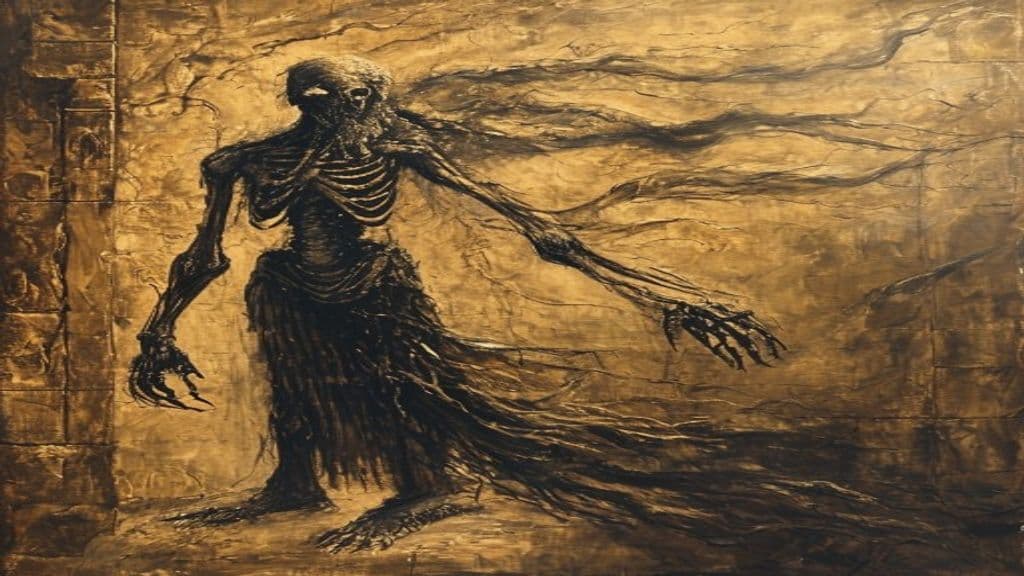
In Mesopotamian belief edimmu belong to a class of spirit-beings (utukku/utukkus) and are specifically the restless dead produced when a corpse was not buried properly or when funerary obligations were neglected. Sources present the term (Akkadian eṭemmu) as referring to the spirits of the dead; when burial or rites were omitted the deceased became an edimmu, remaining active in the world and turning hostile toward the living. Modern renderings sometimes conflate spellings (edimmu/ekimmu), but the consistent conceptual origin across sources is funerary neglect producing a wandering, vengeful dead-spirit within the utukku taxonomy.
Classical description in the provided sources emphasizes incorporeality: edimmu are ‘completely or nearly incorporeal, “wind” spirits’ rather than solid corpses. In later modern and gaming sources their depiction varies widely — examples include skeletal, wind-lashed figures cloaked in tatters (Pathfinder / fandom descriptions), bat- or vampiric-like opponents in some video games, or undead-styled monsters in RuneScape — but these are explicitly derivative portrayals distinct from the traditional, insubstantial characterization (sources: Wikipedia; Pathfinder fandom; RuneScape wiki; game/fiction references).
Reported abilities and behaviors in the sources center on harm to the living arising from their status as restless dead: edimmu were thought to cause disease, to inspire criminal or antisocial impulses in people, and to 'suck the life out' of susceptible individuals or those who were sleeping. They could possess people in cases where taboos were broken (a cited example is failure to respect prohibitions such as eating ox meat). Because they are portrayed as insubstantial 'wind' spirits, their mode of damage is typically described in terms of life-draining and affliction rather than overt physical manifestations; sources also record that they might sometimes be appeased by funerary libations or repasts.
Weaknesses
- conditionproper burial of the dead
- conditionobservance of taboos (reduces provocation/possession risk)
Wards
- ritualfuneral repasts / libations
- conditionfulfillment of funerary obligations

Jiangshi (hopping corpse)
A jiangshi (jiāngshī, 僵尸) is a reanimated human corpse in Chinese popular belief and media that moves with a stiff, hopping gait and is commonly depicted in modern sources as subject to control or containment by Taoist priests using talismans and ritual implements. The contemporary image is heavily shaped by Hong Kong cinema, which standardizes visual motifs (Qing robes, yellow fulu, glutinous rice) and priestly intervention.

Preta (Hungry Ghost)
A post-mortem supernatural being associated with extreme, unremitting hunger and thirst. In Hindu usage the Sanskrit term can mean a deceased person, while Buddhist traditions develop the category into a distinct realm of hungry spirits whose condition illustrates karmic consequences for demeritorious action.
'Ain Samiya Goblet
Silver cup from the Middle Bronze Age I, discovered in a tomb at Ain Samiya. (Note: 1. Power tier should be "None", but add a note explaining that historical artifacts don't fit into the typical power tier classification. 2. Add a description of its appearance based on it being a sil)
A'annepada
A'annepada (Sumerian cuneiform 𒀀𒀭𒉌𒅆𒊒𒁕; also romanized Aanépàdda) is attested as a historical ruler of the First Dynasty of Ur, flourishing c. 2350 BC. He is recorded in dedicatory and foundation inscriptions as king of Ur and as son of Mesannepada, credited with temple-building and dedication to deities such as Ninhursag and Inanna.
Abu
Abu is a poorly understood Mesopotamian god attested in modern reference summaries. Secondary literature tentatively links him with vegetation and snakes and records that he was often paired with a deity written gu2-la2, but primary details about his cult, iconography, and myths are lacking in the cited sources.
Abzû
Abzû (Sumerian abzû; Akkadian Apsû) is the primordial freshwater abyss in Sumerian–Akkadian cosmology: the deep fresh waters that underlie and surround the earth, source of springs, rivers and ritual holy waters, and a creative principle whose mingling with the salt sea (Tiamat) figures in Mesopotamian cosmogony.
Abī-simtī
Abī-simtī (also rendered Abi-simti, Abisimti) is a named woman attested in third-millennium BCE Mesopotamian documentary and literary texts. She appears in administrative account records as a provider of animals and donor to temple cults and in Sumerian love-song literature as the named beloved/consort addressed by a royal speaker.
Adad
Adad (also Hadad, Haddad; Sumerian Iškur) is the storm- and rain-deity attested in ancient Mesopotamian and Canaanite religious contexts. Sources identify him as a principal weather god whose domain is storms and rainfall and whose name appears across multiple Near Eastern languages and sites, including Ebla (as Hadda, c. 2500 BCE).
Adapa
Adapa is a mythic figure from ancient Mesopotamian (Sumerian and Akkadian) literature: a mortal fisherman and temple sage of Ea at Eridu endowed with exceptional wisdom. He appears in a fragmentary tale in which he breaks the wings of the south wind and is summoned to the divine court; his name was later invoked in exorcistic and ritual contexts as an authoritative identity.
Adonis
Adonis is a mythic mortal youth in ancient Greek tradition, beloved by goddesses (notably Aphrodite and Persephone) whose death and seasonal return are the focus of the women’s midsummer festival Adonia. The cultic practices—planting short-lived 'gardens of Adonis' on rooftops, ritual lamentation, and casting an effigy and withered plants into the sea—symbolically link him to vegetation cycles and Near Eastern dying-and-regenerating god traditions.
Adrammelech
Adrammelech is attested in ancient Semitic textual tradition as a local god of 'Sepharvaim.' The name is commonly glossed as "Magnificent king." In modern times the name has been reused in diverse fictional, musical, and online contexts, but those are creative reworkings rather than continuations of the brief ancient attestation.
Aga of Kish
Aga of Kish (Aga, Agga, Akka) is an Early Dynastic Mesopotamian king recorded in the Sumerian King List, the Tummal Inscription, epigraphic objects, and the Sumerian poem "Gilgamesh and Aga." He functions in texts as a historical/legendary political actor who attempted hegemonic demands on Uruk and was ultimately captured and released by Gilgamesh.
Agasaya
Agasaya is presented in modern secondary sources as a little-attested Semitic war goddess who, according to some summaries, was later absorbed as the warrior aspect of the major Mesopotamian goddess Ishtar. The attestation in available materials is sparse and much inferences about her name, attributes, and later influence are explicitly marked speculative in those sources.
Agum II (Agum‑Kakrime)
Agum II (called Agum‑Kakrime in the inscriptionary tradition) is a Kassite-era Babylonian king known from the Agum‑Kakrime Inscription and later copies. He appears in Akkadian inscriptional and king-list traditions as a royal restorer who recovered and reinstalled the cult statue of Marduk and refurbished the É-sagila, presenting himself as a legitimate shepherd‑king and temple benefactor.
Community Record
- [1]Edimmu — Wikipedia. Wikipedia, 'Edimmu' (summary of Mesopotamian tradition and later adaptations)wiki
- [2]Edimmu — Wikidata. Wikidata entry for Edimmuwiki
- [3]Edimmu — The RuneScape Wiki. RuneScape Wiki entry describing in-game edimmu monsters and mechanicswiki
- [4]Killing edimmu - The RuneScape Wiki (Money making guide). RuneScape Wiki guide referencing edimmu as game creatureswiki
- [5]Edimmu | Pathfinder Wiki | Fandom. Pathfinder fandom entry describing a game adaptation of the edimmuother
- [6]Vampire Vednesdays: Edimmu – Into the Wonder. Blog post summarizing modern/vampiric treatments of edimmu in fictionother
- [7]Final Fantasy XIII: Mission 05 - Joyless Reunion (Edimmu) - Jegged.com. Game reference to an edimmu-named enemy in Final Fantasy XIIIother
- [8]Edimmu | ANZV | Edged Circle Productions. Modern creative work using the edimmu nameother
- [9]Edimmu | Megami Tensei Wiki. Megami Tensei Wiki summary stating eṭemmu/Eṭemmu refers to spirits of the dead and describing edimmu/ekimmu as nearly incorporeal wind spirits that drain life and originate when the dead are not buried properly.wiki
- [10]Edimmu | Megami Tensei Fandom. Fandom entry summarizing edimmu/ekimmu as spirits of the dead produced by improper burial and describing vengeful, life-draining behavior and appeasement by funerary offerings.wiki
- [11]Underworld - Wikipedia (entry excerpt provided in research notes). "The underworld, also known as the netherworld or hell, is the supernatural world of the dead in various religious traditions and myths, located below the world of the living. Chthonic is the technical adjective for things of the underworld.","Notes on sources and limitations" (excerpt).wiki