
Across the cited sources Pretas are presented not as a single origin myth but as a karmic rebirth-state within Indic and East Asian cosmologies: beings reborn as Pretas suffer from intensified appetites (craving) and an inability to assuage them, consequences of past actions and attachment. The Mulian narrative (an elaboration of the Yulanpen Sutra) provides a ritual-historical working example in which a filial practitioner (Mulian) petitions the Buddha and organizes offerings and monastic participation to transfer merit and relieve his mother's suffering—linking moral conduct, filial duty, and remedial ritual to the condition and remediation of Pretas (Wikipedia: Preta; Mulian Rescues His Mother).
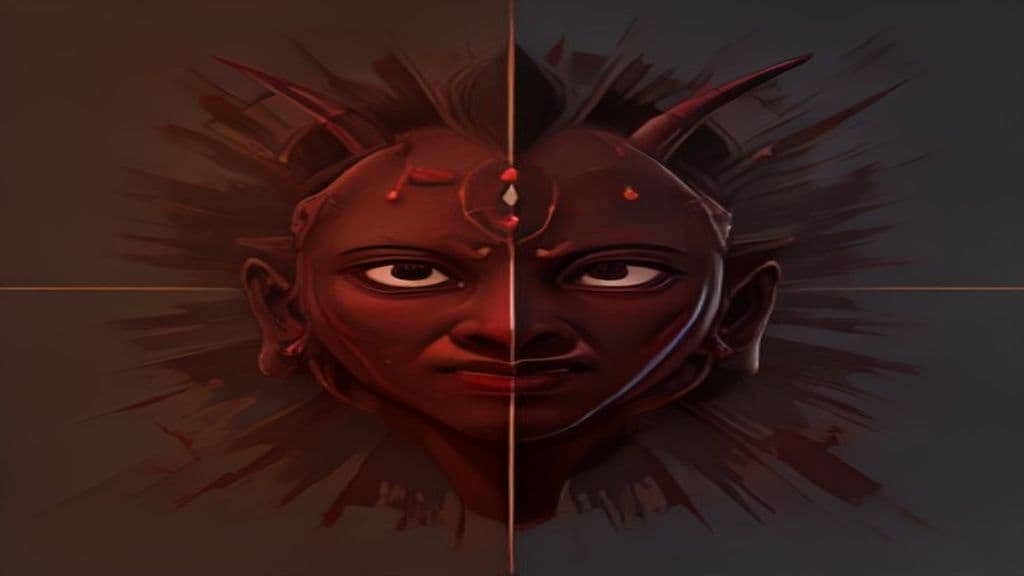
The supplied sources emphasize the experiential suffering of Pretas rather than offering a single, consistent canonical physical description. Modern summaries and popular accounts often depict hungry-ghost motifs (emaciation, inability to ingest food, grotesque appetites), but the primary materials in the supplied corpus foreground the being's extreme hunger and thirst and its role as a model of postmortem suffering rather than a standardized iconographic anatomy. Consequently, descriptions in the sources prioritize the condition (insatiable craving) and moral significance over a single fixed physical form.
Pretas are characterized primarily by the behavioral condition of unending hunger and thirst that cannot be satisfied. Sources describe their suffering as greater than that of humans, centered on extreme appetites; Buddhist didactic texts situate this condition as the fruit of demeritorious actions (akusala), making the Preta both a consequence of karma and a pedagogical example. Secondary materials summarize folkloric motifs—fixation on particular substances or corrupt desires producing specific cravings—but the supplied primary overview emphasizes the general incapacity to be sated and the moral causation rather than a catalogue of supernatural powers or varied abilities.
*Péh₂usōn (reconstructed)
Péh₂usōn is a hypothetical Proto‑Indo‑European pastoral guardian reconstructed by comparative scholars from parallels in Greek and Vedic traditions. Proposed as a Graeco‑Aryan ancestor‑figure, the reconstruction describes a protector of flocks, roads, and travellers rather than an attested historical cultic personality.
Abhimanyu
Abhimanyu is a youthful Kuru/Pandava warrior-hero in the Sanskrit epic Mahābhārata. Son of Arjuna and Subhadra, he is famed for entering the Chakravyuha battle formation on the thirteenth day of the Kurukshetra War and dying at age sixteen; his posthumous son Parikshit continues the Kuru line.
Acala
Acala (Sanskrit: अचल, 'The Immovable') is a wrathful protective deity (dharmapala) in Vajrayāna and East Asian esoteric Buddhism, classed among the Wisdom Kings (Vidyārāja). He functions as a ritual focus for visualization and mantra practice intended to remove obstacles and bind or destroy hostile forces.
Acalanātha (Acala / Achala)
Acalanātha (also Acala or Achala) is a wrathful deity and dharmapāla — a protector of the Dharma — prominent in Vajrayana and East Asian Mahayana Buddhist contexts. Presented as a fierce, non‑human or semi‑divine protector-figure, Acalanātha functions to defend the teaching and practitioners by removing obstacles and confronting threats to the transmission and practice of Buddhism.
Achyuta
Achyuta (Sanskrit: अच्युत, acyuta) is primarily an epithet/theonym in Vaishnava Hindu tradition applied to Vishnu and Krishna, signifying the divine quality of being 'not fallen' — immutable, infallible, and imperishable. It functions as a devotional name in scripture, liturgy, and Pancharatra lists of divine emanations rather than as an autonomous folkloric spirit.
Acintya
Acintya is an Indonesian Hindu theological-symbolic representation of the ineffable supreme divine principle. In Balinese and Javanese practice it functions as a way to make ultimate reality present in ritual and art—often aniconically as an empty throne (padmasana) or anthropomorphically as a naked, flame-surrounded figure—rather than as a narrative, intervening deity.
Adi (asura)
Adi is attested in modern reference works as the name of an Asura who 'appears in the Matsya Purāṇa.' Beyond this single-line citation in secondary sources, no descriptive material about the figure is provided in the supplied research notes.
Adi Shakti
Adi Shakti (also Adi Parashakti, Mahadevi, Adya Shakti) is the primordial feminine power in Hindu/Shakta theology, regarded as the ultimate reality (Para Brahman) and the source from which all goddesses and gods manifest. She is both an impersonal cosmic principle (Mulaprakriti) and a focus of devotional invocation in temples, mantras, and pilgrimage sites such as Shakti Peethas.
Adi Vinayaka
Adi Vinayaka (Ādi Vināyaka; also called Nara Mukha Vinayaka) is a named iconographic and devotional form of the Hindu god Ganesha portraying the deity with a human head, described in sources as the form before the episode of decapitation by Shiva. It is rarely worshipped and appears in a small number of South Indian shrines and in devotional/musical repertoires.
Aditi
Aditi is a major Vedic goddess in Hindu tradition who personifies the boundless, infinite cosmic principle and functions as the maternal matrix from which many celestial deities (the Ādityas and other groups) are born. In the Vedic hymns she is invoked as a protective liberator who guards petitioners, provides wealth and safety, and frees devotees from hindrances such as sin and sickness.
Agastya
Agastya (also Agathiyar/Agasti) is a revered Vedic and later-period Indian rishi (sage) figure credited in textual traditions as an inspired seer, ascetic, teacher, culture-founder, and attributed author of Vedic, Puranic and Tamil works; in South Indian tradition he is associated with origins of Tamil grammar and Siddha medicine and is identified astronomically with the star Canopus.
Aghasura
Aghasura is an asura from the Vaishnava/Hindu narrative tradition (notably the Srimad‑Bhāgavatam) who, at the command of Kamsa, assumed the form of a vast serpent to ambush Kṛṣṇa and the cowherd boys in Vṛndāvana. The episode demonstrates Kṛṣṇa’s protective, divine power as he enters and destroys the demon from within.
Community Record
- [1]Preta (Wikipedia). "Preta, also known as hungry ghost, is the Sanskrit name for a type of supernatural being described in Hinduism, Buddhism, Taoism, and Chinese folk religion as undergoing suffering greater than that of humans, particularly an extreme level of hunger and thirst."wiki
- [2]The Eight Great Hells and the Realms of Woe (Archive). The book "provides a vivid, systematic, and analytical journey through the Eight Great Hells (Ata Mahā Niraya) and the sub-realms of woe, including the Animal, Preta (Hungry Ghost), and Asura realms. Exploring the immutable laws of Karma, this text serves as a powerful spiritual mirror reflecting the harrowing consequences of demeritorious actions (Akusala)."literary
- [3]Pretas (Old European Culture blog). The Sanskrit word "preta" (प्रेत) literally means "departed, deceased, a dead person" derived from ... (entry on Pretas).folk
- [4]The Horror!: Hungry Ghosts, Fall Holidays, and More (New Books Network Substack). Discussion noting cultural attention to hungry-ghost figures and the Hungry Ghost Festival among fall-holidays roundups.other
- [5]Preta - New World Encyclopedia. Entry noting Pali form 'peta' and summarizing the Preta concept in Buddhist and South Asian contexts.wiki
- [6]Preta | Megami Tensei Wiki | Fandom. Modern popular-culture summary referencing folkloric motifs (greedy, jealous, or corrupted people producing insatiable appetites) and cross-cultural name-forms (E-gui, Gaki, Yidak).other
- [7]The Buddhist Path to Liberation. Bhikkhu Bodhi. 2000. The Connected Discourses of the Buddha. Wisdom Publications.academic
- [8]Ancestors and Spirits in the Hindu World. Parry, Jonathan. 1994. Death in Banaras. Cambridge University Press.academic
- [9]Bhoota (ghost) — Wikipedia. Wikipedia contributors, 'Bhoota (ghost)', Wikipedia, The Free Encyclopedia, https://en.wikipedia.org/wiki/Bhoota_(ghost)wiki
- [10]Mulian Rescues His Mother. Wikipedia entry 'Mulian Rescues His Mother' — describes the tale as an elaboration of the Yulanpen Sutra and its role in ritual merit-transfer (Ullambana/Ghost Festival contexts).wiki
- [11]Hungry Ghost (Preta) in Burma. USC Digital Folklore Archives — oral account (collected 10 November 2011) documenting contemporary Burmese storytelling and lived religious reference to hungry ghosts and ritual practice.folk
- [12]Everywhere (archive entry linking collected materials). Archive collection referenced in the supplied materials (contextual/collection-level source in the dataset).other
- [13]Are the Gray Aliens Hungry Ghosts? (podcast episode). Contemporary interpretive audio episode raising analogies between hungry-ghost concepts and modern anomalistic phenomena (included among supplied sources as a modern reinterpretation).other