
The earliest known published account of Edward Mordake appears in an 1895 Boston Post article by fiction writer Charles Lotin Hildreth; that sensational item presented Mordake as an example among 'human freaks.' The story was reproduced and elaborated in the 1896 miscellany Anomalies and Curiosities of Medicine, which supplied the most widely circulated picturesque details (the second face female, malignant, whispering of hellish things, Mordake heir to an English peerage). The narrative claims doctors refused to remove the face, that Mordake begged that the face be destroyed before burial 'lest it continues its dreadful whisperings in my grave,' and that he died young (accounts vary between age 22 and 23). Modern archival and critical treatments classify the tale as apocryphal or a hoax, note the lack of corroborating civil or medical records, and observe that some institutional details in the original retellings (for example references to a 'Royal Scientific Society') were likely fictional or fabricated.
In the sensational accounts reproduced in late-19th-century print, Edward Mordake is described as a handsome, well-educated young English gentleman whose natural face is attractive and whose back-of-head anomaly is 'another face' occupying part of the posterior skull. That second face is variously described as female in aspect—'lovely as a dream, hideous as a devil'—with eyes and lips that could express emotions independently (sneering while Mordake was happy, smiling while he wept). The printed narrative reports that the posterior face's eyes tracked observers and its lips 'gibbered without ceasing.' The story presents this morphology as congenital; later commentators note medical conditions such as craniopagus parasiticus, diprosopus, or a parasitic twin only as modern retrospective hypotheses rather than claims documented by the original sources.
The capacities attributed to the posterior face are narrative attributions from the sensational sources: it reportedly made independent facial expressions, its eyes followed onlookers, its lips moved or 'gibbered,' and, critically in the tale, it whispered to Mordake at night 'of such things as they only speak of in Hell,' depriving him of rest and driving him to seclusion and eventual suicide. The accounts also state Mordake sought surgical removal but that 'no doctor would attempt it.' There is no empirical documentation beyond the published anecdote to substantiate literal agency or supernatural capacities.
Weaknesses
- othermedical/surgical removal (narrative request)
- otherdestruction of the face before burial (Mordake's request)
Wards
- otherpre-burial destruction or concealment (individual request)

Futakuchi-onna
Futakuchi-onna (二口女, ふたくちおんな; "two-mouthed woman") is a Japanese yōkai characterized in folktales by an otherwise ordinary woman who bears a second, functional mouth on the back of her head beneath her hair. Stories commonly present the second mouth as a supernatural condition associated in narrative causation with stinginess, neglect, or injury.
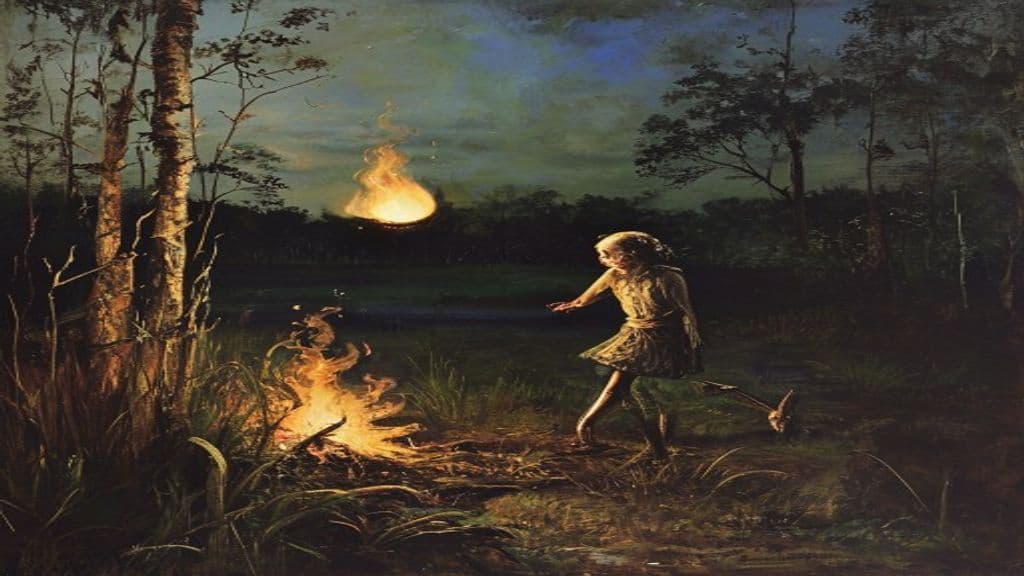
Will-o'-the-wisp
An atmospheric 'ghost light' — a small, mobile, lamp-like light seen at night over marshes, bogs, wet ground, or graveyards. In many cultures the phenomenon is interpreted as a supernatural being or manifestation (wandering nature-spirit, soul of the dead, transformed witch, or treasure-indicator); modern science offers chemiluminescent explanations for some occurrences.
3-D Man
3-D Man is a Marvel Comics superhero identity associated with a 1950s-era origin in which the body of Chuck Chandler can materialize in three-dimensional existence when activated by his brother Hal via a pair of glasses. The mantle was later assumed by Delroy Garrett (formerly Triathlon) in modern continuity.
5 Ronin
5 Ronin is a 2011 Marvel Comics five-issue limited series that reimagines five Marvel superhero archetypes as rōnin (masterless samurai) in a fictionalized post‑Sekigahara feudal Japan. The work places Wolverine, Hulk, Punisher, Psylocke, and Deadpool analogues into period roles to explore displacement, revenge, and identity in an era of political upheaval.
58 Concordia
58 Concordia is a fairly large main-belt asteroid orbiting the Sun, discovered in 1860 and named after the Roman goddess Concordia. Astronomical sources classify it as a C-type (carbonaceous) body with a multi-year orbital period and measurable rotation and pole orientations.
9MOTHER9HORSE9EYES9
An anonymous Reddit screen name and online persona used by the author of the Interface series, a multipart speculative-horror narrative posted in short installments across Reddit in 2016. The name functions as the signature of an authorial identity and as a focal label for a fandom that created archives, a subreddit, and a wiki documenting the story and its fictional phenomena (notably entities called "flesh interfaces").
A Elbereth Gilthoniel
An Elvish hymn in Sindarin addressed to Elbereth (Varda) from J. R. R. Tolkien's legendarium. Presented in The Lord of the Rings and later musical and dramatic adaptations, the hymn functions as devotional poetic language that evokes Elvish reverence for the star-kindler rather than an independent supernatural agent.
A.R.G.U.S.
A.R.G.U.S. is a fictional clandestine United States government agency in the DC Comics universe that investigates, contains, and manages superhuman, meta-human, and supernatural incidents and assets. Introduced in The New 52 continuity, it functions as an institutional actor providing intelligence, logistical support, covert task forces (notably Task Force X / the Suicide Squad), and a dedicated magic division across comics and media adaptations.
Abdiel
Abdiel (Hebrew עֲבְדִּיאֵל) is primarily a theophoric Hebrew personal name meaning "servant of El/servant of God," attested once in the Hebrew Bible (1 Chronicles 5:15). In later literature—most notably John Milton's Paradise Lost—Abdiel is reimagined as a faithful seraph who opposes Satan's revolt. The provided sources do not treat Abdiel as an autonomous folkloric spirit type or record rituals or wards associated with the name.
Abena Mansa
A name attested in a single contemporary Ghanaian blog anecdote as a 'mysterious being'; available sources do not establish Abena Mansa as a coherent, traditional supernatural figure or provide corroborating ethnographic detail.
Abiel
Abiel is attested in the supplied sources only as a male given name — borne by several historical American individuals and listed as two minor biblical figures. The provided materials contain no evidence presenting Abiel as a supernatural, mythological, or folkloric entity.
Abigail
Abigail is a female figure in the Hebrew Bible portrayed in 1 Samuel 25 as the intelligent and beautiful wife of Nabal who intervenes to prevent David from committing violence; later tradition regards her as one of the Tanakh's seven female prophets and as a model of beauty and wisdom.
Abin Sur
Abin Sur is a fictional extraterrestrial Green Lantern from the planet Ungara in DC Comics. A former history professor turned Green Lantern of Space Sector 2814, he discovered and investigated a prophecy tied to the "Blackest Night," died wounded on Earth and chose Hal Jordan as his ring-successor, and was later reanimated as a Black Lantern in the Blackest Night storyline.
Abishai
Abishai is a personal name attested in several distinct sources: a biblical individual described as the eldest son of Zeruiah (sister of King David); a Semitic chief named in an inscription at Beni-Hasan in Middle Egypt; and modern cultural uses including a named monster in Dungeons & Dragons and as an artist/stage name. The supplied materials do not present Abishai as a supernatural being within a living cosmology.
Community Record
- [1]Edward Mordake. Wikipedia: 'Edward Mordake' entry (summarizing the 1895 Boston Post article and the 1896 Anomalies and Curiosities of Medicine reproduction; discusses hoax status)wiki
- [2]Wikidata: Edward Mordake. Wikidata item for Edward Mordake (authority/identifier record linking related resources)other
- [3]Archive: Short Stuff — Edward Mordake. Archive summary and audio discussing Edward Mordake and the persistence of the tale as an urban legendother
- [4]Hoaxilla #303 – Edward Mordrake. Podcast episode analyzing the Edward Mordake story and treating it as a hoax/urban legendother
- [5]Desmistificando - Edward Mordake. Archive program discussing and debunking the Edward Mordake narrativeother
- [6]Anomalies and Curiosities of Medicine (1896) — entry reproduced from contemporary press. Reproduction/summary of the 1896 miscellany entry that popularized the detailed version of the Mordake anecdoteliterary