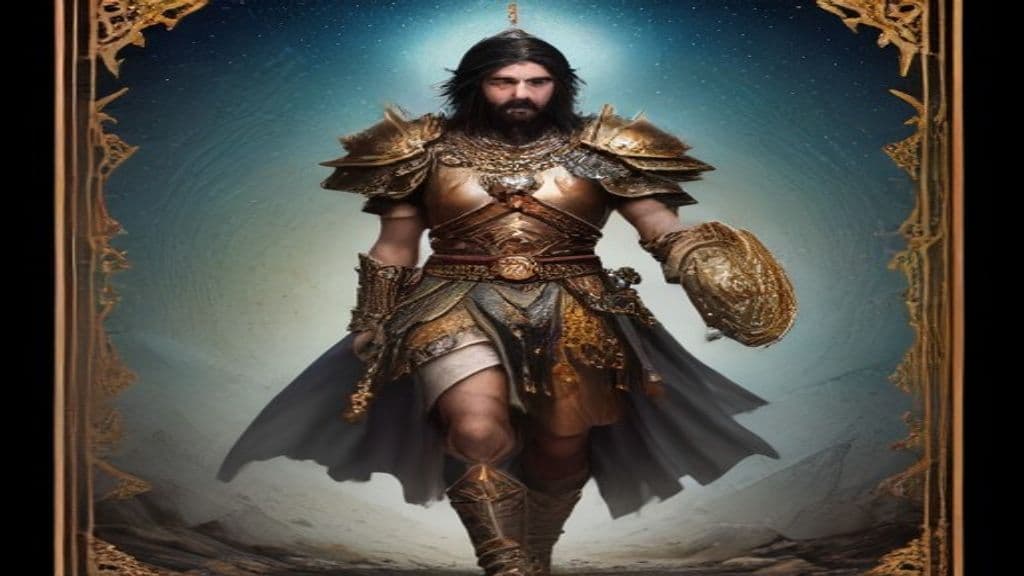
Esfandiyār appears in the Shahnameh as a Kayanian crown prince whose name derives from Middle Persian Spandadāt (Avestan Spəntōδāta-, 'Given by Spenta Armaiti'). In the epic he is closely associated with the spread and support of Zarathustrian religion: the prophet Zarathustra gives him a chain, heavenly armor, and a divine blessing that mark him as a sacredly endorsed royal champion. His narrative role situates him in the mytho-historical past of ancient Iran as an instrument of royal and religious authority.
Textual sources emphasize Esfandiyār’s princely and martial presentation rather than precise anthropological detail. He is portrayed wearing or possessing the heavenly armor and carrying the chain bestowed by Zarathustra; these items are central visual markers. Manuscript and miniature traditions (e.g., the Great Mongol/Demotte Shahnameh and Safavid illustrations) repeatedly depict him in regal, martial guise — often helmeted and armed — though the narrative does not record standardized specifics of height, hair, or ordinary dress beyond his regalia and warrior accoutrements.
Within the Shahnameh narrative Esfandiyār is a supremely capable warrior whose role is framed as divinely supported. Zarathustra’s gifts are said to make him invulnerable in combat and to provide a chain that can bind even demons or evil magicians, according to the epic. He undertakes seven labors—killing monstrous wolves and lions, slaying a dragon and a wicked enchantress, killing a Simurgh and its two offspring, surviving a three-day storm, and crossing a desert—that demonstrate prowess against both natural and supernatural foes. Despite his stated invulnerability, the Simurgh provides specific secret knowledge that reveals a vulnerability (a special double-headed tamarisk arrow, to be shot through the eyes), which ultimately allows a mortal wound in the duel with Rostam. Esfandiyār also embodies moral behaviors central to the story: filial obedience to his father, acceptance of divine blessing, and a tragic assignment of blame at his death.
Weaknesses
- conditionocular vulnerability (eyes)
- othernarrative-specific countermeasure: must be struck through the eyes by a special double-headed tamarisk arrow made with a Simurgh feather
Wards
- ritualZarathustra's blessing/curse on anyone who spills Esfandiyār's blood
- otherheavenly armor and binding chain bestowed by Zarathustra (narrative protective items)

Arjasp
Arjasp (Arjāsp) is a legendary Iranian antagonist attested in the Avesta, Middle Persian literature, and the epic Shahnameh. In earlier Zoroastrian hymns he appears as leader of the hostile Xyaona tribe opposed to Vishtaspa/Goshtasp's adoption of Zoroastrianism; in later Pahlavi and epic tradition he is historicized as a Turanian king and military rival who besieges Iranian strongholds and is slain by the hero Esfandiyar.

Rakhsh (Persian Tradition)
A mythological stallion and companion to the legendary hero Rostam in the Persian national epic Shahnameh. (Note: 1. Power tier: Based on Rakhsh's association with a legendary hero, it seems more likely to be Greater (deity-level) rather than Lesser. 2. Abilities: While we can infer that Rakhsh has strength and s)
Ab-Zohr
Ab-Zohr is the culminating rite of the Zoroastrian Yasna service: a formal offering to the waters (Aban/Apas) that creates the consecrated liquid parahaoma and functions to purify, strengthen, and atone for damage done to waters. It is a ritual action rather than an independent supernatural being.
Aban (Āb/Ābān)
Aban (Avestan apas; Middle Persian āb/ābān) is the collective, sacred principle of the waters in Zoroastrian cosmology — both the element water and its personified hypostases (the Apas/Ahuranis). Aban functions as a primordial, life-giving creation, a calendrical and liturgical focus (day-name, month-name, Abanagan feast), and a ritual object of veneration (ape zaothra, Aban Yasht) rather than a malign force to be expelled.
Aban Yasht
The Aban Yasht is a hymn from the Persian tradition that praises Anahita, a goddess associated with water, fertility, and wisdom. It consists of 132 stanzas and is part of the 21 Yashts collection. (Note: - Power tier should be "Primordial" or possibly "Cosmic", given that it's a hymn of great spiritual significance and associated with a goddess. - The article incorrectly states that Anahita is associa)
Abtin
Abtin (Persian: آبتین), attested also as Athwya, is a mythic ancestral figure in Iranian tradition described in Avestan and later epic literature as one of a small set of formative human-like figures involved in preparing the corporeal world and as the father of the epic hero-king Fereydun in the Shahnama.
Adur Burzen-Mihr
Adur Burzen-Mihr is a consecrated Atash Behram — one of the three Great Fires of late antique Sasanian Zoroastrianism — historically associated with the farmer social estate and with a cultic location in northeastern Iran. Medieval texts (e.g., the Bundahishn) and later summaries record it as a major pilgrimage fire with legendary associations of protection and miraculous efficacy; its documentary history after the early Islamic period is unclear.
Adur Farnbag
Adur Farnbag is one of the three Great or Royal fires in the Zoroastrian ritual/topographical system of pre‑Islamic Iran. Presented in the sources as a continuously tended sacred fire housed in a temple, it is attested in secondary accounts as a focus of cultic activity, miracle stories, and association with elite ritual geography in the Parthian–Sasanian eras.
Adur Gushnasp
Adur Gushnasp (Middle Persian: Ādur ī Gušnasp; New Persian: Āzargušnasp) is a pre-Islamic Zoroastrian Great Fire — one of the three highest grade sacred temple fires (Atash Behram) of Sasanian-era Iran. Housed at the temple-site historically called Shiz (modern Takht-e Soleymān, Adurbadagan), it functioned as a continuously tended cultic fire, a pilgrimage destination, and a focal point of royal patronage and warrior-class identity.
Aeshma
Aeshma is the Zoroastrian hypostasis of wrath — a fiendish being who personifies rage and functions as an ontological opponent to Ahuric principles and ritual discipline. In scripture and later tradition he distracts worship, foments violence and drunkenness, can be driven off by prayer or by divine agents such as Sraosha and Mithra, and will be overthrown or flee at the final renovation.
Afrasiab
Afrasiab is the legendary king and arch-enemy of Iran in Iranian epic and Zoroastrian-influenced tradition. Attested from the Avestan Fraŋrasyan through Middle Persian and the Shahnameh, he functions as a powerful Turanian ruler associated with sorcery, subterranean dwellings, and opposition to Iranian heroes and divine agencies.
Aghrirat
Aghrirat is a named Turanian noble and peacemaker in the Shahnameh and Iranian mythic tradition, presented as a son of Pashang and brother of Afrasiab and Garsivaz. He is notable for his kind and gentle character and for attempting, largely unsuccessfully, to end the hostilities between Iran and Turan.
Ahriman (Angra Mainyu)
Angra Mainyu (Middle Persian Ahriman) is the hypostasis or personification of destructive, deceitful, and disordering mentality in Zoroastrian tradition. In the earliest (Gathic) layer it is presented as a choiceful destructive mainyu opposed to the constructive Spenta Mainyu; in later Pahlavi exegesis it becomes a personified cosmic antagonist who nevertheless is described as ontologically deficient and non-divine.
Ahura
Ahura is an Avestan term that designates a class of divinities in the Indo‑Iranian and Zoroastrian tradition, marking the sacred ‘lords’ who are to be reverenced and opposed to the rejected class of daevas. In Zoroastrian scripture the label functions as both a technical category and an honorific applied to high divine figures such as Ahura Mazda, Mithra, and Apam Napat.
Community Record
- [1]Esfandiyār. Wikipedia, entry 'Esfandiyār' (summary of Shahnameh episodes, etymology, gifts from Zarathustra, seven labors, Simurgh counsel)wiki
- [2]Battle of Rostam and Esfandiyār. Wikipedia, article on the battle between Rostam and Esfandiyār (duel circumstances, Simurgh guidance, fatal wound)wiki
- [3]Wikidata: Esfandiyār. Wikidata entry for Esfandiyār (identification as legendary Iranian hero)other
- [4]Esfandiyar Slays Nowzar / Great Mongol Shahnameh (illustration context). Archive reproduction of manuscript illumination context referencing the Great Mongol (Demotte) Shahnameh traditionliterary
- [5]The dying Esfandiyar watched by Rostam and Zal (Safavid painting). Fitzwilliam Museum Shahnameh object page for a Safavid illustration depicting the dying Esfandiyārliterary
- [6]Immortals In Ancient Iranian Myths - Transoxiana 12 (notes on Pasutan and related material). Transoxiana article referencing elements of the Shahnameh episodes and attendant figures (e.g., Pasutan)academic