
In the Mahabharata narrative Ghatotkacha is born in the forest after Bhima (a Pandava prince) encounters and marries the rakshasi Hidimbi. Hidimbi raises him in the forest; he is of rakshasi lineage through his mother while maintaining filial ties to his human father Bhima and the Pandava household. In later episodes of the epic, during the Pandavas' exile and the Kurukshetra War, Bhima summons or remembers him and Ghatotkacha appears to aid the Pandavas in battle.
The name Ghatotkacha is explained as referring to a pot-shaped, bald head (ghata = pot; utkacha interpreted as head), and sources emphasize his distinctive round/bald head. He is described as physically large and powerful; at his death he is said to enlarge his body to crush an akshauhini of the enemy army. Beyond these traits the cited material presents him primarily through martial and supernatural attributes rather than a standardized visual schema.
Ghatotkacha functions as a major warrior allied to the Pandavas: he leads troops of rakshasas and is described in the epic as head of an akshauhini. He fights and kills numerous enemy combatants and asuras, employs the mace like his father Bhima, and uses magical powers and celestial weapons in combat. He is especially effective at night — his powers (including the power of illusion) are described as heightened after sunset — and can cause massive destruction, most notably forcing Karna to expend his single-use vasavi śakti to mortally wound him. The epic also records that Bhima could summon him by thinking of him, indicating a close, prompt availability to the Pandava side.
Weaknesses
- conditionvulnerable to single-use celestial weapon (vasavi śakti) in epic account
Wards
None recorded.

Bhīma
Bhīma (Bhīmasena) is one of the principal heroes of the Hindu epic Mahābhārata: the second of the five Pāṇḍava brothers, a semi‑divine warrior famed for prodigious physical strength, mastery of the gada (mace), and ferocious devotion to family and vows. He is presented as the mythic son of the wind god Vāyu, whose divine paternity explains his extraordinary attributes and role in the Kurukṣetra War, where he slays the hundred Kaurava brothers among other foes.
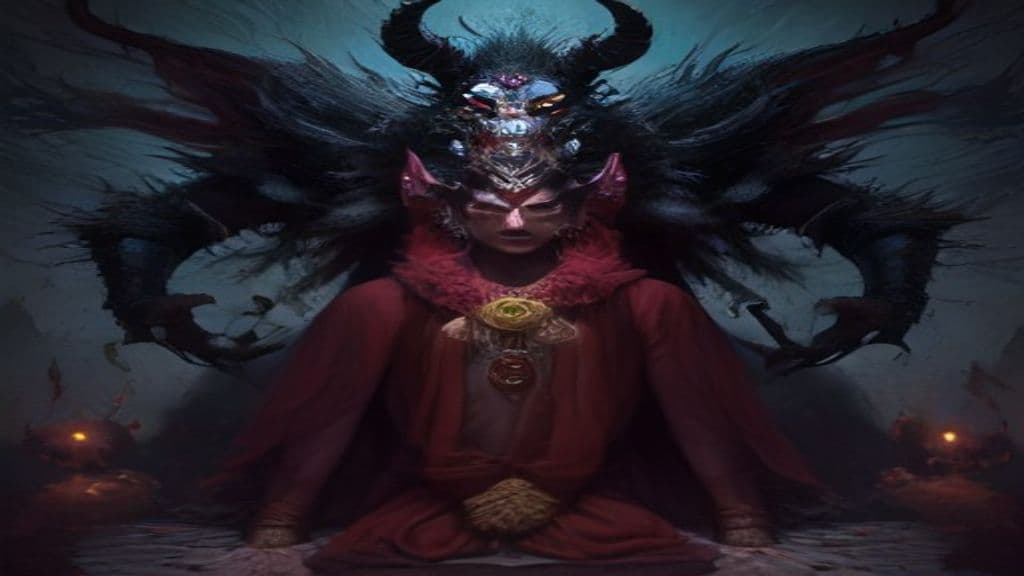
Rakshasa (Himalayan variants)
A Himalayan reception of the pan-Indian rakshasa motif: hostile or disruptive non‑human beings known from Sanskrit epic and Puranic literature, here noted where Himalayan sources and discussions intersect with the broader epic tradition. The supplied sources do not document distinct, well‑attested Himalayan folklore variants; the entry therefore presents primarily the epic/legendary profile as transmitted into Himalayan contexts in general references.
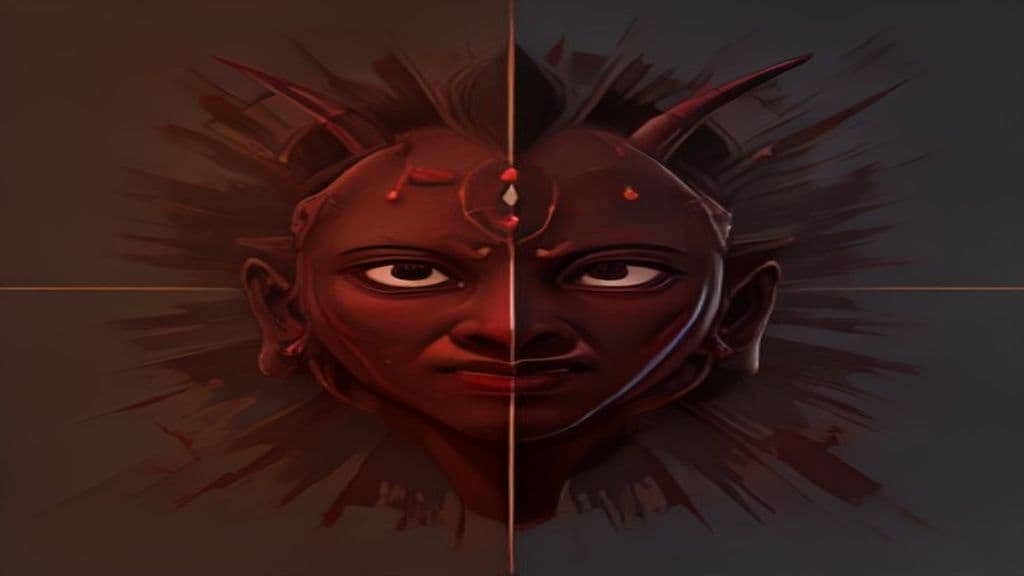
Asura
Asura (Sanskrit: असुर) are a class of supernatural beings in Indian religious traditions. In Hinduism they are described as power-seeking beings related to, and often oppositional toward, the Deva; in Buddhist cosmology they form a demigod/titan class characterized by passions such as wrath and envy. Individual asura figures (notably the asura Svarbhānu) appear in myths that produce the eclipse-entities Rahu and Ketu.
*Péh₂usōn (reconstructed)
Péh₂usōn is a hypothetical Proto‑Indo‑European pastoral guardian reconstructed by comparative scholars from parallels in Greek and Vedic traditions. Proposed as a Graeco‑Aryan ancestor‑figure, the reconstruction describes a protector of flocks, roads, and travellers rather than an attested historical cultic personality.
Abhimanyu
Abhimanyu is a youthful Kuru/Pandava warrior-hero in the Sanskrit epic Mahābhārata. Son of Arjuna and Subhadra, he is famed for entering the Chakravyuha battle formation on the thirteenth day of the Kurukshetra War and dying at age sixteen; his posthumous son Parikshit continues the Kuru line.
Achyuta
Achyuta (Sanskrit: अच्युत, acyuta) is primarily an epithet/theonym in Vaishnava Hindu tradition applied to Vishnu and Krishna, signifying the divine quality of being 'not fallen' — immutable, infallible, and imperishable. It functions as a devotional name in scripture, liturgy, and Pancharatra lists of divine emanations rather than as an autonomous folkloric spirit.
Acintya
Acintya is an Indonesian Hindu theological-symbolic representation of the ineffable supreme divine principle. In Balinese and Javanese practice it functions as a way to make ultimate reality present in ritual and art—often aniconically as an empty throne (padmasana) or anthropomorphically as a naked, flame-surrounded figure—rather than as a narrative, intervening deity.
Adi (asura)
Adi is attested in modern reference works as the name of an Asura who 'appears in the Matsya Purāṇa.' Beyond this single-line citation in secondary sources, no descriptive material about the figure is provided in the supplied research notes.
Adi Shakti
Adi Shakti (also Adi Parashakti, Mahadevi, Adya Shakti) is the primordial feminine power in Hindu/Shakta theology, regarded as the ultimate reality (Para Brahman) and the source from which all goddesses and gods manifest. She is both an impersonal cosmic principle (Mulaprakriti) and a focus of devotional invocation in temples, mantras, and pilgrimage sites such as Shakti Peethas.
Adi Vinayaka
Adi Vinayaka (Ādi Vināyaka; also called Nara Mukha Vinayaka) is a named iconographic and devotional form of the Hindu god Ganesha portraying the deity with a human head, described in sources as the form before the episode of decapitation by Shiva. It is rarely worshipped and appears in a small number of South Indian shrines and in devotional/musical repertoires.
Aditi
Aditi is a major Vedic goddess in Hindu tradition who personifies the boundless, infinite cosmic principle and functions as the maternal matrix from which many celestial deities (the Ādityas and other groups) are born. In the Vedic hymns she is invoked as a protective liberator who guards petitioners, provides wealth and safety, and frees devotees from hindrances such as sin and sickness.
Agastya
Agastya (also Agathiyar/Agasti) is a revered Vedic and later-period Indian rishi (sage) figure credited in textual traditions as an inspired seer, ascetic, teacher, culture-founder, and attributed author of Vedic, Puranic and Tamil works; in South Indian tradition he is associated with origins of Tamil grammar and Siddha medicine and is identified astronomically with the star Canopus.
Agent Liberty
Agent Liberty is a fictional human operative persona in DC Comics and its television adaptation (Arrowverse). The identity—most prominently used by Benjamin 'Benjy/Ben' Lockwood—functions as a costumed, paramilitary/enforcer role tied to political movements (Sons/Children of Liberty) or official security details, driven by ideological 'liberty' rhetoric rather than supernatural agency.
Aghasura
Aghasura is an asura from the Vaishnava/Hindu narrative tradition (notably the Srimad‑Bhāgavatam) who, at the command of Kamsa, assumed the form of a vast serpent to ambush Kṛṣṇa and the cowherd boys in Vṛndāvana. The episode demonstrates Kṛṣṇa’s protective, divine power as he enters and destroys the demon from within.
Agiya Baital
The fire-form of the Vetala — a cremation ground spirit of UP and Bihar that manifests as a wandering flame rather than a corpse-inhabitor, leading night travellers off roads and into marshland or flames with a dancing fire that seems always just ahead.
Community Record
- [1]Ghatotkacha — Wikipedia. Wikipedia article 'Ghatotkacha' (accessed as provided in research notes)wiki
- [2]The Birth Of Ghatotkacha (Amar Chitra Katha comic listing). Archive listing for Amar Chitra Katha: 'The Birth Of Ghatotkacha' (bibliographic source referenced in research notes)other
- [3]Vir Ghatotkacha (regional dramatic/folk listing). Archive listing 'Vir Ghatotkacha Natak' (regional/dramatic retelling referenced in research notes)other
- [4]Ghatotkacha — Ed. By Anant Pai (1997 listing). Archive listing for a 1997 India Book House/Anant Pai edition referenced in research notesother