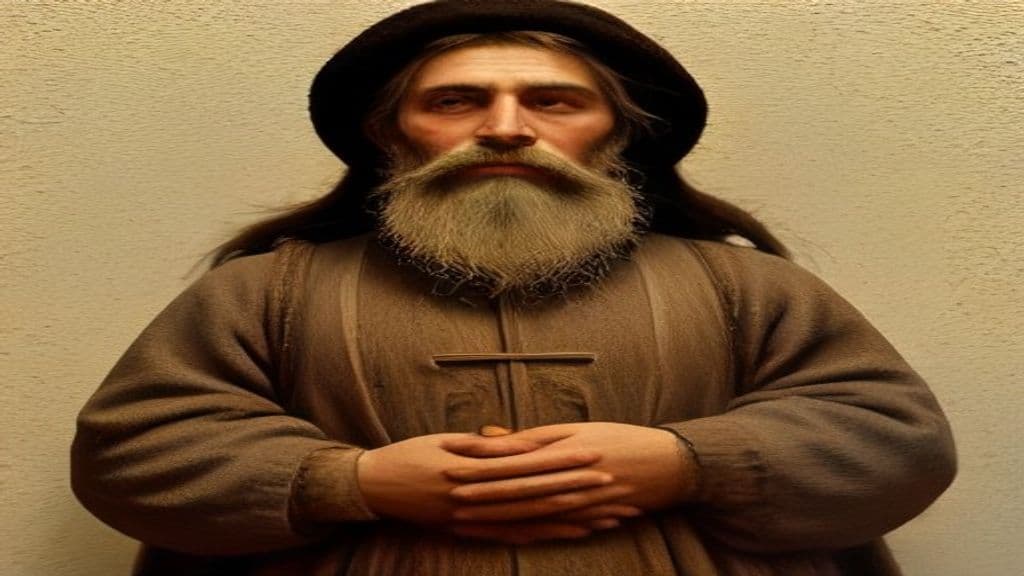
The name derives from Middle High German gütel / güttel, originally signifying a small idol (a 'little god') and later acquiring associations with the adjective gut ('good'). Over time dialectal corruptions produced many regional name-forms. In some local beliefs the Heugütel (hay-Gütel) is explicitly identified as the soul of a child who died unbaptized; conversely, other regional variants are understood as indigenous household sprites, little earth-manikins, or pond-associated water-sprite figures. Thus the Gütel concept folds together an older term for a little deity/house idol with localized Christian-era concerns about unbaptized child-souls and domestic spirit-helpers.
Accounts vary by locality rather than presenting a single fixed form. Early attestations describe a hunchbacked kobold-like manikin. Heugütel of hay-lofts are reported as bearded little old manikins and are also described in sources as sometimes appearing colored black; that same Heugütel is characterized as usually half-naked in some reports (and can be driven away by clothing). In Lower Lusatia the beings are portrayed as tiny Erdmannlein (dwarf earth-men). Water-associated variants are linked to ponds or pits (Gütchenteich / Gütchengrube) from which newborns are said to come. Heugütel may leave small child-like footprints in ash. Haargütel/Hoorgitel forms are tied to hair-related mischief rather than a single described bodily form.
Gütel occupy a spectrum of domestic functions: many accounts present them as obliging, child-friendly household spirits that help in house and stable and even cradle or dally with sleeping children. Other regional variants are mischievous or harmful: teasing or playing with sleeping children in ways blamed for restlessness, chills, ague, seizures or measles; tangling horse manes and women's hair; entering stables at night and tormenting livestock so cows growl and horses bite or kick. A Saxon variant (Jütel / Jüdchen / Mützchen) practices aufhocken—leaping upon a traveller's back and forcing them to carry the spirit, leaving the victim faint and ill. A loud heavy plunge at night associated with a Gütel can be read as an omen of impending death, and the spirit may be propitiated by substitutionary offerings.
Weaknesses
- conditionprompt baptism of newborns
- substancegreased stove door (with bacon rind)
- othergift of new clothes (drives Saxon Jüdel/Heugütel away)
- otherlaced straw from the bed of the woman in childbirth placed at doors
Wards
- ritualplace leftover bathing water in a little pot on the stove
- ritualhang eggshells and playing cards on the crib
- ritualplace a bow and arrows in the cellar and barn for the spirit to play with
- substancegrease the stove door with a bacon rind
- rituallace a straw from the bed of the woman in childbirth at every door
- othergive a gift of new clothes (Saxony) — drives spirit away but withdraws household blessing
- conditionensure pious Christian household life (Heugütel reportedly stays only in pious homes)

*Perkʷūnos
*Perkʷūnos is the reconstructed Proto-Indo-European thunder‑god hypothesized by comparative linguistics and mythology. Scholarly reconstructions portray him as a storm or thunder figure associated with fructifying rain and as the combatant who fights a multi‑headed water‑serpent to release life‑giving waters; no direct attestations from the Proto‑Indo‑European period survive and the figure is inferred from later Indo‑European traditions.
*Péh₂usōn (reconstructed)
Péh₂usōn is a hypothetical Proto‑Indo‑European pastoral guardian reconstructed by comparative scholars from parallels in Greek and Vedic traditions. Proposed as a Graeco‑Aryan ancestor‑figure, the reconstruction describes a protector of flocks, roads, and travellers rather than an attested historical cultic personality.
57 Mnemosyne
57 Mnemosyne is a large main-belt asteroid (S-type) discovered in 1859 and named after the Greek Titaness Mnemosyne. It is a non-sentient astronomical body studied for its orbital and rotational properties and has been used in dynamical measurements related to Jupiter.
Abaddon
In Hebrew scripture Abaddon is primarily a noun meaning 'destruction' or a section/condition of the underworld paired with Sheol; in the New Testament Book of Revelation Abaddon is personified as an angelic figure (Greek Apollyon) described as the king of an army of locusts released from the abyss during the apocalypse.
Abadir
Abadir is a polysemous name attested in distinct cultural contexts: a legendary founding saint and clan ancestor in eastern Ethiopia (Sheikh Abadir Umar Al‑Rida / Aw Abadir), a term applied to cone‑shaped cult stones in Phoenician religious description, and a personal name of a martyr (Abadir/Apater) in the Coptic Synaxarium. The attestations are independent usages of the same name rather than a single supernatural being.
Abadiu of Antinoe
Abadiu of Antinoe was a fourth‑century bishop of Antinoe (Antinoopolis, in Roman Egypt) commemorated as a martyr and saint in the Coptic Orthodox Church, with a feast day on 26 December. Sources record that he was killed during a theological dispute with Arian opponents and reference him in collections of Egyptian martyrs.
Abagtha
Abagtha (Hebrew: אבגתא, ’Ǎḇaḡṯā) is a named human court official in the Hebrew Bible’s Book of Esther, listed among seven chamberlains who ministered before King Ahasuerus and were commanded to bring Queen Vashti before the king. He is attested only in Esther 1:10 and is presented as an institutional palace attendant rather than a supernatural being.
Aban Yasht
The Aban Yasht is a hymn from the Persian tradition that praises Anahita, a goddess associated with water, fertility, and wisdom. It consists of 132 stanzas and is part of the 21 Yashts collection. (Note: - Power tier should be "Primordial" or possibly "Cosmic", given that it's a hymn of great spiritual significance and associated with a goddess. - The article incorrectly states that Anahita is associa)
Abanoub
Abanoub is a 4th‑century Egyptian Christian child martyr venerated in the Coptic tradition. Remembered for his public confession of Christ, miraculous healings associated with his passion, and the translation and veneration of his relics, his feast is observed on July 31 (Epip 24) and his cult centers include Nehisa and Samanoud.
Abaskhiron the Soldier
A Coptic Orthodox martyr venerated for refusing imperial idolatry during the Diocletian persecution; reputedly healed by the Archangel Michael, preserved in monastery relics, and commemorated on 14 June (7 Paoni).
Abath
No corroborated folkloric entity named "Abath" is documented in the provided sources. The string appears in the supplied material only as a surname/personal name in Aruban/Dutch-Caribbean archival records and as an unrelated taxonomic or encyclopedic hit; no mythic attributes, origin stories, rituals, or apotropaic practices for an entity called Abath are present in the documents reviewed.
Abatur
Abatur is an uthra (celestial emanation) in Mandaeism described as the 'father of the Uthras' and called the Ancient (ʿattīqā). He resides on the boundary between the World of Light and lower regions, functions as a judge who weighs souls (Abatur Muzania), and supplies instructions and materials to the demiurgic uthra Ptahil in accounts from the Diwan (Scroll) of Abatur.
Community Record
- [1]Gütel. Wikipedia contributors, 'Gütel,' Wikipedia, The Free Encyclopedia.wiki
- [2]Gütel (Wikidata entry). Wikidata entry Q64411317other