
Attestations vary by region and period. In Ugaritic mythic cycles Haddu/Baʿal functions as the sky/storm lord who fights the sea-god Yamm and secures rulership among the gods (the Baal Cycle). Mesopotamian and Sumerian traditions use cognate forms (Adad, Iškur) and the Sumerogram dIM to denote the storm power; genealogical placement differs in texts and traditions (the deity appears with different parentage and family relations in different corpora), reflecting variant local theological schemes rather than a single canonical birth-narrative.
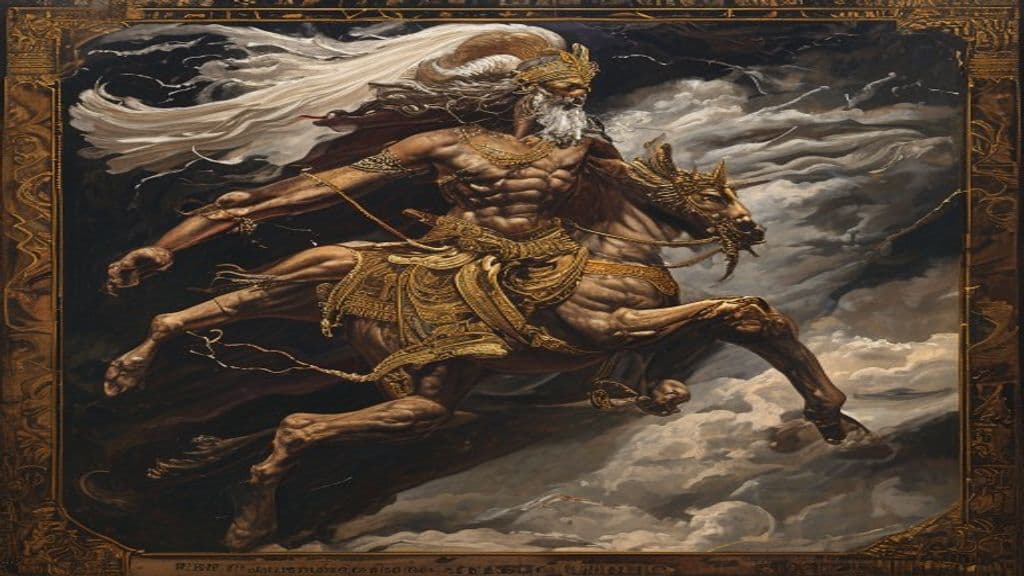
Textual and iconographic evidence (especially Mesopotamian/Akkadian) commonly portray the storm god as a bearded male figure wearing a bull-horned headdress and bearing martial/storm attributes such as a club and a thunderbolt or spear; the bull is a regular symbolic animal associated with him. Regional art and texts show some variation in depiction and emphasis across time and place.
Hadad/Adad/Iškur is associated with storm, thunder, and rain and is invoked as the deity who brings fertility to fields through rainfall and, conversely, can cause destructive storms and drought when absent or angered. In Mesopotamia he shares cultic association with the sun-god Shamash in the patronage of oracles and divination; mythic narratives position him as a warrior figure in contests that establish cosmic and cultic order.
Weaknesses
None recorded.
Wards
- ritualTemple cult, hymns, and votive offerings
- ritualDivination and oracle consultation (patronage of Adad and Shamash)

Shamash (Utu)
Shamash (Akkadian šamaš; Sumerian Utu) is the ancient Mesopotamian sun god, a principal deity responsible for the visible sun and for juridical, protective, and divinatory functions. He is venerated especially at Sippar and Larsa, appears in major myths as an ally of heroes, and is regarded as the divine witness whose sight underwrites justice and truth.
Baal
Baal (bāʿal) is a Northwest Semitic title meaning 'owner' or 'lord' that served as a theonym in the ancient Levant; in Ugaritic and Canaanite texts it appears as the name/title of a prominent storm and fertility god (often rendered Baʿal Haddu) who features centrally in the Baal Cycle and in regional cults tied to rain, fertility, and kingship. In later monotheistic literatures the term becomes a polemical label for rival or foreign deities and is reinterpreted in various receptions.
'Ain Samiya Goblet
Silver cup from the Middle Bronze Age I, discovered in a tomb at Ain Samiya. (Note: 1. Power tier should be "None", but add a note explaining that historical artifacts don't fit into the typical power tier classification. 2. Add a description of its appearance based on it being a sil)
A'annepada
A'annepada (Sumerian cuneiform 𒀀𒀭𒉌𒅆𒊒𒁕; also romanized Aanépàdda) is attested as a historical ruler of the First Dynasty of Ur, flourishing c. 2350 BC. He is recorded in dedicatory and foundation inscriptions as king of Ur and as son of Mesannepada, credited with temple-building and dedication to deities such as Ninhursag and Inanna.
Abadir
Abadir is a polysemous name attested in distinct cultural contexts: a legendary founding saint and clan ancestor in eastern Ethiopia (Sheikh Abadir Umar Al‑Rida / Aw Abadir), a term applied to cone‑shaped cult stones in Phoenician religious description, and a personal name of a martyr (Abadir/Apater) in the Coptic Synaxarium. The attestations are independent usages of the same name rather than a single supernatural being.
Abu
Abu is a poorly understood Mesopotamian god attested in modern reference summaries. Secondary literature tentatively links him with vegetation and snakes and records that he was often paired with a deity written gu2-la2, but primary details about his cult, iconography, and myths are lacking in the cited sources.
Abzû
Abzû (Sumerian abzû; Akkadian Apsû) is the primordial freshwater abyss in Sumerian–Akkadian cosmology: the deep fresh waters that underlie and surround the earth, source of springs, rivers and ritual holy waters, and a creative principle whose mingling with the salt sea (Tiamat) figures in Mesopotamian cosmogony.
Abī-simtī
Abī-simtī (also rendered Abi-simti, Abisimti) is a named woman attested in third-millennium BCE Mesopotamian documentary and literary texts. She appears in administrative account records as a provider of animals and donor to temple cults and in Sumerian love-song literature as the named beloved/consort addressed by a royal speaker.
Acerbas
Acerbas (also recorded as Sychaeus, Sycharbas, Zacherbas) is a figure in classical Greco‑Roman accounts of Phoenician/Tyrian tradition: a wealthy priest of Melqart (the Tyrian Hercules) whose concealed riches and murder by King Pygmalion precipitate Elissa/Dido's flight from Tyre and the foundation of Carthage. He is presented as a human priestly figure of high social rank rather than as a supernatural being.
Adad
Adad (also Hadad, Haddad; Sumerian Iškur) is the storm- and rain-deity attested in ancient Mesopotamian and Canaanite religious contexts. Sources identify him as a principal weather god whose domain is storms and rainfall and whose name appears across multiple Near Eastern languages and sites, including Ebla (as Hadda, c. 2500 BCE).
Adamma
Adamma is an ancient north‑Syrian goddess attested in Eblaite palace records ca. 2400 BCE and later incorporated into Hurrian and Emar contexts. She functioned as a named cultic deity with an institutional priesthood, a month and festival bearing her name, and documented offerings from the royal palace.
Adapa
Adapa is a mythic figure from ancient Mesopotamian (Sumerian and Akkadian) literature: a mortal fisherman and temple sage of Ea at Eridu endowed with exceptional wisdom. He appears in a fragmentary tale in which he breaks the wings of the south wind and is summoned to the divine court; his name was later invoked in exorcistic and ritual contexts as an authoritative identity.
Adonis
Adonis is a mythic mortal youth in ancient Greek tradition, beloved by goddesses (notably Aphrodite and Persephone) whose death and seasonal return are the focus of the women’s midsummer festival Adonia. The cultic practices—planting short-lived 'gardens of Adonis' on rooftops, ritual lamentation, and casting an effigy and withered plants into the sea—symbolically link him to vegetation cycles and Near Eastern dying-and-regenerating god traditions.
Adrammelech
Adrammelech is attested in ancient Semitic textual tradition as a local god of 'Sepharvaim.' The name is commonly glossed as "Magnificent king." In modern times the name has been reused in diverse fictional, musical, and online contexts, but those are creative reworkings rather than continuations of the brief ancient attestation.
Community Record
- [1]Hadad - Wikipedia. Wikipedia contributors, 'Hadad,' Wikipedia, The Free Encyclopediawiki
- [2]Hadad - Biblical Cyclopedia. Biblical Cyclopedia, entry 'Hadad'other
- [3]Hadad - International Standard Bible Encyclopedia. International Standard Bible Encyclopedia, entry 'Hadad'other
- [4]Hadad Statue - Wikipedia. Wikipedia contributors, 'Hadad Statue,' Wikipedia, The Free Encyclopediawiki
- [5]1 Kings 20 (biblical references to Ben-Hadad etc.). 1 Kings 20 (biblical chapter), referenced in source setliterary
- [6]Hadad | The amazing name Hadad: meaning and etymology. Abarim Publications, 'Hadad: meaning and etymology'other