
Hannya is primarily a theatrical and folkloric figure rather than a single mythic individual. The label 般若 (hannya) is the Japanese phonetic rendering of the Sanskrit prajñā ('wisdom'); sources offer multiple hypotheses for the name's application to the mask, presented as possibilities rather than settled fact: that an artisan or monk called Hannya-bō may have perfected the mask; that the name derives from a line in the Noh play Aoi no Ue referring to the 'hannya-goe' (the voice reciting the Heart Sutra); or that the artisan needed great 'hannya' (wisdom) to create the expressive mask. Historically the mask functions within a dramaturgical tradition (Noh and related forms) portraying women whose jealousy, obsession, or resentment has transformed them into dangerous, tormented spirits (onryō/ikiryō analogues).
In the theatrical context the Hannya mask is characterized by two sharp, bull-like horns, metallic or golden eyes, and a leering or grimacing mouth; coloration varies by character nuance—paler (white) faces indicate refined or aristocratic women turned spirit, red faces indicate less refined origins, and darker reds indicate fuller demonic transformation. Noh technique exploits the mask's geometry so that it appears terrifying when viewed head-on but sorrowful or mournful when the actor tilts the mask downward, allowing a single mask to embody both wrath and torment. Related masks mark intermediate stages of transformation (namanari, deigan, hashihime, jya, shinjya).
Sources describe the Hannya primarily as the representational form of women who have become demons through obsessive jealousy and resentment; in plays the Hannya functions as a vengeful agent whose wrath produces curses, possession, or violent action within narrative contexts (examples in Aoi no Ue, Kanawa, Dōjōji, Momijigari, Kurozuka). Modern popular summaries add physical-attack details (claws, wounds that won't heal) but these elements are not corroborated in the theatrical and encyclopedic sources and should be regarded as later popular embellishments. Ritual specialists and sutra recitation appear in narratives as means by which the Hannya may be repelled or resolved, indicating its place in a ritual-imaginary system rather than a fixed catalogue of occult powers.
Weaknesses
- mantraHeart Sutra recitation (hannya-goe) — recited voice that, in Aoi no Ue and related narrative usages, functions to repel the spirit
- ritualPrayers or ritual intervention by a specialist (e.g., Abe no Seimei in the play Kanawa) — narrative/ritual means shown to repel or counter the Hannya
Wards
- mantraHeart Sutra recitation (hannya-goe)
- ritualPrayers or ritual rites performed by an onmyōji/ritual specialist (as depicted in play narratives)

Onryō
Onryō are vengeful spirits in Japanese folklore who return after death to redress wrongs suffered in life by harming the living; they are commonly portrayed in literature and film as wronged individuals—frequently women—whose resentment manifests as lethal retribution, and in some accounts as causing wider calamities.
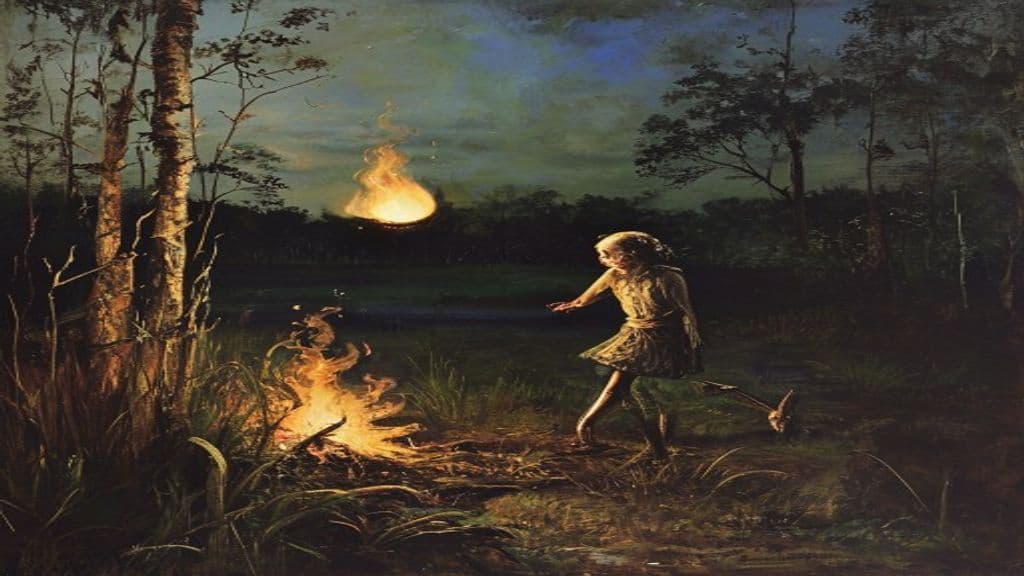
Will-o'-the-wisp
An atmospheric 'ghost light' — a small, mobile, lamp-like light seen at night over marshes, bogs, wet ground, or graveyards. In many cultures the phenomenon is interpreted as a supernatural being or manifestation (wandering nature-spirit, soul of the dead, transformed witch, or treasure-indicator); modern science offers chemiluminescent explanations for some occurrences.
5 Ronin
5 Ronin is a 2011 Marvel Comics five-issue limited series that reimagines five Marvel superhero archetypes as rōnin (masterless samurai) in a fictionalized post‑Sekigahara feudal Japan. The work places Wolverine, Hulk, Punisher, Psylocke, and Deadpool analogues into period roles to explore displacement, revenge, and identity in an era of political upheaval.
Abumi-guchi
A Japanese yōkai classed as a tsukumogami: an animated stirrup (abumi) depicted in Sekien Toriyama's Gazu Hyakki Tsurezure Bukuro. Traditional accounts say it is formed from a stirrup that belonged to a soldier who fell in battle and that it waits where the stirrup lies for its dead owner to return.
Abura-akago
An Edo-period yōkai depicted as an oil‑licking infant or a ball of flame. First recorded in illustrated compendia (notably Toriyama Sekien's Konjaku Gazu Zoku Hyakki), the Abura-akago is tied to tales of oil‑stealing fires and functions in part as an etiological warning about wasting or stealing oil.
Abura-sumashi
A yōkai spirit from the Amakusa region of Kumamoto Prefecture, Japan, said to inhabit mountain passes. Traditionally explained as the ghost of a person who stole oil, it appears to surprise travelers and is represented in modern media with a straw-coat body and a potato- or stone-like head.
Aburabō / Abura-bōzu / Aosaginohi (traditions)
Two distinct Japanese traditions appear under related flame imagery: Aosaginohi/Aosagibi is presented as a will-o'-the-wisp type luminous night phenomenon interpreted as reflections from herons; aburabōzu (abura bōzu, "oil monk") appears in a separate anecdote as a reported fire-breathing apparition in a 12th-century Yasaka Shrine tale. The sources treat them as separate portrayals rather than a single unified being.
Acala
Acala (Sanskrit: अचल, 'The Immovable') is a wrathful protective deity (dharmapala) in Vajrayāna and East Asian esoteric Buddhism, classed among the Wisdom Kings (Vidyārāja). He functions as a ritual focus for visualization and mantra practice intended to remove obstacles and bind or destroy hostile forces.
Acalanātha (Acala / Achala)
Acalanātha (also Acala or Achala) is a wrathful deity and dharmapāla — a protector of the Dharma — prominent in Vajrayana and East Asian Mahayana Buddhist contexts. Presented as a fierce, non‑human or semi‑divine protector-figure, Acalanātha functions to defend the teaching and practitioners by removing obstacles and confronting threats to the transmission and practice of Buddhism.
Agaru
Agaru (attested historically as Agarum) appears in the supplied sources as a Bronze Age Near Eastern toponym—often identified with Failaka Island—and as a modern personal or media name. The provided material contains no evidence that Agaru is a supernatural being in any traditional cosmology.
Agni
Agni is the Vedic personification of fire in Hindu tradition: a sacred, mediating principle that manifests as terrestrial fire, atmospheric lightning, and celestial sun, and that receives and conveys sacrificial offerings. Prominent in the Rigvedic corpus, Agni functions as sanctifier, witness of rites of passage, and a transformational inner principle in later Upanishadic literature.
Aizen Myō-ō (Rāgarāja)
Aizen Myō-ō corresponds to the deity Rāgarāja, a wrathful/transformation-oriented figure venerated in Esoteric and Vajrayāna Buddhist traditions. The figure is especially revered in Chinese Esoteric Buddhism in Chinese communities and in the Japanese Esoteric schools Shingon and Tendai.
Ajisukitakahikone
Ajisukitakahikone is a kami in Japanese mythic literature (Kojiki/Nihon Shoki). He appears in the transfer-of-rule cycle between heaven and earth, is described as a son of Ōkuninushi, associated with the Kamo cult (called Kamo no ōmikami in some modern museum/catalog entries), and features in narratives that explain landscape formation and meteorological genealogy.
Aka Manto
Aka Manto (赤マント, "Red Cloak") is a Japanese urban legend and schoolyard ghost-story about a masked, cloaked figure who appears in public or school toilet stalls and forces occupants to choose between colored toilet paper; each choice in the tale produces a violent supernatural consequence. The legend is part of modern popular folklore recorded in school contexts from the 1930s onward rather than a formal religious myth.
Community Record
- [1]Hannya — Wikipedia. Wikipedia contributors, 'Hannya,' Wikipedia, The Free Encyclopedia.wiki
- [2]Hannya - 般若 -はんにゃ | SaruDama. SaruDama, 'Hannya - 般若 -はんにゃ', Japanese folklore summary.folk
- [3]JAANUS / Hannya bosatsu 般若菩薩. JAANUS entry on Hannya-bosatsu; notes the Buddhist lexical background of 般若 (prajñā).academic
- [4]Triple Threat: Hannya - Ravens N' Pennies. Ravens N' Pennies, modern folklore summary mentioning popular embellishments.folk
- [5]Maka hannya haramitsu — Wikipedia (related term). Wikipedia contributors, 'Maka hannya haramitsu.'wiki