
The earliest attestation in the supplied materials is the word hashmal in Ezekiel's Merkabah/chariot vision (Ezekiel 1:4–5), where it appears as a radiant substance or color within a divineophany. In later Jewish angelological schemata (as reported in the provided sources) the term is taken over as the name of an angelic rank (Hashmallim), placed fourth among ten ranks in Maimonides' list as cited in the secondary material. Thus the concept shows a developmental trajectory from descriptive visionary language to technical classificatory usage in Jewish intellectual history.
In Ezekiel's vision the term is associated with a bright, lustrous element: the quoted passage describes a stormy wind, cloud and fire, and 'out of the midst thereof as the colour of electrum' (hashmal in the Hebrew); classical translations include the Septuagint's elektron and the Authorized Version's 'amber.' The supplied angelological descriptions do not provide a detailed anthropomorphic portrait of Hashmallim, emphasizing instead their role within the heavenly order rather than specific bodily features.
The provided sources characterize Hashmallim primarily in administrative and governance terms: one glossual entry describes them as angels who 'govern and administrate Heaven' and analogizes their functions to human political and civil-service roles (politicians, cops, lawyers, civil servants). They are reported in the supplied material to be closely associated with the archangel Gabriel (an attribution presented in the gloss source). The materials do not ascribe specific combative, healing, or elemental powers beyond their bureaucratic and hierarchical functions; their placement as the fourth rank in a tenfold hierarchy (as cited) implies an established office within a broader celestial bureaucracy.
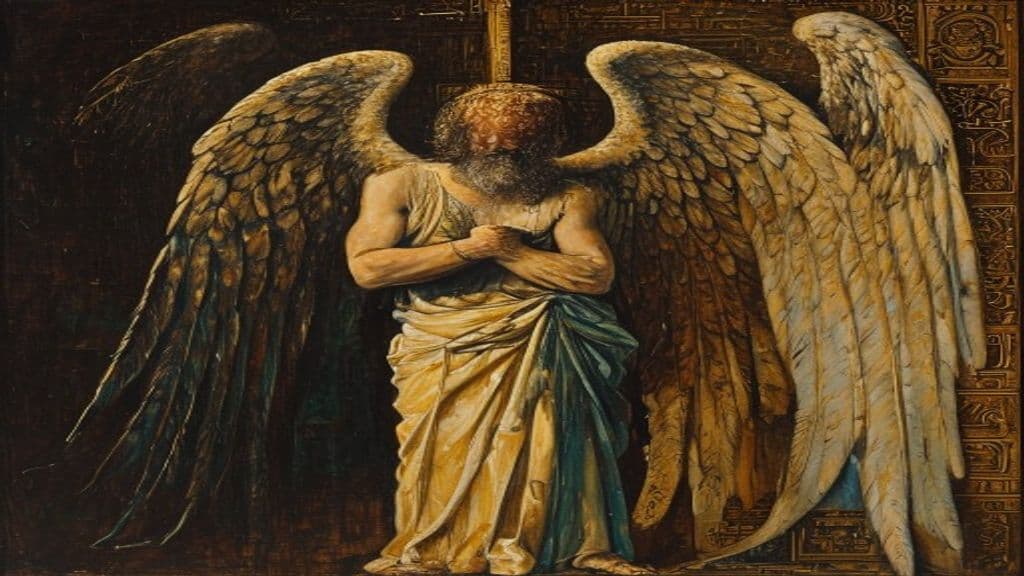
Gabriel
A principal heavenly messenger in Jewish, Christian, and Islamic literatures, Gabriel is portrayed as an archangel who reveals and explains divine messages, announces births and divine intent, and executes certain divine judgments in apocalyptic texts.

Djinn
The class of supernatural beings created from smokeless fire in Islamic cosmology — a parallel civilization to humanity, capable of belief or unbelief, with their own prophets, society, and judgment before God.
Aaron
Aaron is a central human figure in Israelite sacred literature: the elder brother of Moses, the first high priest (progenitor of the Aaronide priesthood), and a spokesman/prophet who mediates between Israel and God in Exodus–Deuteronomy narratives. His role in the texts establishes hereditary priestly authority, ritual functions (sacrifices, blessing, use of Urim and Thummim), and institutional norms for Israelite cultic life.
Abaddon
In Hebrew scripture Abaddon is primarily a noun meaning 'destruction' or a section/condition of the underworld paired with Sheol; in the New Testament Book of Revelation Abaddon is personified as an angelic figure (Greek Apollyon) described as the king of an army of locusts released from the abyss during the apocalypse.
Abagtha
Abagtha (Hebrew: אבגתא, ’Ǎḇaḡṯā) is a named human court official in the Hebrew Bible’s Book of Esther, listed among seven chamberlains who ministered before King Ahasuerus and were commanded to bring Queen Vashti before the king. He is attested only in Esther 1:10 and is presented as an institutional palace attendant rather than a supernatural being.
Abdiel
Abdiel (Hebrew עֲבְדִּיאֵל) is primarily a theophoric Hebrew personal name meaning "servant of El/servant of God," attested once in the Hebrew Bible (1 Chronicles 5:15). In later literature—most notably John Milton's Paradise Lost—Abdiel is reimagined as a faithful seraph who opposes Satan's revolt. The provided sources do not treat Abdiel as an autonomous folkloric spirit type or record rituals or wards associated with the name.
Abel
Abel is the second son of Adam and Eve in the Genesis narrative, a shepherd whose accepted offering and subsequent murder by his brother Cain form the biblical account of the first death. Later interpretive traditions expand his role, treating him as an archetypal righteous victim, a postmortem avenging or adjudicating figure, and in some systems (notably Mandaean) identifying him with an angelic lightbeing.
Abiathar
Abiathar (Hebrew: אֶבְיָתָר, ʾEḇyāṯār) is a named human priestly figure in the Hebrew Bible. He is presented as a survivor of the Nob massacre who fled to David with priestly regalia, served as a priest and counselor in David's court, and was later deposed and sent to Anathoth by Solomon for supporting Adonijah.
Abiel
Abiel is attested in the supplied sources only as a male given name — borne by several historical American individuals and listed as two minor biblical figures. The provided materials contain no evidence presenting Abiel as a supernatural, mythological, or folkloric entity.
Abigail
Abigail is a female figure in the Hebrew Bible portrayed in 1 Samuel 25 as the intelligent and beautiful wife of Nabal who intervenes to prevent David from committing violence; later tradition regards her as one of the Tanakh's seven female prophets and as a model of beauty and wisdom.
Abijah of Judah
Abijah (also Abijam or Abiah) is presented in the biblical and later interpretive traditions as a short-reigning human king of Judah from the Davidic line. He is portrayed as a dynastic successor whose military actions (notably the battle at Mount Zemaraim) and moral evaluation in rabbinic literature are interpreted theologically in relation to the Davidic covenant.
Abimelech
Abimelech is a Hebrew personal name and occasionally a regnal title attested in the Hebrew Bible and later traditions. It appears as the name/title of Philistine rulers in the patriarchal narratives (the "king of Gerar" who interacts with Abraham and Isaac) and as the personal name of Abimelech son of Jerubbaal (Gideon) in Judges, a dynastic usurper whose brief rule ends in violent death.
Abishag
Abishag is a young woman from Shunem described in 1 Kings 1 as chosen to attend the aged King David, brought to lie beside him to provide warmth and serve as a helper/servant; her later status became a political issue in the succession disputes following David's death.
Abishai
Abishai is a personal name attested in several distinct sources: a biblical individual described as the eldest son of Zeruiah (sister of King David); a Semitic chief named in an inscription at Beni-Hasan in Middle Egypt; and modern cultural uses including a named monster in Dungeons & Dragons and as an artist/stage name. The supplied materials do not present Abishai as a supernatural being within a living cosmology.
Community Record
- [1]Hashmal (Wikipedia article). Wikipedia, 'Hashmal' article (supplied excerpt describing Ezekiel usage, Maimonides placement, and modern Hebrew meaning).wiki
- [2]Wikidata entry Q5679052 (Hashmal). Wikidata item for Hashmal (metadata reference supplied among sources).other
- [3]Hashmal Angel (Imaginova glossary entry). Gloss entry noting Hashmallim as angels who 'govern and administrate Heaven' and linking them to the archangel Gabriel (supplied as Source 8).other
- [4]Discussion: 'What's the meaning of "Hashmal" (electricity in modern Hebrew) in the bible? (Ezekiel 1:4)'. Community Q&A discussing translation history and semantic range from Ezekiel to modern Hebrew usage (supplied among sources).other