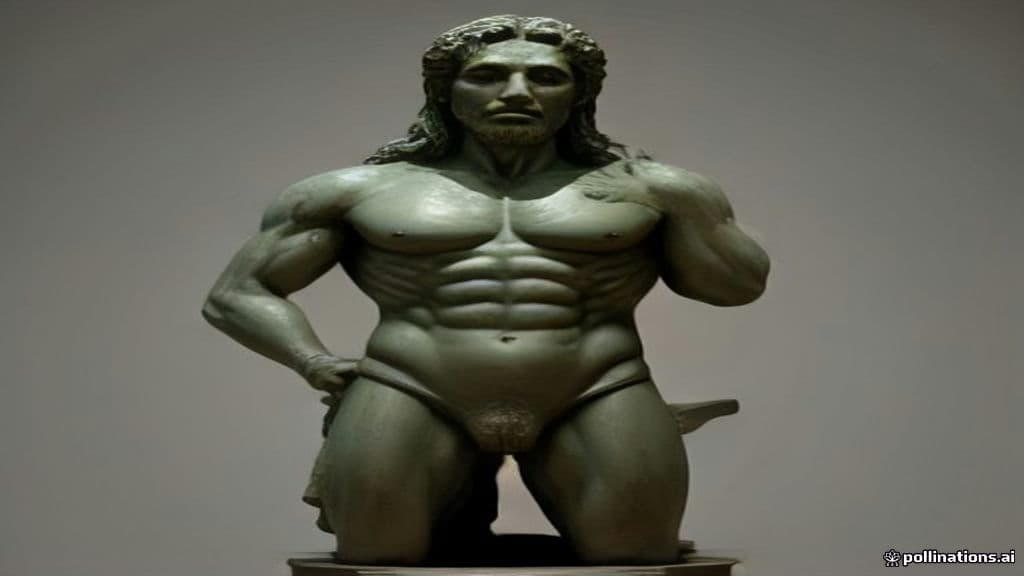
In Etruscan religious imagination Hercle is described as the exemplary mortal elevated to divine status by incorporation into the divine household of Tinia and Uni. Iconographic scenes—most famously the suckling motif in which Uni breast-feeds Hercle—represent his ritual adoption or apotheosis into the chief gods' family. While visually cognate with the Greek Heracles, Etruscan sources present Hercle as a locally-integrated culture-hero whose deeds justify divine elevation and whose figure served as an aspirational model for aristocratic identity.
Etruscan art consistently portrays Hercle as a muscular male hero often nude or partially nude, usually bearing the standard Heracles attributes of a club and a lionskin. He appears across mediums—bronze mirrors, small bronzes, and painted pottery—in varied scenes including intimate compositions with Menrva, presenting the child Epiur, and being crowned by a deity (Munthuch). Some Etruscan mirrors name or label him, linking iconography to cult identity.
Hercle functions in multiple overlapping roles in Etruscan religion: he is depicted as a liminal defender against creatures beyond human borders, a master of animals and protector of flocks, herds, and herdsmen, and is associated with running water in Etruria. He also held a more oracular character in Etruria than his Greek counterpart; archaeological inscriptions and dedications (notably from a sanctuary at Caere) attest to cultic invocation and votive practice. His narrative of divine elevation (suckling by Uni, crowning scenes, presentation of Epiur) further marks him as a protector and exemplar incorporated into the divine family.

Tinia
Tinia (also Tin, Tinh, Tins, Tina) is the chief sky god of the Etruscan religion, associated with thunderbolts, divination, and the guarantying of boundaries. He occupies a role analogous to Roman Jupiter and Greek Zeus and appears in Etruscan votive inscriptions and on the Piacenza Liver used for haruspicy.

Hercules
Hercules (Latin: Hercules) is the Roman reception of the Greek divine hero Heracles: a semi-divine, divinized heroic figure son of Jupiter and the mortal Alcmena who was widely venerated across Italy. Represented in cult, votive art, and literature, he functions as a protector and martial champion whose identity was adapted through Etruscan and local Italic contexts.
Aesar
Aesar is a term attested in comparative and antiquarian literature as a name or class-label applied to divine or semi‑divine beings in discussions of Etruscan religion. In the provided sources it appears chiefly in speculative comparisons with other pantheons (e.g., Norse Æsir, Irish 'Living Ones', Egyptian Asar/Osiris) and as a proposed Etruscan word meaning 'a god' in secondary commentary.
Aita
Aita is an Etruscan chthonic epithet of the older god Śuri (Suri), functioning as an underworld lord in late Etruscan iconography and funerary contexts. Appearing from about the 4th century BC, Aita shows strong influence from the Greek Hades and is depicted rarely in tomb paintings and grave goods.
Apollo
Olympian deity of ancient Greek religion associated with prophecy, healing, music, archery, purification, and civic order. Principal patron of the Delphic oracle, protector of youth and flocks, and ambivalently both healer and bringer of plague.
Apollo of Veii (Aplu)
A life-size late Archaic Etruscan terracotta cult statue of the deity Aplu (Etruscan Apollo) created for the acroterial program of the Portonaccio sanctuary at Veii, ca. 510–500 BCE; intended as an architectural cult image and narrative participant in a roofline group depicting Apollo and Heracles.
Apulu
Apulu (Etruscan: 𐌀𐌐𐌖𐌋𐌖; syncopated Aplu) is an epithet/aspect of the Etruscan fire god Śuri combining solar/sky and chthonic/volcanic functions. Attested in inscriptions, major sculpture (notably the Apollo of Veii) and small votive objects, Apulu is associated with sun and light, thunder and lightning, healing and plague, and the protection of divination.
Asius
Asius (Ancient Greek: Asios) is a personal name borne by several mortal leaders allied with Troy in Greek epic and mythographic tradition. The figures called Asius appear in leader-lists, genealogies, and battle narratives of the Trojan War cycle rather than as a distinct supernatural entity.
Aulus Vibenna
Aulus Vibenna (Etruscan Avile Vipina) is a remembered historical and legendary Etruscan aristocrat and military leader from Vulci, attested in mid-1st millennium BCE inscriptions and tomb painting. He appears in votive dedications (a bucchero chalice) and in the François Tomb fresco cycle alongside his brother Caelius and companions such as Mastarna (identified with Servius Tullius in later tradition).
Begoe
Begoe is a scarcely attested named figure in Etruscan religious tradition, recorded in a 19th‑century retelling as able to slay an ox by whispering a sacred name. Modern references sometimes list Begoe as a variant spelling of the better‑attested Etruscan figure Vegoia/Vegoe, but evidence is fragmentary.
Caelius Vibenna
Caelius Vibenna (Etruscan Caile Vipina) is presented in the supplied tradition as an Etruscan noble and legendary leader associated with a circle of companions; he appears in Etruscan tomb painting (notably the François Tomb at Vulci) and in later Roman antiquarian tradition as an ancestral or eponymous figure tied to the Caelian Hill of Rome. The corpus treats him as a human aristocratic/heroic figure rather than a supernatural being.
Calu
Calu is an Etruscan theonym/epithet denoting the chthonic, dark aspect of the fire-underworld god Śuri; the name was also used as a synonym for the underworld itself. Iconography and cultic language associate Calu with darkness and lupine (wolf) attributes and link the epithet to central-Italian wolf-ritual phenomena.
Charun
An Etruscan chthonic attendant and psychopomp depicted in funerary art; Charun escorts the dead to the underworld and appears in grotesque, monstrous form often bearing a hammer. He is typically an underworld functionary rather than the sovereign ruler of the dead.
Culsu
Culsu is an attested name listed among Etruscan deities and legendary figures in modern compilations. Available sources provide only nominal attestation (the name and a modern label of 'goddess'); no independent ancient narratives, functions, iconography, or rituals are recorded in the supplied materials.
Community Record
- [1]Hercle. Wikipedia contributors, 'Hercle,' Wikipedia, The Free Encyclopedia.wiki
- [2]Hercle (Wikidata). Wikidata entry Q2738940 for Hercle.other
- [3]Epiur. Wikipedia contributors, 'Epiur,' Wikipedia, The Free Encyclopedia.wiki
- [4]Los Etruscos (excerpted material). Peinado, Lara & Federico, Los Etruscos (excerpt).other
- [5]Plautus and Terence: use of Hercle (Mehercle). Scholarly article on classical Latin usages of Hercle/Mehercle as oath-forms (Plautus, Terence).academic