
Heshana Qaghan appears in Chinese and other near-contemporary records as Ashina Daman of the Ashina ruling clan who rose to the khaganate of the Western Turks in the early 7th century CE. He is presented as the second khagan of the Western Turkic Khaganate (per the cited summary) operating within the fractious environment of Turkic tribal confederations and imperial Chinese influence. His tenure is recorded through a series of political and military events between circa 605 and 619 CE: imposition of heavy taxation on the Tiele, a massacre of many Tiele chieftains that provoked rebellion, flight and military defeat, diplomatic engagement with the Sui court including imperial recognition and marriage in 611, and final loss of power and execution after being handed over in 619.
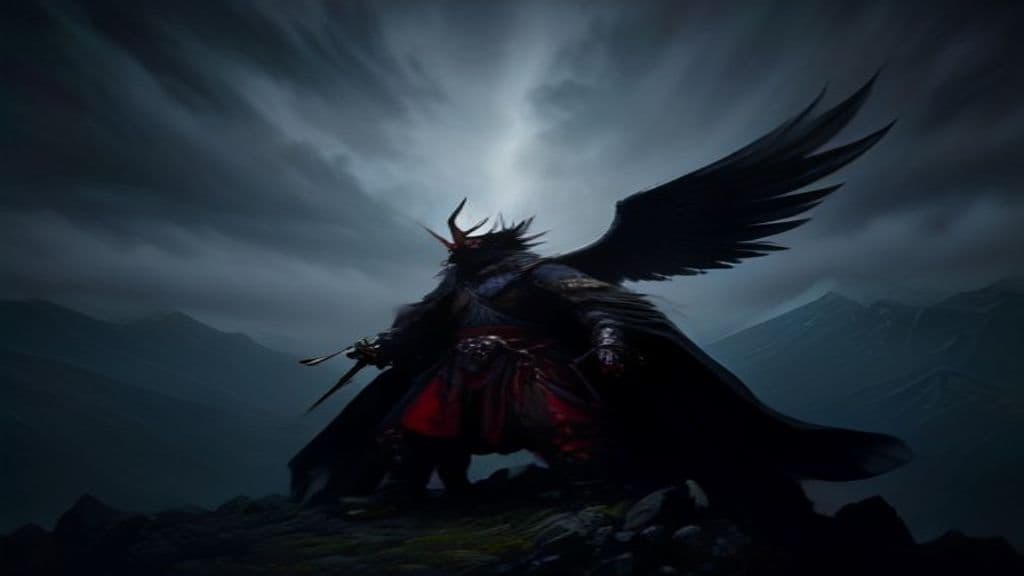
Contemporary sources cited in the available summary provide no physical description of Heshana Qaghan's person, dress, or features. Records identify him by title and clan name (Ashina Daman) and by honorific/transcribed khagan titles used in Chinese annals, but they do not preserve details of his appearance or emblematic regalia in the excerpted material.
The sources record Heshana Qaghan's capacities in political and military terms rather than supernatural powers. As khagan he exercised fiscal extraction and punitive authority over subject tribes, notably collecting excessive taxes from the Tiele and allegedly convening and killing about 100 Tiele chieftains, an action that provoked wide rebellion. The Tiele backed rival leaders (Geleng as Yiwuzhenmohe Khan and Yishibo as Yiedie Khan), driving Daman from Dzungaria toward the Ili River around 605. He was militarily challenged and routed by Shikui, after which he fled to Gaochang. Sui imperial diplomacy intervened: Pei Ju was dispatched to persuade him to come to the Sui court (he submitted after threats against his mother) and in 611 Emperor Yang granted him the title Heshana Qaghan and arranged a marriage to a Chinese princess. By 619 he had lost control of his khaganate and was at Chang'an, where, under pressure from Shibi khagan, Emperor Gaozu of Tang had him delivered to Eastern Turk emissaries to be executed.
Weaknesses
- conditionloss of tribal support
- conditionmilitary defeat by subordinates or rivals (e.g., Shikui)
- conditionvulnerability to Chinese imperial political leverage (threats to kin, promises of titles/marriage)
Wards
None recorded.
Abzar İyesi
A Turkic iyesi (possessive/guardian spirit) of the courtyard, outbuildings, and farmstead grounds; ambivalent in nature, it protects its domain but may harm livestock and cause mischief, often appearing in animal forms.
Ak Ana
Ak Ana (also Ağ Ana, Ak Ene) is the primordial water-mother of Turkic and some Siberian (Khanty, Mansi) traditions: a holy maternal creator principle associated with the pre-earth expanse of water, fertility of the land, and the threshold to the spirit world.
Akshobhya
Akshobhya is a transcendent buddha of Mahāyāna and Vajrayāna Buddhism, one of the Five Wisdom (Dhyāni) Buddhas. He personifies 'mirror knowledge' (ādarśa-jñāna), is conventionally placed in the East, and is lord of the eastern Pure Land Abhirati; in esoteric texts he is associated with the eastern Vajra division and invoked in mantra/mandala ritual contexts.
Al (Alı)
No folkloric or ethnographic evidence for a supernatural entity named "Al" or "Alı" is present in the supplied source set. The available materials are modern biographical, political, linguistic, and religious texts that do not describe a Turkish spirit, demon, or other supernatural being by this name.
Alaz
Alaz is the Turkic god of fire associated with hearths, flame, and the Great Fire (Ulugh Od). He is described as a powerful fire-being who sends protector-spirits (İye) to household hearths and can cause destructive fires when angered; fire under his authority is also a purifying force.
Alp Er Tunga
Alp Er Tunga is a legendary heroic ruler of Turan in early Turkic tradition, remembered as an ideal warrior-king and ancestral figure invoked in medieval dynastic genealogies. He also appears in Iranian epic tradition under the cognate name Afrosiyab/Afrasiab, where the figure is framed differently.
Amitābha Buddha
Amitābha is a principal Mahayana Buddha who presides over the Western Pure Land (the Land of Ultimate Bliss). Devotional practices—most centrally recitation of his name and chanting of Pure Land sutras—are presented in sources as the means by which Amitābha welcomes practitioners for rebirth in his hindrance-free realm.
Amrak
Amrak is not attested in the provided sources as a supernatural being. The lexical string "Amrak" appears across unrelated secular contexts — as a historical regnal name (Amrak Khagan / Ashina Anluo), a Turkish place-name (Çamrak / amrak), titles in modern Arabic-language music, an institutional name/acronym (AMRAK Institute), and as a modern brand/typeface/project name. No folkloric, ritual, or mythological descriptions of an entity called "Amrak" are present in the cited material.
Anantacāritra
Anantacāritra (Sanskrit: अनन्तचारित्र) is a bodhisattva figure in the Lotus Sūtra, identified as one of the four great perfected bodhisattvas who attend Gautama Buddha. The name is glossed as "Boundless Practice" and, in Tiantai commentary, is read as representing eternity.
Ao Guang (Dragon King of the East Sea)
Ao Guang is the Dragon King (Dragon God) who presides over the East Sea (Dōng Hǎi) in Chinese mythology, literature, and folk-religion. He is presented in sources as a regional aquatic deity associated with water and weather and appears as a named supernatural figure in classical vernacular novels such as Journey to the West and Fengshen Yanyi.
Ao Kuang
Ao Kuang (also attested as Ao Guang) is the Dragon King of the East Sea in Chinese mythology and folk religion, one of a quartet of sea-dragon sovereigns associated in folklore with the cardinal seas. He appears in classical literature and later popular media as a ruler of maritime waters whose favor or displeasure is connected to tides, rain, floods and storms.
Apa Qaghan
Apa Qaghan (阿波可汗, Ābō Kèhán) is an historical Ashina prince and mid-6th century claimant to the Göktürk khaganate. Sources portray him as a political and military actor involved in the succession disputes after Taspar Qaghan's death, ruling contested steppe territories and engaging with both western Turkic allies and Sui China.
Community Record
- [1]Heshana Qaghan — Wikipedia. Wikipedia contributors, 'Heshana Qaghan', Wikipedia, The Free Encyclopedia, https://en.wikipedia.org/wiki/Heshana_Qaghanwiki