
The sources treat Hindu gods as a class within a long-standing religious tradition rather than as a single unified origin narrative. Individual gods have distinct origins in particular texts: Mitra is attested in Vedic literature (Rigveda) and in the Mitanni inscription where he is invoked as a protector of treaties, and is generally listed among the Adityas, the sons of the goddess Aditi (Source 6). Other major deities are positioned within canonical genealogies and functional trios (for example, the modern reference to the Hindu trinity — Brahma, Vishnu, Shiva — in a contemporary dramatic adaptation), indicating layered mythic genealogies and roles across sources (Source 9). The general encyclopedia overview emphasizes that devotees may treat any given deity as supreme or as one among many depending on theological orientation (Source 1).
Appearance varies widely by deity and by regional/iconographic tradition. The sources give Ganesha as a clear visual example: "the chubby, gentle, wise, elephant-headed Hindu god," depicted with an elephant head on a corpulent human body and associated iconographic attributes tied to beginnings and scholarship (Source 8). The published summary for Mitra in the sources does not supply a physical description (Source 6). More broadly, the encyclopedia overview implies that appearance is specialized per deity and tradition rather than uniform (Source 1).
Abilities and social functions differ by deity and by devotional framing. Ganesha is described as the patron of beginnings and intellectuals and is "revered before major undertakings," indicating a customary power to bless ventures and remove obstacles in popular practice (Source 8). Mitra is historically invoked as a protector of treaties (Mitanni inscription, Rigveda), indicating a role in upholding oaths and social contracts in ancient contexts (Source 6). The general sources stress that conceptions of divine power are flexible: some traditions treat a deity as supreme (Ishvara/Bhagavān), others as one divine being among many (Deva/Devi), which shapes perceived abilities and authority (Source 1).
Weaknesses
- otherNo universal weakness; varies by deity and tradition — sources do not describe universal vulnerabilities to be exploited
Wards
- ritualDevotional discipline and ritual observances (mangalacharan, japa, aarti, bhog, dandavat pranam, tri-sandhya) — practices recorded as devotional prescriptions in a contemporary Hindi devotional excerpt rather than as wards against gods (Source 4)

Ganesha
Ganesha (Gaṇeśa), also called Ganapati or Vinayaka, is a widely revered Hindu deity identified by an elephant head who functions as remover of obstacles, patron of arts and learning, and god of beginnings; he is son of Shiva and Parvati and head of the gaṇas in many traditional accounts.

Hanuman
Hanuman is a divine vanara (monkey‑like being) in Hindu literature, foremost companion and devoted servant (Rama-dūta) of Lord Rama in the Ramayana. Revered in later Bhakti traditions, he is worshipped as a protector and exemplar of devotion, strength, and service.
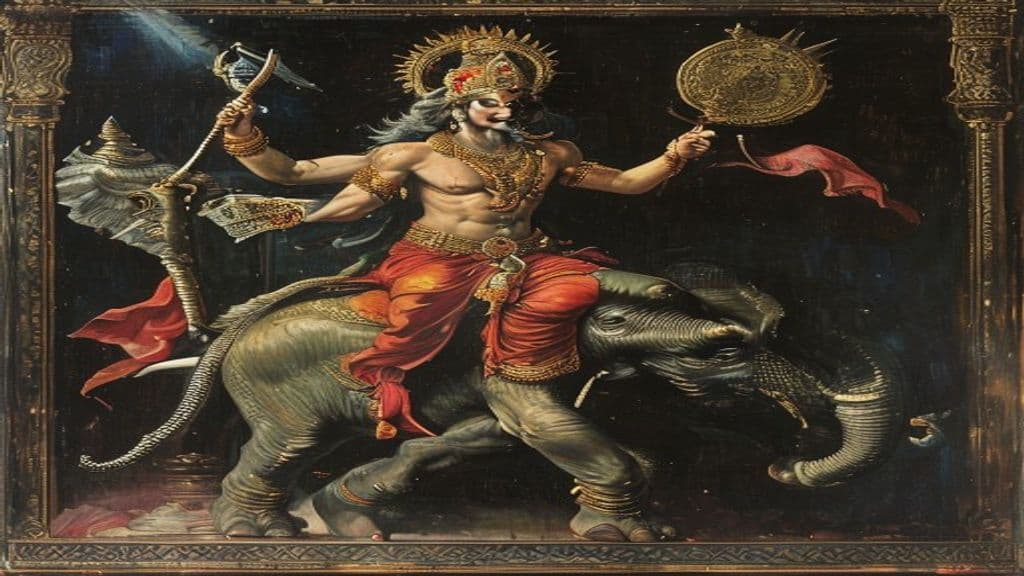
Indra
Indra is a major Vedic deity, king of the devas and lord of Svarga (heaven), associated primarily with the sky, storms, lightning, rain, rivers and martial heroism; he is central in the Rigveda and later appears across Hindu, Buddhist and Jain cosmologies with varying status.
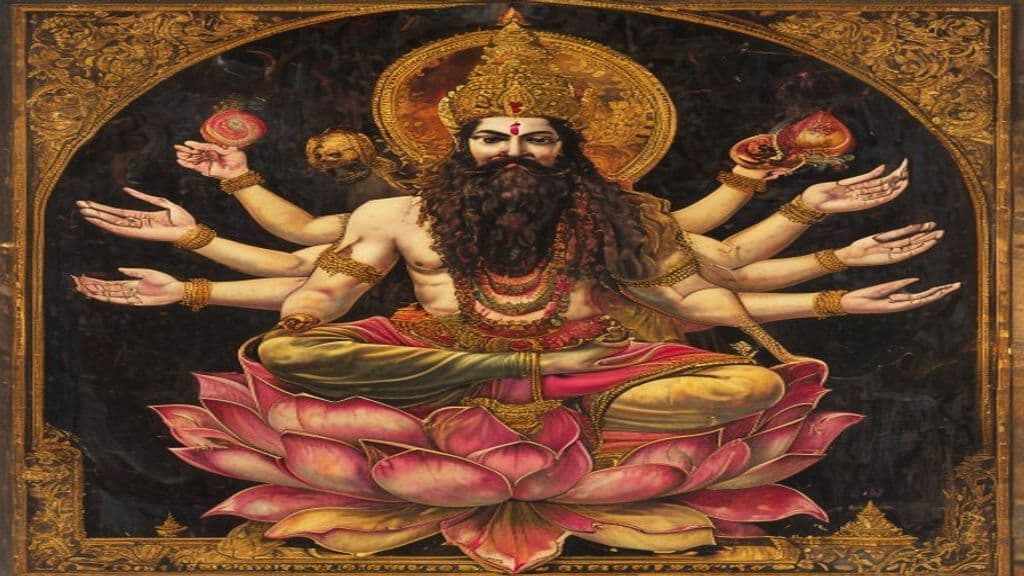
Brahmā
Brahmā is the personified Creator god in Hindu textual tradition, presented as the creative member of the Trimurti (with Viṣṇu and Śiva). In Purānic cosmogonies he is said to emerge as Svayambhu from Hiranyagarbha (the golden egg) and to produce the world and living beings; the term is distinct from the impersonal metaphysical brahman.
*Péh₂usōn (reconstructed)
Péh₂usōn is a hypothetical Proto‑Indo‑European pastoral guardian reconstructed by comparative scholars from parallels in Greek and Vedic traditions. Proposed as a Graeco‑Aryan ancestor‑figure, the reconstruction describes a protector of flocks, roads, and travellers rather than an attested historical cultic personality.
Abhimanyu
Abhimanyu is a youthful Kuru/Pandava warrior-hero in the Sanskrit epic Mahābhārata. Son of Arjuna and Subhadra, he is famed for entering the Chakravyuha battle formation on the thirteenth day of the Kurukshetra War and dying at age sixteen; his posthumous son Parikshit continues the Kuru line.
Achyuta
Achyuta (Sanskrit: अच्युत, acyuta) is primarily an epithet/theonym in Vaishnava Hindu tradition applied to Vishnu and Krishna, signifying the divine quality of being 'not fallen' — immutable, infallible, and imperishable. It functions as a devotional name in scripture, liturgy, and Pancharatra lists of divine emanations rather than as an autonomous folkloric spirit.
Acintya
Acintya is an Indonesian Hindu theological-symbolic representation of the ineffable supreme divine principle. In Balinese and Javanese practice it functions as a way to make ultimate reality present in ritual and art—often aniconically as an empty throne (padmasana) or anthropomorphically as a naked, flame-surrounded figure—rather than as a narrative, intervening deity.
Adi (asura)
Adi is attested in modern reference works as the name of an Asura who 'appears in the Matsya Purāṇa.' Beyond this single-line citation in secondary sources, no descriptive material about the figure is provided in the supplied research notes.
Adi Shakti
Adi Shakti (also Adi Parashakti, Mahadevi, Adya Shakti) is the primordial feminine power in Hindu/Shakta theology, regarded as the ultimate reality (Para Brahman) and the source from which all goddesses and gods manifest. She is both an impersonal cosmic principle (Mulaprakriti) and a focus of devotional invocation in temples, mantras, and pilgrimage sites such as Shakti Peethas.
Adi Vinayaka
Adi Vinayaka (Ādi Vināyaka; also called Nara Mukha Vinayaka) is a named iconographic and devotional form of the Hindu god Ganesha portraying the deity with a human head, described in sources as the form before the episode of decapitation by Shiva. It is rarely worshipped and appears in a small number of South Indian shrines and in devotional/musical repertoires.
Aditi
Aditi is a major Vedic goddess in Hindu tradition who personifies the boundless, infinite cosmic principle and functions as the maternal matrix from which many celestial deities (the Ādityas and other groups) are born. In the Vedic hymns she is invoked as a protective liberator who guards petitioners, provides wealth and safety, and frees devotees from hindrances such as sin and sickness.
Agastya
Agastya (also Agathiyar/Agasti) is a revered Vedic and later-period Indian rishi (sage) figure credited in textual traditions as an inspired seer, ascetic, teacher, culture-founder, and attributed author of Vedic, Puranic and Tamil works; in South Indian tradition he is associated with origins of Tamil grammar and Siddha medicine and is identified astronomically with the star Canopus.
Aghasura
Aghasura is an asura from the Vaishnava/Hindu narrative tradition (notably the Srimad‑Bhāgavatam) who, at the command of Kamsa, assumed the form of a vast serpent to ambush Kṛṣṇa and the cowherd boys in Vṛndāvana. The episode demonstrates Kṛṣṇa’s protective, divine power as he enters and destroys the demon from within.
Agiya Baital
The fire-form of the Vetala — a cremation ground spirit of UP and Bihar that manifests as a wandering flame rather than a corpse-inhabitor, leading night travellers off roads and into marshland or flames with a dancing fire that seems always just ahead.
Agneya / Āgneyī
Āgneyī (feminine) or Āgneya (masculine adjective) is a Vedic–Puranic divine figure and ritual principle tied to the fire-god Agni and the southeastern direction. In textual traditions she appears both as a personified daughter/shakti of Agni and as an adjectival/technical term applied to fire-consecrated things (direction, astra, etc.). She also occurs as the name Agneya (or Anala) among items revealed in a Shaiva-Agamic list associated with the Aghora face of Sadashiva.
Community Record
- [1]Hindu deities (Wikipedia). "Hindu deities are the gods and goddesses in Hinduism. Deities in Hinduism are as diverse as its traditions."wiki
- [2]Mitra (Hindu god) (Wikipedia). "Mitra (Sanskrit: मित्र IAST: Mitrá ) is a Hindu god and generally one of the Adityas... In the Mitanni inscription, Mitra is invoked as one of the protectors of treaties. In the Rigveda..."wiki
- [3]The Great Hindu God with the head of an elephant. "Ganesh, or Ganesha, the chubby, gentle, wise, elephant-headed Hindu god, is one of the most popular deities in Hinduism. He is the patron of beginnings and intellectuals. He is revered before major undertakings."other
- [4]Hindi devotional excerpt — rules essential for the devotee (archive). List of devotional prescriptions including सुबह उठकर मंगलाचरण करना; त्रिसंध्या वंदन; दंडवत प्रणाम; भोग, आरती; मासिक साध संगति (Source 4, Hindi excerpt).folk
- [5]Hindu Gods Get Summons From Court - American Renaissance (news item). News report noting a judge issued advertisements summoning Ram and Hanuman for a property dispute, illustrating civic invocation of deities (Source 7).other
- [6]The Displaced Hindu Gods Trilogy (dramatic adaptation). Modern dramatic work inspired by the Hindu trinity (Source 9).other
- [7]Buddhist vihara decoration question (Buddhism StackExchange). Note on appearance of Surya and Indra in Buddhist vihara decoration, illustrating cross-religious iconographic presence (Source 11).other