
In the classical tradition Hippolyta (Ancient Greek: Ἱππολύτη) is named as a daughter of Ares and Otrera and the ruling woman of the Amazons. Her royal position and kinship tie her into foundation and heroic myths: her girdle (zoster) is the object of Heracles' Ninth Labour, and her person is entwined with Theseus in variants that report abduction, marriage, or transfer of the Amazon queen to Athens. Multiple traditions diverge as to whether she surrendered the girdle willingly, was taken in battle, was abducted by Theseus, or was otherwise identified with other named Amazons (for example Antiope or Melanippe) in differing local or authorial accounts.
Classical summaries emphasize Hippolyta's role and insignia rather than a fixed portrait: she is described as the Amazon queen and the bearer of a named war-belt (zoster) associated with Ares and with her authority. Narrative contexts imply martial accoutrements appropriate to an Amazon ruler, but the supplied sources do not record a standardized physical description or specific costume details. In later literature (e.g., Shakespeare's A Midsummer Night's Dream) she appears as a noble bride-to-be at Theseus' court, a dramatic role rather than an ethnographic depiction.
In the classical material Hippolyta's notable capacities are political and military leadership as queen of the Amazons and possession of the zoster, a war-belt that functions as a token of authority; the belt is central to Heracles' labour narrative. Behaviors recorded across traditions vary: in some accounts she offers or surrenders the belt to Heracles (reports say she was impressed and gave it without argument), in others she is resisted, abducted, or becomes entangled in the Theseus narratives. Modern adaptations attribute expanded supernatural or immortal traits to characters named Hippolyta (for example DC Comics’ reinterpretations present Amazon queens with enhanced longevity or mythic power), but these are reception-layer reworkings and not classical attestations in the supplied sources.

Ares
Ares (Ancient Greek: Ἄρης) is the ancient Greek Olympian god of war who personifies the physical violence, valor, and bloodlust of combat. Worshiped irregularly across Greece and Asia Minor, he was both honored and ritually restrained by communities that sought to direct his martial power toward protection rather than wanton destruction.
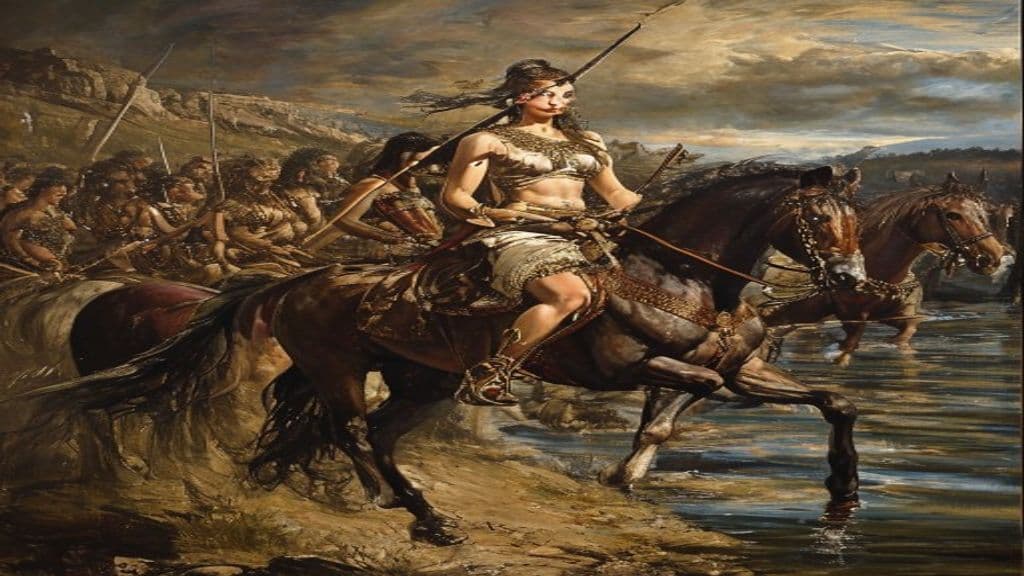
Amazons
A society of women-warriors in ancient Greek myth and legend, depicted as skilled horsemen and archers who inhabit the periphery of the Greek world and act as recurring opponents and counterparts to Greek heroes. Treated by ancient authors as a past people and by modern scholars as a mythic construct possibly inspired by Eurasian female warrior burials.

Heracles
Heracles is the greatest hero of Greek myth whose career bridges mortal hero-cult and full divinization. Celebrated for his Twelve Labours, martial prowess, and travels between the mortal world, the underworld, and Olympus, he functioned as a civic patron, ancestor of royal lines (the Heracleidae), and object of cult that treated him both as chthonic hero and as god.

Theseus
Theseus is a legendary hero of Greek myth credited with clearing dangers from Attic roads, slaying the Minotaur, and performing foundational civic acts for Athens (including synoikismos and establishing cult practice). He is portrayed as of mixed mortal and divine parentage and functions as a culture-hero and exemplar in later authors' moralizing biographies.
*Péh₂usōn (reconstructed)
Péh₂usōn is a hypothetical Proto‑Indo‑European pastoral guardian reconstructed by comparative scholars from parallels in Greek and Vedic traditions. Proposed as a Graeco‑Aryan ancestor‑figure, the reconstruction describes a protector of flocks, roads, and travellers rather than an attested historical cultic personality.
3-D Man
3-D Man is a Marvel Comics superhero identity associated with a 1950s-era origin in which the body of Chuck Chandler can materialize in three-dimensional existence when activated by his brother Hal via a pair of glasses. The mantle was later assumed by Delroy Garrett (formerly Triathlon) in modern continuity.
5 Ronin
5 Ronin is a 2011 Marvel Comics five-issue limited series that reimagines five Marvel superhero archetypes as rōnin (masterless samurai) in a fictionalized post‑Sekigahara feudal Japan. The work places Wolverine, Hulk, Punisher, Psylocke, and Deadpool analogues into period roles to explore displacement, revenge, and identity in an era of political upheaval.
58 Concordia
58 Concordia is a fairly large main-belt asteroid orbiting the Sun, discovered in 1860 and named after the Roman goddess Concordia. Astronomical sources classify it as a C-type (carbonaceous) body with a multi-year orbital period and measurable rotation and pole orientations.
9MOTHER9HORSE9EYES9
An anonymous Reddit screen name and online persona used by the author of the Interface series, a multipart speculative-horror narrative posted in short installments across Reddit in 2016. The name functions as the signature of an authorial identity and as a focal label for a fandom that created archives, a subreddit, and a wiki documenting the story and its fictional phenomena (notably entities called "flesh interfaces").
A.R.G.U.S.
A.R.G.U.S. is a fictional clandestine United States government agency in the DC Comics universe that investigates, contains, and manages superhuman, meta-human, and supernatural incidents and assets. Introduced in The New 52 continuity, it functions as an institutional actor providing intelligence, logistical support, covert task forces (notably Task Force X / the Suicide Squad), and a dedicated magic division across comics and media adaptations.
Aba (disambiguation / name-form)
Aba is a polyvalent name-form attested across many unrelated contexts (place names, personal names, animal names, and brief mythological listings). The provided sources do not support a single, coherent supernatural entity called "Aba" and offer no descriptive or ritual material for such a being.
Abarbarea
Abarbarea is a name attested in classical Greek and Roman sources for freshwater nymphs (naiads). The name appears for at least two individual mythic figures — a naiad wife of Bucolion and a naiad counted among ancestors of the Tyrians — and Hesychius records plural forms that may indicate the name was also used as a class-name (Abarbareai / Abarbalaiai).
Abas
Abas (Ancient Greek: Ἄβας, gen.: Ἄβαντος) is not a single mythic being but a recurring personal name borne by multiple mortals and minor mythic figures in Greek epic and genealogical traditions — kings, founders, seers, warriors, attendants, a centaur, and a youth transformed by a goddess. The name is glossed in the sources as 'guileless' or 'good-hearted' and appears across Argive, Theban, Trojan, Euboean, and other local cycles.
Abderus
Abderus (Ancient Greek: Ἄβδηρος, romanized Ábdēros) is a mortal heroic figure in Greek myth closely associated with Heracles, remembered as the youth left in charge of the Mares of Diomedes who was killed by them. He functions as an eponymous local/divine-hero ancestor for the city of Abdera and received funerary commemoration and athletic agones at his tomb.
Abdiel
Abdiel (Hebrew עֲבְדִּיאֵל) is primarily a theophoric Hebrew personal name meaning "servant of El/servant of God," attested once in the Hebrew Bible (1 Chronicles 5:15). In later literature—most notably John Milton's Paradise Lost—Abdiel is reimagined as a faithful seraph who opposes Satan's revolt. The provided sources do not treat Abdiel as an autonomous folkloric spirit type or record rituals or wards associated with the name.
Abena Mansa
A name attested in a single contemporary Ghanaian blog anecdote as a 'mysterious being'; available sources do not establish Abena Mansa as a coherent, traditional supernatural figure or provide corroborating ethnographic detail.
Community Record
- [1]Hippolyta (Wikipedia). Wikipedia contributors, 'Hippolyta', Wikipedia, The Free Encyclopedia.wiki
- [2]Hippolyta (DC Comics) (Wikipedia). Wikipedia contributors, 'Hippolyta (DC Comics)', Wikipedia, The Free Encyclopedia.wiki
- [3]A Midsummer Night's Dream — Act 5 scene 1 (online text). William Shakespeare, A Midsummer Night's Dream, Act 5 scene 1 (online edition).literary
- [4]Hippolyta — Marvunapp (Olympian goddess / Amalgam entries). Marvunapp entry 'Hippolyta (Olympian goddess)' (popular reference / comic adaptation summary).other
- [5]Alchetron: Hippolyta. Alchetron entry 'Hippolyta' (popular-encyclopedia summary).other
- [6]Wikidata: Hippolyta. Wikidata entry Q21486050 'Hippolyta'.wiki
- [7]Selections from theatrical and reception materials referencing Hippolyta. Archive collection including theatrical discussions referencing Hippolyta in reception contexts.other
- [8]Battlestar Wiki: Hippolyta (fanwiki). Battlestar fan wiki entry 'Hippolyta' (modern fictional adaptation).other