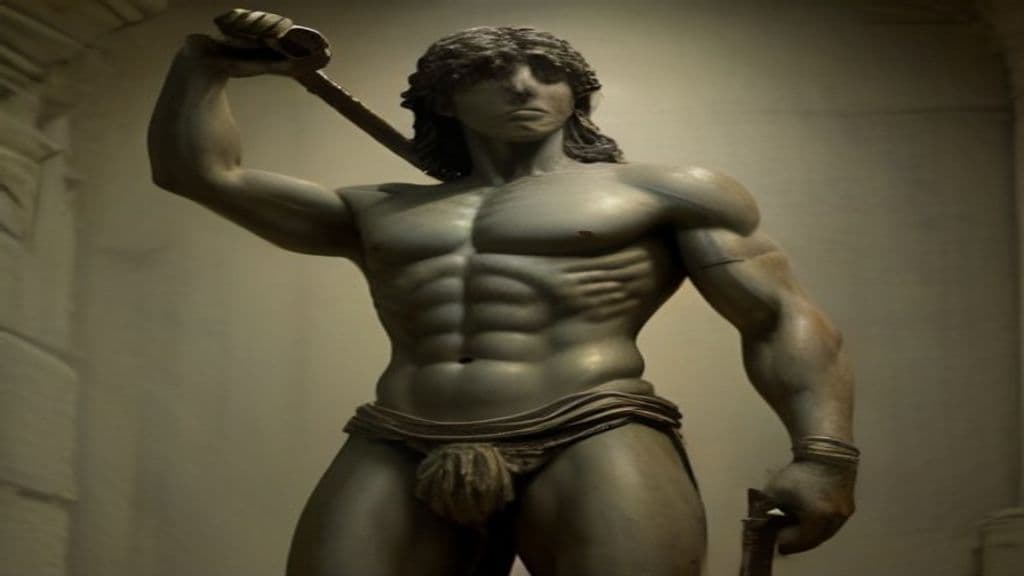
Theseus is narrated as the son of Aethra and Aegeus (with some accounts adding Poseidon as a divine father), conceived in the mythic past and raised in Troezen. As a youth he recovered his father's tokens (sword and sandals) concealed under a heavy rock, proving his lineage and embarking on the overland journey to Athens. His mixed mortal/divine parentage is given in classical summaries as the motif explaining his exceptional status among Greek heroes.
Classical texts and later iconography represent Theseus as a robust, physically powerful young man rather than as a non-human apparition. Narrative attributes function as identifying markers in art and story: the stout staff or club associated with his defeat of Periphetes, the sword and sandals retrieved from beneath the rock, and scenes of wrestling or single combat. Later prints and paintings continue to portray him in heroic human form (e.g., scenes with Aegeus or Aethra).
Theseus is depicted with exceptional physical strength, martial skill, and cunning; he performs a series of six road-labours (Periphetes the Club Bearer, Sinis/Pityokamptes, the Crommyonian Sow, Sciron, Cercyon, Procrustes) clearing chthonic dangers at liminal sites, and he later sails to Crete and slays the Minotaur. His supposed divine paternity (Poseidon in some accounts) and mortal descent (Aegeus) are given as the mythic explanation for his extraordinary capacities. As king-founder he also undertakes civic acts: synoikismos (political consolidation of Attica), building a palace on the Acropolis (reported in summaries), and establishing cult practice (notably an Aphrodite cult on the Acropolis' southern slope ascribed by Pausanias in later reports cited in summaries).
Weaknesses
- otherhuman fallibility (narrative errors and moral failings)
- othervulnerabilities in story: family tragedy (forgetting to change sails leading to Aegeus' death) and susceptibility to betrayal or domestic plots (Ariadne's abandonment, Medea's plotting in sources)
Wards
None recorded.

*Perkʷūnos
*Perkʷūnos is the reconstructed Proto-Indo-European thunder‑god hypothesized by comparative linguistics and mythology. Scholarly reconstructions portray him as a storm or thunder figure associated with fructifying rain and as the combatant who fights a multi‑headed water‑serpent to release life‑giving waters; no direct attestations from the Proto‑Indo‑European period survive and the figure is inferred from later Indo‑European traditions.
*Péh₂usōn (reconstructed)
Péh₂usōn is a hypothetical Proto‑Indo‑European pastoral guardian reconstructed by comparative scholars from parallels in Greek and Vedic traditions. Proposed as a Graeco‑Aryan ancestor‑figure, the reconstruction describes a protector of flocks, roads, and travellers rather than an attested historical cultic personality.
3-D Man
3-D Man is a Marvel Comics superhero identity associated with a 1950s-era origin in which the body of Chuck Chandler can materialize in three-dimensional existence when activated by his brother Hal via a pair of glasses. The mantle was later assumed by Delroy Garrett (formerly Triathlon) in modern continuity.
5 Ronin
5 Ronin is a 2011 Marvel Comics five-issue limited series that reimagines five Marvel superhero archetypes as rōnin (masterless samurai) in a fictionalized post‑Sekigahara feudal Japan. The work places Wolverine, Hulk, Punisher, Psylocke, and Deadpool analogues into period roles to explore displacement, revenge, and identity in an era of political upheaval.
57 Mnemosyne
57 Mnemosyne is a large main-belt asteroid (S-type) discovered in 1859 and named after the Greek Titaness Mnemosyne. It is a non-sentient astronomical body studied for its orbital and rotational properties and has been used in dynamical measurements related to Jupiter.
A Elbereth Gilthoniel
An Elvish hymn in Sindarin addressed to Elbereth (Varda) from J. R. R. Tolkien's legendarium. Presented in The Lord of the Rings and later musical and dramatic adaptations, the hymn functions as devotional poetic language that evokes Elvish reverence for the star-kindler rather than an independent supernatural agent.
A.R.G.U.S.
A.R.G.U.S. is a fictional clandestine United States government agency in the DC Comics universe that investigates, contains, and manages superhuman, meta-human, and supernatural incidents and assets. Introduced in The New 52 continuity, it functions as an institutional actor providing intelligence, logistical support, covert task forces (notably Task Force X / the Suicide Squad), and a dedicated magic division across comics and media adaptations.
Aba (disambiguation / name-form)
Aba is a polyvalent name-form attested across many unrelated contexts (place names, personal names, animal names, and brief mythological listings). The provided sources do not support a single, coherent supernatural entity called "Aba" and offer no descriptive or ritual material for such a being.
Abaddon
In Hebrew scripture Abaddon is primarily a noun meaning 'destruction' or a section/condition of the underworld paired with Sheol; in the New Testament Book of Revelation Abaddon is personified as an angelic figure (Greek Apollyon) described as the king of an army of locusts released from the abyss during the apocalypse.
Aban Yasht
The Aban Yasht is a hymn from the Persian tradition that praises Anahita, a goddess associated with water, fertility, and wisdom. It consists of 132 stanzas and is part of the 21 Yashts collection. (Note: - Power tier should be "Primordial" or possibly "Cosmic", given that it's a hymn of great spiritual significance and associated with a goddess. - The article incorrectly states that Anahita is associa)
Abarbarea
Abarbarea is a name attested in classical Greek and Roman sources for freshwater nymphs (naiads). The name appears for at least two individual mythic figures — a naiad wife of Bucolion and a naiad counted among ancestors of the Tyrians — and Hesychius records plural forms that may indicate the name was also used as a class-name (Abarbareai / Abarbalaiai).
Abas
Abas (Ancient Greek: Ἄβας, gen.: Ἄβαντος) is not a single mythic being but a recurring personal name borne by multiple mortals and minor mythic figures in Greek epic and genealogical traditions — kings, founders, seers, warriors, attendants, a centaur, and a youth transformed by a goddess. The name is glossed in the sources as 'guileless' or 'good-hearted' and appears across Argive, Theban, Trojan, Euboean, and other local cycles.
Community Record
- [1]Theseus - Wikipedia (excerpted). Wikipedia: 'Theseus … was a divine hero in Greek mythology, famous for slaying the Minotaur.'; 'The mix gave Theseus a combination of divine as well as mortal characteristics…'; 'Pausanias reports that after synoikismos, Theseus established a cult of Aphrodite ("Aphrodite of all the People") on the southern slope of the Acropolis.'wiki
- [2]Wikidata entry Q110738703. Wikidata: Theseus listed as a male given name / entity entry referenced in supplied materials.other
- [3]Archive: Theseus and Aegeus (print). Archive listing indicating later artistic depiction titled 'Theseus and Aegeus' referenced in supplied materials.other
- [4]Archive: Theseus and his Mother Aethra | Laurent de la Hyre (print). Archive listing indicating later artistic depiction 'Theseus and his Mother Aethra' referenced in supplied materials.other
- [5]Archive: related cultural item referencing 'Ship of Theseus' thought experiment. Archive listing noted among supplied materials indicating later cultural uses of the Theseus figure (Ship of Theseus reference).other