
Ancient testimonies offer multiple, often contradictory accounts of Homer's origins and life: various cities (Chios, Smyrna, Cyme, Ios, Argos, Pylos, Athens) claimed him, and some biographies assign mythical parentage (e.g., a Muse) or other legendary details. Modern scholarship dates the composition of the Iliad and the Odyssey to roughly the late eighth or early seventh century BC and emphasizes oral transmission and formulaic composition; many scholars treat the poems as products of an oral tradition and debate the extent to which a single historical individual named Homer authored them. Antiquity also attributed a broader corpus (the 'Homerica' such as the Homeric Hymns, Batrachomyomachia, Margites) to the Homeric name, demonstrating how the persona served as an anchor for multiple related works.
Ancient biographical traditions repeatedly depict Homer as blind, a recurring motif in most surviving lives and testimonies; beyond that motif there is no consistent corporeal portrait in the sources. Later antiquarian accounts supply varying details of parentage and regional origin, but no single, reliable physical description emerges from the tradition. Modern popular uses of the name (for example, the fictional character Homer Simpson) are separate cultural adaptations and are not descriptions of the classical persona.
The sources attribute to Homer literary and performative mastery rather than supernatural powers: composition and recitation of long epic narratives, expertise in oral-formulaic technique, and the role of a rhapsode or wandering bard who performed at festivals and public gatherings. The Homeric poems are credited with shaping Greek education and ideals (heroism, glory, honor), and Plato famously remarks that Homer 'has educated Greece,' indicating the formative cultural influence of the works associated with the name.
Weaknesses
- conditionnot applicable — sources provide no magical weaknesses
Wards
- othernone recorded — sources do not describe ritual wards or protections against Homer

Rusalka
Water spirits in Slavic folklore — the spirits of young women who died by drowning or suicide, bound to rivers and lakes. Beautiful and dangerous, they can bewitch men to their deaths.
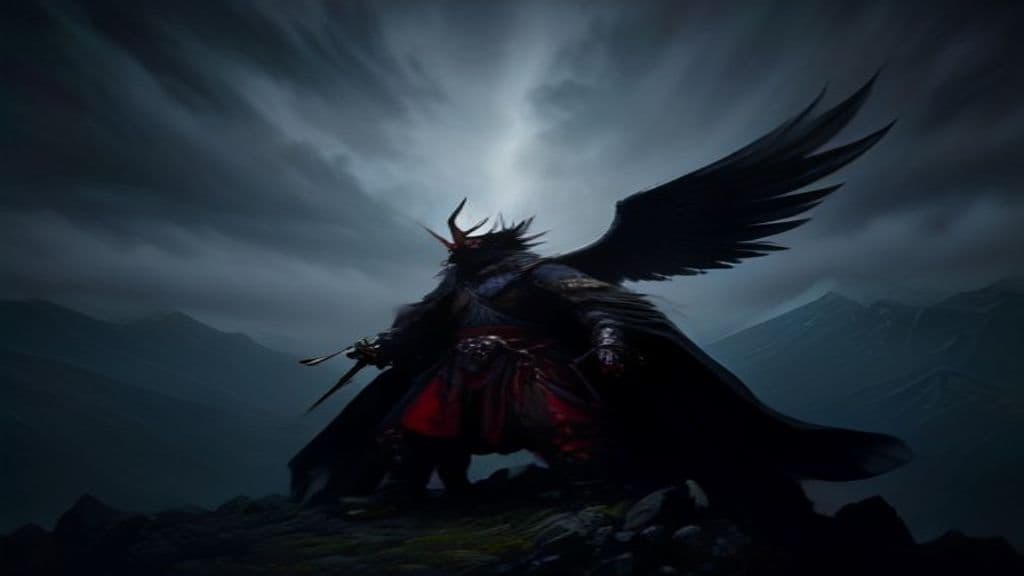
Tengu
Proud, warrior-like mountain spirits of Japan, associated with martial arts, pride, and the wild mountains. Neither fully good nor evil — they test and train warriors and monks, but punish the arrogant.
Rusalka
Water spirits in Slavic folklore — the spirits of young women who died by drowning or suicide, bound to rivers and lakes. Beautiful and dangerous, they can bewitch men to their deaths.

Banshee
A female spirit of Irish and Scottish folklore whose wail heralds an impending death in a family of Gaelic descent. Not a cause of death — a witness to it.
*Perkʷūnos
*Perkʷūnos is the reconstructed Proto-Indo-European thunder‑god hypothesized by comparative linguistics and mythology. Scholarly reconstructions portray him as a storm or thunder figure associated with fructifying rain and as the combatant who fights a multi‑headed water‑serpent to release life‑giving waters; no direct attestations from the Proto‑Indo‑European period survive and the figure is inferred from later Indo‑European traditions.
*Péh₂usōn (reconstructed)
Péh₂usōn is a hypothetical Proto‑Indo‑European pastoral guardian reconstructed by comparative scholars from parallels in Greek and Vedic traditions. Proposed as a Graeco‑Aryan ancestor‑figure, the reconstruction describes a protector of flocks, roads, and travellers rather than an attested historical cultic personality.
57 Mnemosyne
57 Mnemosyne is a large main-belt asteroid (S-type) discovered in 1859 and named after the Greek Titaness Mnemosyne. It is a non-sentient astronomical body studied for its orbital and rotational properties and has been used in dynamical measurements related to Jupiter.
Aba (disambiguation / name-form)
Aba is a polyvalent name-form attested across many unrelated contexts (place names, personal names, animal names, and brief mythological listings). The provided sources do not support a single, coherent supernatural entity called "Aba" and offer no descriptive or ritual material for such a being.
Abaddon
In Hebrew scripture Abaddon is primarily a noun meaning 'destruction' or a section/condition of the underworld paired with Sheol; in the New Testament Book of Revelation Abaddon is personified as an angelic figure (Greek Apollyon) described as the king of an army of locusts released from the abyss during the apocalypse.
Aban Yasht
The Aban Yasht is a hymn from the Persian tradition that praises Anahita, a goddess associated with water, fertility, and wisdom. It consists of 132 stanzas and is part of the 21 Yashts collection. (Note: - Power tier should be "Primordial" or possibly "Cosmic", given that it's a hymn of great spiritual significance and associated with a goddess. - The article incorrectly states that Anahita is associa)
Abandinus
Abandinus is a locally attested Romano‑Celtic theonym known from a single inscribed bronze feather (votive object) dedicated at Godmanchester (the Roman fort Durovigutum) in Cambridgeshire. Scholars interpret him as a local god or male spirit tied to a specific place and possibly associated with a nearby spring or stream; this association is tentative and based on etymological readings of the name.
Abarbarea
Abarbarea is a name attested in classical Greek and Roman sources for freshwater nymphs (naiads). The name appears for at least two individual mythic figures — a naiad wife of Bucolion and a naiad counted among ancestors of the Tyrians — and Hesychius records plural forms that may indicate the name was also used as a class-name (Abarbareai / Abarbalaiai).
Abas
Abas (Ancient Greek: Ἄβας, gen.: Ἄβαντος) is not a single mythic being but a recurring personal name borne by multiple mortals and minor mythic figures in Greek epic and genealogical traditions — kings, founders, seers, warriors, attendants, a centaur, and a youth transformed by a goddess. The name is glossed in the sources as 'guileless' or 'good-hearted' and appears across Argive, Theban, Trojan, Euboean, and other local cycles.
Abath
No corroborated folkloric entity named "Abath" is documented in the provided sources. The string appears in the supplied material only as a surname/personal name in Aruban/Dutch-Caribbean archival records and as an unrelated taxonomic or encyclopedic hit; no mythic attributes, origin stories, rituals, or apotropaic practices for an entity called Abath are present in the documents reviewed.
Abatur
Abatur is an uthra (celestial emanation) in Mandaeism described as the 'father of the Uthras' and called the Ancient (ʿattīqā). He resides on the boundary between the World of Light and lower regions, functions as a judge who weighs souls (Abatur Muzania), and supplies instructions and materials to the demiurgic uthra Ptahil in accounts from the Diwan (Scroll) of Abatur.
Abatwa (Twa / Batwa)
Abatwa (also recorded as Twa, Batwa, Mutwa; singular forms Barhwa or Murhwa in some transcriptions) are indigenous hunter‑gatherer peoples of the Great Lakes region of Central Africa, historically identified as some of the earliest inhabitants of the area. The available sources treat them as human ethnic groups whose livelihoods, lands, and populations have been severely affected by conservation policies and modern violence.
Community Record
- [1]Homer - Wikipedia. Wikipedia, 'Homer'.wiki
- [2]The Iliad by Homer (MIT Classical Archive). The Internet Classics Archive, 'The Iliad' translated text.literary
- [3]On Translating Homer, by Matthew Arnold (parts 1–2). Matthew Arnold, 'On Translating Homer'.literary
- [4]Homer Simpson - Wikipedia. Wikipedia, 'Homer Simpson' (example of modern cultural reuse of the name).wiki
- [5]Homer and the Iliad (users.globalnet.co.uk). Online essay, 'Homer and the Iliad'.other