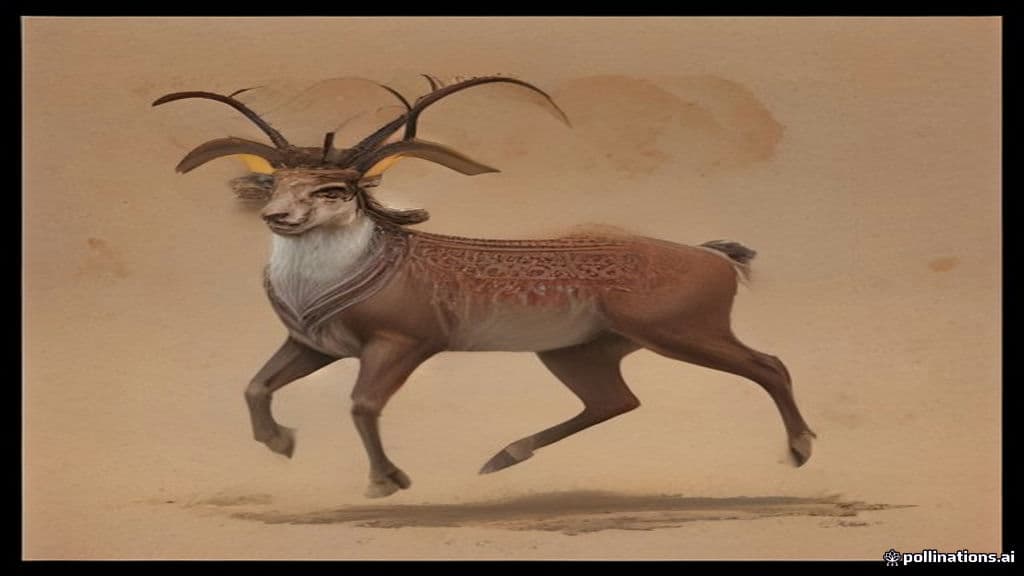
Ibex is an animal (non-supernatural) in Mesopotamian folklore, from Eurasia. A group of wild goat species (genus Capra) notable for the males' large curved, ridged horns; in the provided sources the ibex is treated as a biological taxon and a recurring archaeological and cultural motif rather than a supernatural being.
The provided sources do not record a mythic or supernatural origin for the ibex. Instead, they situate the animal within natural history and material culture: ibex species are biological members of genus Capra, and depictions of ibex appear across ancient archaeological contexts (Harappan seals, Minoan and Near Eastern artifacts), reflecting the animal's economic and symbolic presence in prehistoric and historic societies rather than a narrated creation or divine origin in the supplied corpus.
Ibex are wild goats characterized by sexually dimorphic size and horn development; males bear large, curved horns with transverse frontal ridges, while females are smaller with thinner, more slowly growing horns. Species differences include the Siberian ibex (80–100 cm at the shoulder, ~60 kg average, long pointed beards, scimitar-shaped horns, dark brown coat with greyish underparts), the Nubian ibex (the smallest species, tan with white underbelly and rump, black legs and dark tail, adapted to arid environments), the Alpine ibex (European Alps), the Iberian ibex (Iberian mountain enclaves), and the Walia ibex (endemic to the Simien Mountains). Horns begin forming at birth and grow throughout life.
Sources describe ecological and behavioral traits rather than supernatural powers. Ibex species are adapted to rugged, often high‑elevation terrain (e.g., Siberian ibex commonly occupy 3000–5300 m, with local variation) or to arid desert regions (Nubian ibex). Their preference for precipitous, rocky habitats functions as an anti‑predator strategy. Human interactions detailed in the sources are hunting and exploitation in prehistory (e.g., ibex DNA in Ötzi's stomach), representation in art and jewelry across multiple ancient cultures, modern conservation concerns, and use as national or regional symbols (notably in Yemen).
'Ain Samiya Goblet
Silver cup from the Middle Bronze Age I, discovered in a tomb at Ain Samiya. (Note: 1. Power tier should be "None", but add a note explaining that historical artifacts don't fit into the typical power tier classification. 2. Add a description of its appearance based on it being a sil)
A'annepada
A'annepada (Sumerian cuneiform 𒀀𒀭𒉌𒅆𒊒𒁕; also romanized Aanépàdda) is attested as a historical ruler of the First Dynasty of Ur, flourishing c. 2350 BC. He is recorded in dedicatory and foundation inscriptions as king of Ur and as son of Mesannepada, credited with temple-building and dedication to deities such as Ninhursag and Inanna.
Abu
Abu is a poorly understood Mesopotamian god attested in modern reference summaries. Secondary literature tentatively links him with vegetation and snakes and records that he was often paired with a deity written gu2-la2, but primary details about his cult, iconography, and myths are lacking in the cited sources.
Abzû
Abzû (Sumerian abzû; Akkadian Apsû) is the primordial freshwater abyss in Sumerian–Akkadian cosmology: the deep fresh waters that underlie and surround the earth, source of springs, rivers and ritual holy waters, and a creative principle whose mingling with the salt sea (Tiamat) figures in Mesopotamian cosmogony.
Abī-simtī
Abī-simtī (also rendered Abi-simti, Abisimti) is a named woman attested in third-millennium BCE Mesopotamian documentary and literary texts. She appears in administrative account records as a provider of animals and donor to temple cults and in Sumerian love-song literature as the named beloved/consort addressed by a royal speaker.
Adad
Adad (also Hadad, Haddad; Sumerian Iškur) is the storm- and rain-deity attested in ancient Mesopotamian and Canaanite religious contexts. Sources identify him as a principal weather god whose domain is storms and rainfall and whose name appears across multiple Near Eastern languages and sites, including Ebla (as Hadda, c. 2500 BCE).
Adapa
Adapa is a mythic figure from ancient Mesopotamian (Sumerian and Akkadian) literature: a mortal fisherman and temple sage of Ea at Eridu endowed with exceptional wisdom. He appears in a fragmentary tale in which he breaks the wings of the south wind and is summoned to the divine court; his name was later invoked in exorcistic and ritual contexts as an authoritative identity.
Adbar
Adbar is an Ethiopian belief concerning spirit possession that is discussed in scholarship and contemporary art alongside the wider regional phenomenon known as zār. These spirits are held to possess individuals (reported mostly among women), causing discomfort or illness; ritual practice aims to reconcile the spirit and the person rather than to eliminate the spirit.
Adonis
Adonis is a mythic mortal youth in ancient Greek tradition, beloved by goddesses (notably Aphrodite and Persephone) whose death and seasonal return are the focus of the women’s midsummer festival Adonia. The cultic practices—planting short-lived 'gardens of Adonis' on rooftops, ritual lamentation, and casting an effigy and withered plants into the sea—symbolically link him to vegetation cycles and Near Eastern dying-and-regenerating god traditions.
Adrammelech
Adrammelech is attested in ancient Semitic textual tradition as a local god of 'Sepharvaim.' The name is commonly glossed as "Magnificent king." In modern times the name has been reused in diverse fictional, musical, and online contexts, but those are creative reworkings rather than continuations of the brief ancient attestation.
Aga of Kish
Aga of Kish (Aga, Agga, Akka) is an Early Dynastic Mesopotamian king recorded in the Sumerian King List, the Tummal Inscription, epigraphic objects, and the Sumerian poem "Gilgamesh and Aga." He functions in texts as a historical/legendary political actor who attempted hegemonic demands on Uruk and was ultimately captured and released by Gilgamesh.
Agasaya
Agasaya is presented in modern secondary sources as a little-attested Semitic war goddess who, according to some summaries, was later absorbed as the warrior aspect of the major Mesopotamian goddess Ishtar. The attestation in available materials is sparse and much inferences about her name, attributes, and later influence are explicitly marked speculative in those sources.
Community Record
- [1]Ibex — Wikipedia. Wikipedia contributors. "Ibex." Wikipedia, The Free Encyclopedia.wiki
- [2]Ibex (Wikidata). Wikidata entry Q951220, "ibex".other
- [3]CIA Reading Room — NEWSWEEK QUESTIONS FOR VICE PRESIDENT BUSH (excerpt). CIA Reading Room document (archive.org), fragmentary references to 'ibex' in logistical/reporting contexts.other
- [4]CIA Reading Room — RAIL FREIGHT TRAFFIC VIA GUBEN (excerpt). CIA Reading Room document (archive.org), fragmentary usage of the term 'ibex'.other
- [5]CIA Reading Room — ERFURT-BINDERSLEBEN AIRFIELD (excerpt). CIA Reading Room document (archive.org), fragmentary usage of the term 'ibex'.other