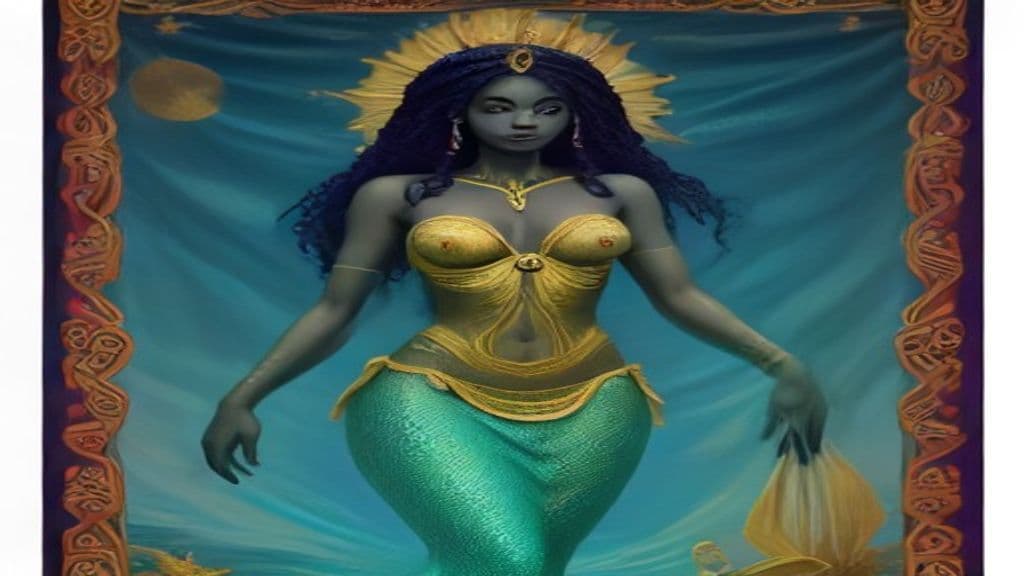
La Sirène's presence in Haitian Vodou is part of a trans‑Atlantic set of water‑spirit beliefs that link West and Central African mermaid/water‑spirit concepts with Caribbean religious formation. Comparative literature on Mami Wata situates mermaid/water‑spirit figures across African and Atlantic contexts, and scholarship and cultural materials on Haitian Vodou describe how Vodou absorbed and adapted diverse African-derived spirits and European iconography. Sources representing La Sirène in Vodou contexts (including pantheon lists and visual ritual objects) locate her within the living pantheon of lwa rather than as an isolated folktale figure (sources: Mami Wata overview; Haitian Vodou contextual sources and exhibition/catalog descriptions) (sources: 1, 6, 9, 11).
Visual and material culture consistently present La Sirène in mermaid/merwoman form with marine motifs. Drapo (Vodou flags) and sequined embroidered banners depict her as a merwoman — for example, a flagged drapo labeled "La Sirene, La Baleine" shows a merwoman playing a horn amid fish and star motifs; exhibitions and gallery presentations also display images of La Sirène alongside other lwa (sources: auction listing for Vodou flag; exhibition/catalog materials; Haitian Vodou art overviews) (sources: 12, 11, 14, 15). Textual sources in the provided material do not supply a standardized textual physical description beyond these visual depictions.
The provided sources do not record detailed, specific powers, behavioral narratives, or liturgical functions unique to La Sirène. What is documented is her status as a Vodou lwa and her inclusion in ritual and visual practice — that is, she is a spirit referenced, depicted, and engaged with within Vodou's ritual culture. Comparative material on Mami Wata places such water spirits within a broader tradition of powerful and sometimes ambivalent aquatic beings, but the supplied sources do not attribute particular abilities (such as bestowing wealth, causing possession, or inflicting harm) to La Sirène specifically and do not provide ritual texts describing such functions (sources: 1, 11, 12).

A ƭat Roog
A term attested in the vocabulary surrounding Roog within the Serer religious system; the provided sources do not supply a clear definitional account of an entity by this exact name. Material available situates the term in the wider context of Serer cosmology in which Roog is the universal supreme deity and ancestor cult (pangool) and priestly mediation (o yaal pangool) structure ritual life.
Abena Mansa
A name attested in a single contemporary Ghanaian blog anecdote as a 'mysterious being'; available sources do not establish Abena Mansa as a coherent, traditional supernatural figure or provide corroborating ethnographic detail.
Abonsam
Abonsam is a malevolent spirit name used in accounts from the Gold Coast (modern Ghana) to explain community-level misfortune such as accidents and disease. When local ritual specialists diagnose Abonsam as the cause, communities perform a prolonged communal expulsion ritual intended to drive the spirit into the sea.
Adjassou-Linguetor
Adjassou-Linguetor is a loa in Haitian Vodou associated with spring water. The limited cited sources describe her as having protruding eyes and a bad temper; beyond these points, the available documentation (Wikipedia and Wikidata) is minimal.
Adze
A vampiric firefly of the Ewe people of West Africa — a spirit that takes the form of a firefly by night and a malicious possessing being by day, drinking the blood of sleeping children and spreading disease.
Adze (Folklore)
Vampiric being in Ewe folklore, transforming into human shape upon capture. (Note: 1. Power tier should be Greater, as "deity-level" powers are implied by the ability to possess humans. 2. Add sensory cues (e.g., glowing lights) based on its firefly form. 3. Add weaknesses and wards)
Aganjú
Primordial Orisha associated with the sun, fire, and the untamed wilderness in Yoruba tradition. (Note: - Remove "untamed wilderness" from Power tier description as it's a trait associated with Lesser entities, not Primordial. - Add Appearance section based on source material (e.g., no specific descript)
Agbọghọ Mmụọ Masquerade
An Igbo masquerade category—literally 'Maiden Spirits'—in which masked (traditionally male) dancers embody the spirits of deceased unmarried girls, performing idealized adolescent feminine comportment and beauty in annual dry‑season civic ceremonies and at funerals and initiation rites in the Nri–Awka region.
Agwé
Agwé is a high-ranking lwa in Haitian Vodou associated with the sea, navigation, fishing, and certain funerary conveyances. He is portrayed as a naval officer who lives in a palace beneath the sea, commands attendant spirits, and is propitiated with maritime offerings and ceremonies.
Alusi
Alusi (also spelled arusi) are spirit-agents or divinities in the traditional religion of the Igbo people, each responsible for specific domains such as health, agriculture, rivers, justice, and the sky. They are worshipped and served through localized cults with priests and devotees and are distinct from clan ancestors (Ndichie).
Anansi
The spider trickster god of Akan folklore — cunning, mischievous, and wise. Keeper of stories and teacher of human beings, brought through the slave trade into Caribbean and African-American tradition.
Asanbosam
The Asanbosam (also Sasabonsam, Asasabonsam) is an Akan folkloric humanoid creature that dwells in trees and is described as vampire-like, feeding on people who enter its forest territory and enforcing localized rules of the woodland.
Community Record
- [1]Mami Wata. Wikipedia: 'Mami Wata or similar is a mermaid, water spirit, and/or goddess in the folklore of parts of Western Africa, Central Africa, Eastern Africa, and Southern Africa.'wiki
- [2]Haitian Vodou. Wikipedia: overview of Haitian Vodou religious system and lwa practice.wiki
- [3]The Haitian Vodou Handbook. Reference overview of Vodou practice and lwa (used as contextual background for Vodou ritual culture).other
- [4]Vodou Love Magic. Contextual material on Vodou practice and lwa in popular/ritual contexts.other
- [5]Haitian Vodou Flag or Banner La Sirene, La Baleine (Lot 201 - May Estate Auction, May 10, 2023). Auction listing describing a drapo labeled 'La Sirene, La Baleine' depicting a Vodou merwoman playing a horn with fish and stars (visual object documentation).other
- [6]AYITI TOMA III: SPIRALING, SILENCE, & SIRENES — CENTRAL FINE. Exhibition text listing La Sirène among Vodou-related visual presentations and situating siren imagery in Haitian art contexts.other
- [7]Drapo Vodou: Haitian Vodou Flags | Indigo Arts (exhibition/gallery). Gallery/exhibition materials documenting drapo and the representation of lwa including water spirits in Vodou material culture.other
- [8]Haitian Vodou art. Wikipedia: overview of Vodou visual arts, including drapo and the depiction of lwa in art and exhibitions.wiki
- [9]Bridge: Fabiola Jean-Louis — 'Waters of the Abyss' (magazine feature). Magazine feature referencing contemporary artistic engagements with siren imagery and Vodou motifs.other