
As a folkloric motif, lake monsters arise from long-standing traditions of liminal water beings; scholars note that many present-day lake-monster accounts are variations of older legends of water kelpies and other freshwater spirits. The Motif-Index places the motif under B11.3.1.1 ('dragon lives in lake'), linking lake monsters to dragon/serpentine and sea-monster traditions. Specific named examples—Loch Ness's 'Nessie', Lake Champlain's 'Champ', and Okanagan Lake's 'Ogopogo'—represent local instances of the broader motif rather than a single origin or species.
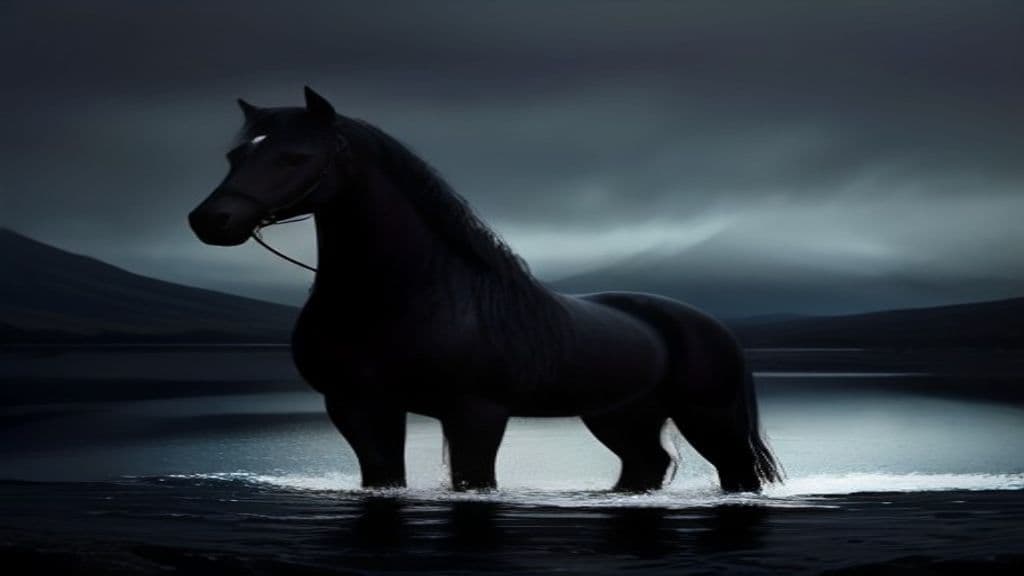
Descriptions vary by period and locale: older reports and folkloric parallels often describe horse-like or kelpie-linked forms, while many modern sightings and alleged images emphasize reptile- or dinosaur-like (plesiosaur-like) bodies or serpentine, humped shapes. The motif-index and scholarship record a spectrum from horse-associated water-beings to serpentine/dragon forms and, in recent popular culture, concretized reptilian silhouettes.
Folklore and modern reports primarily attribute presence and enigmatic movement to lake monsters: dwelling in deep waters, producing surface undulations or humped, serpentine sightings, and in some older kelpie-linked tales, luring or dangerous behavior toward humans. Contemporary scholarly commentary frames many accounts as misidentifications (for example, otters swimming in line creating a serpentine illusion) or hoaxes rather than demonstrations of supernatural powers.
Abdiel
Abdiel (Hebrew עֲבְדִּיאֵל) is primarily a theophoric Hebrew personal name meaning "servant of El/servant of God," attested once in the Hebrew Bible (1 Chronicles 5:15). In later literature—most notably John Milton's Paradise Lost—Abdiel is reimagined as a faithful seraph who opposes Satan's revolt. The provided sources do not treat Abdiel as an autonomous folkloric spirit type or record rituals or wards associated with the name.
Abiel
Abiel is attested in the supplied sources only as a male given name — borne by several historical American individuals and listed as two minor biblical figures. The provided materials contain no evidence presenting Abiel as a supernatural, mythological, or folkloric entity.
Abigail
Abigail is a female figure in the Hebrew Bible portrayed in 1 Samuel 25 as the intelligent and beautiful wife of Nabal who intervenes to prevent David from committing violence; later tradition regards her as one of the Tanakh's seven female prophets and as a model of beauty and wisdom.
Accolon
Accolon is a mortal knight of the Arthurian court, presented in the Post-Vulgate Merlin tradition and Malory's Le Morte d'Arthur as Morgan le Fay's paramour and instrument in a plot to supplant King Arthur; his tale centers on enchanted weapons (Excalibur and its scabbard), love-manipulation, and a tragic duel with Arthur.
Adils
Adils (Old Norse Aðils; also Eadgils, Adillus, Athisl, Adhel) is a semi‑legendary sixth‑century Swedish king attested in Old Norse saga material and later medieval traditions. He appears in saga episodes as a storied royal figure involved in warfare, court acts, and marriage suits rather than as a supernatural being.
Adsullata
Adsullata is attested as a Continental Celtic river goddess associated with the River Savus (modern Sava) in the Roman province of Noricum. Later traditions record her presence in Brittany as a goddess of hot springs and present her as an antecedent or origin-form of the Anglo‑Celtic sun goddess Sul.
Afaon fab Taliesin
Afaon fab Taliesin is a medieval Welsh warrior-counsellor, named as a son of the bard Taliesin and recorded among Arthur’s retinue in Welsh tradition. He appears in the Welsh Triads and in the tale Breuddwyd Rhonabwy (The Dream of Rhonabwy) as a notable martial figure and proverb-speaker rather than as a supernatural being.
Agent Liberty
Agent Liberty is a fictional human operative persona in DC Comics and its television adaptation (Arrowverse). The identity—most prominently used by Benjamin 'Benjy/Ben' Lockwood—functions as a costumed, paramilitary/enforcer role tied to political movements (Sons/Children of Liberty) or official security details, driven by ideological 'liberty' rhetoric rather than supernatural agency.
Agilaz (Egil)
Agilaz (reconstructed Proto-Germanic) — commonly recorded in medieval sources as Egil or Ægil — is a legendary archer attested in Germanic heroic tradition. He appears as the brother of Völund (Wayland/Weland) in the Old Norse poem Völundarkviða and in the Thidreks saga, and his name is also inscribed on early medieval objects (Franks Casket, Pforzen buckle). The attested material presents him as a named heroic human archer within saga and inscriptional contexts rather than as a recurrent supernatural species.
Aglovale
Aglovale (also Agloval, Aglovan, Aglovaus, Acglavael) is a human knight of Arthurian romance, presented as the eldest legitimate son of King Pellinore and a Knight of the Round Table in the Vulgate/Post‑Vulgate cycles, Malory, and later adaptations. He brings his long‑lost brother Perceval to Camelot, takes part in military actions (including slaying Agrippa in one account), and his death is related in varying ways across traditions (accidental at Gawain's hand, deliberate murder by Orkney kin, or killed during Lancelot's rescue of Guinevere).
Agnarr Geirröðsson
Agnarr Geirröðsson is a mortal prince attested only in the Poetic Edda poem Grímnismál; he aids Odin (disguised as Grímnir) during Geirröðr's torture and, after Odin reveals himself and King Geirröðr dies, Agnarr succeeds as king.
Agne
Agne (also attested Agni, Hogne, Agni Skjálfarbondi) is a semi-legendary king of Sweden in Old Norse saga tradition, preserved in the Ynglingatal corpus and prose expansions such as Snorri Sturluson's Ynglinga saga. He is portrayed as a mighty and famous warrior-king whose campaign in Finland, marriage to Skjalf, and death by hanging form a remembered episode connected to local place-names and a burial mound.
Community Record
- [1]Lake monster — Wikipedia. Wikipedia contributors, 'Lake monster', Wikipedia, The Free Encyclopedia, https://en.wikipedia.org/wiki/Lake_monster (accessed in provided research notes).wiki
- [2]Lake monster — Wikidata entry Q1187704. Wikidata entry Q1187704, 'lake monster', http://www.wikidata.org/entity/Q1187704 (accessed in provided research notes).wiki
- [3]Fortean Times, 1977, no.23 (archive listing). Fortean Times no.23 (1977), archive listing, https://archive.org/details/ft1977no23 (referenced in provided research notes for historic reporting context).other
- [4]Archive items (contextual references). Archive item listing (included in provided research notes for tangential mentions), https://archive.org/details/harlequin-contraption-ft.-kasane-teto-xkq-usb-yy-lk-4.other
- [5]Archive item: Eggy live (contextual reference). Archive item listing (included in provided research notes), https://archive.org/details/eggy2025-03-13.dpa4060akgc426ck61.other