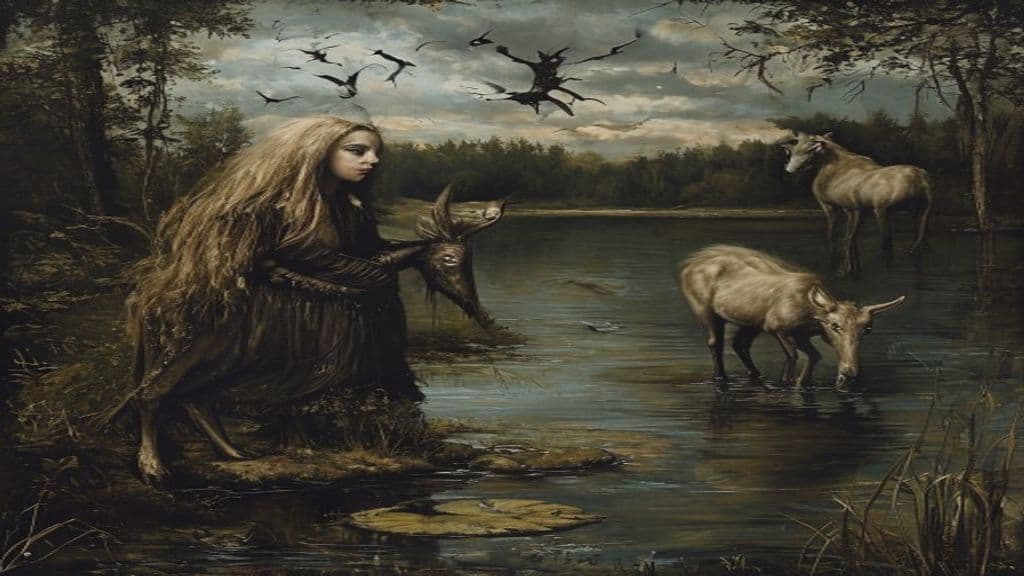
In the Baltic folkloric corpus Lauma/laumė is described as originally a sky spirit who descended to earth; sources state that her compassion for human suffering brought her down from the clouds. In Lithuanian accounts Laumės are also framed as some of the oldest goddesses, imagined as dwelling in a cloudy sky-court (tradition includes images such as a throne in the clouds). Over time these divine figures were folk-transformed into local fairy-like beings inhabiting lakes, meadows and forests.
Descriptions vary across tales. Laumės are often female and may appear anthropomorphic or as hybrids and animal forms: women with bird-claws for feet; women with the head or lower body of a female goat; half-human/half-dog or half-mare forms; or as mares, female goats, bears or dogs. Folklore sometimes depicts them with a single eye. They are also described in celestial terms as beautiful cloud-dwelling goddesses; narrative motifs include exaggerated breasts with stone-like nipples (folkloric identification of belemnite fossils as 'Laumės nipples'). Laumės commonly appear in groups, frequently in threes, and are associated with dancing in circles that leave rings in grass.
Laumės occupy an ambivalent moral role. Beneficially, they are guardians of birth, mothers, children and orphans; they are skilled in women's crafts (weaving and spinning) and help or reward the industrious (tales include returning an abandoned child unharmed and bestowing treasure). They are also portrayed as atmospheric or weather-affecting beings: their singing and dancing may cause rain, hail or storms and they are linked to rainbow motifs. Dangerously, some tales portray them as lethal to women who are targeted for their hair or body parts (if a laumė loses yarn she may take women's hair, entrails or veins, first killing them), and as predators of men—luring men with lust, exhausting them to death and then eating their bodies (a motif compared in sources to the Greek Lamia). They also pronounce or foretell newborns' fates in folklore. Laumės are said to fear iron.
Weaknesses
- substanceiron (tools made from iron)
Wards
- substanceiron (displaying or carrying iron tools)

Rusalka
Water spirits in Slavic folklore — the spirits of young women who died by drowning or suicide, bound to rivers and lakes. Beautiful and dangerous, they can bewitch men to their deaths.
Apsara
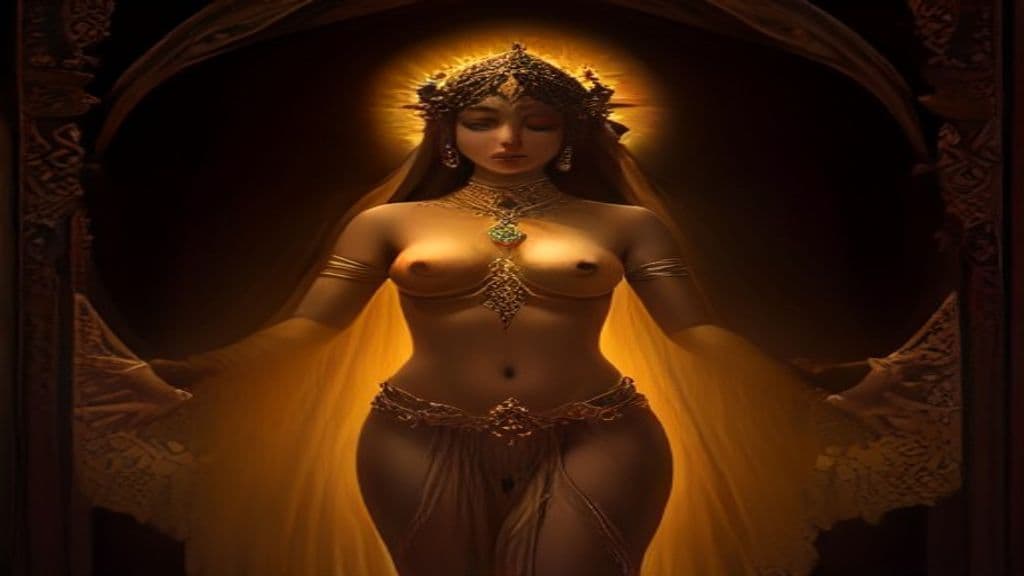
Celestial dancers and water nymphs of Hindu cosmology — beautiful semi-divine beings who dance at the court of Indra and, by his command, descend to earth to distract sages from excessive asceticism.
Will-o'-the-wisp
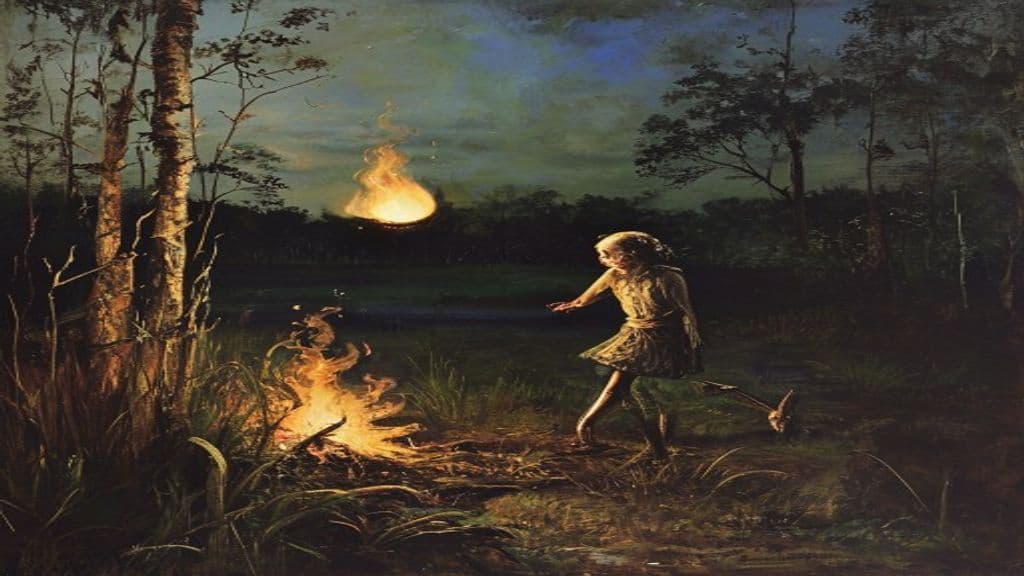
An atmospheric 'ghost light' — a small, mobile, lamp-like light seen at night over marshes, bogs, wet ground, or graveyards. In many cultures the phenomenon is interpreted as a supernatural being or manifestation (wandering nature-spirit, soul of the dead, transformed witch, or treasure-indicator); modern science offers chemiluminescent explanations for some occurrences.

Lamia
In ancient Greek mythology, Lamia is described as a child-eating monster who, in later tradition, came to be regarded as a type of night-haunting spirit or 'daimon'. The supplied sources do not provide a full physical description or detailed mythic genealogy, and some modern fictional portrayals recast her with serpentine features which are not attested in the provided classical summary.
Aitvaras
Aitvaras is a Baltic (primarily Lithuanian) household/nature spirit that, according to available summaries, lodges in homes and provides its household with material goods—often described as stolen gold and grain—while also bringing misfortune or trouble. It is variously described as a rooster- or chicken-like bird indoors and as a dragon-like or serpentine bird outdoors, often with fiery/meteor imagery.
Alatyr
A sacred world-stone in East Slavic and wider Slavic folklore, described as the "father to all stones" and the "navel of the earth." Located at the world's center (often on Buyan island), it is associated with a miraculous spring, sacred letters, healing properties, and liminality between the human world and other realms.
Alka
Alka (plural alkas) is a class of sacred natural places in pre-Christian Baltic religion—Latvian and Lithuanian—functioning as set-apart cult sites where offerings and sacrifices were made. Treated as holy ground rather than a single anthropomorphic spirit, alkas served as loci connecting communities with ancestors and otherworldly realms and frequently appear in toponyms across the Baltic landscape.
Auseklis
Auseklis is a named youthful celestial being in Latvian folk-song tradition (dainas), associated with the dawn and a particular eight-pointed star emblem. He appears among the Dieva dēli (sons of Dievs) as an attendant of the Sun (Saule), a suitor in the mythic 'celestial wedding', and a participant in household-like sky rituals.
Aušrinė
Aušrinė is the Lithuanian personification and deity of the morning star (planet Venus) in traditional Baltic cosmology. She is a feminine liminal figure associated with dawn, beauty, youth, love, health and renewal who appears each morning to prepare the way for Saulė (the Sun).
Ašvieniai
Ašvieniai are the paired divine twins of Baltic (particularly Lithuanian) tradition, horse-associated celestial beings who pull the chariot of Saulė (the Sun) across the sky and appear as protective little horses used as apotropaic motifs in vernacular architecture and household objects.
Bangpūtys
Bangpūtys is a reconstructed masculine sea-and-storm deity from Lithuanian mythology. Known from very scanty sources, modern mythologists portray him as an austere, vindictive master of winds and the sea and as the reconstructed father-figure of the cardinal wind-gods.
Black cat
A domestic cat with black fur that functions both as an ordinary companion animal and as a versatile folkloric symbol. In many traditions it is an omen of good or bad fortune, is associated with witches and seafaring luck, and has been repurposed in modern political and cultural symbolism.
Dievas
Dievas (Lithuanian; Dievs in Latvian; Diews in Old Prussian) is the primordial supreme sky deity in Baltic religion, understood as the luminous sky-dome, a creator and ruler of gods, and a god of light, prosperity and time. The lexeme is a Baltic reflex of Proto-Indo-European *Dyēus and, following Christianization, the same word came to denote the Christian God.
Dievs (Dievas)
Dievs (Latvian Dievs; Lithuanian Dievas) is the primordial sky‑father of the Baltic traditional pantheon, presented in sources as a supreme luminous sky power, creator and ruler of the gods, and associated with light, prosperity, and cosmic order. The theonym survives in modern Latvian language and civic/religious usage but the supplied corpus gives little on specific myths, iconography, or ritual praxis tied to the pre‑Christian figure.
Eglė the Queen of Serpents (Žilvinas)
A central figure of a Lithuanian folktale in which a speaking serpentine ruler—called the grass-snake/serpent prince Žilvinas—marries the human maiden Eglė, keeps an underwater palace and household, can be summoned by a secret chant, and whose story culminates in human→tree metamorphoses after betrayal.
Gabija
Gabija is the Lithuanian household fire spirit and protector of the hearth and family. Treated as a living presence in the home, she is cared for through routine domestic practices (feeding, covering embers, providing water) and is held responsible in folklore for wandering or destructive fires when offended or neglected.
Community Record
- [1]Lauma — Wikipedia. Wikipedia: 'Lauma' article (lead and sections on appearance, abilities, dwellings and customs)wiki
- [2]Blue Moon Fiber Arts product description — Lauma. Product description referencing Latvian Lauma as 'guardian of birth, mothers and children' and 'a sky spirit brought to earth by her compassion'.other
- [3]Research notes and collected quotations (provided corpus). Compiled research notes supplied by requester summarizing attested folklore motifs (appearance, behaviors, ritual absence, time markers, locations, cultural context).folk