
The category of the lilin in Jewish and related traditions is traced in the sources to older Mesopotamian spirit categories. Sources link the Hebrew forms לִילֵי / לִילִין (lilin) to Akkadian lilû (a class of spirits) and to the female forms lilītu / ardat-lilî (wind-demons/ghosts). Jewish texts present lilin as related to or descended from Lilith—sometimes as male counterparts or as her offspring—and they appear in late antique ritual and literary contexts (e.g., 2 Baruch's lamentation summons 'Lilin, come you from the desert'). The archaeological and textual incantation-bowl corpus of late antiquity (Sasanian-period Mesopotamia) shows lilin being named, bound, and sealed in household magic, indicating a syncretic development from Mesopotamian demonology into Jewish and local magical practices.
Descriptions vary across the sources. Some summaries (modern reference to the compiled corpus) describe lilin as human in form with wings; other variant descriptions in the literature note an otherwise bald visage with hair covering other parts of the face and body. Incantation-bowl formulas record lilin appearing to people in human likenesses—specifically 'appear to men in the likeness of women, and to women in the likeness of men'—suggesting either shape-changing or presentation in opposite-gender guises in the magical texts.
Across Talmudic, targumic, apocalyptic, and incantation-bowl sources, lilin are depicted primarily as nocturnal spirits that sexually accost humans (bowls and rabbinic anecdotes describe coupling with humans and producing spirit-offspring), cause terror and household affliction, and enter into relationships with people that ritual specialists treat as contractual or legal ties. They are numerous and routinely subject to binding or sealing by higher ritual authorities (e.g., bowl formulas that adjure seals or invoke named demon-kings), indicating they are powerful enough to menace households but not sovereign over divine or demonic order.
Weaknesses
- ritualBinding and sealing by named seals (as in incantation-bowl formulas invoking 'the great seal of Ashmedai') — documented in bowl inscriptions
- ritualFormal annulment/divorce (geṭ-like) formulae used in bowls to sever spirit-human attachments — documented in 'Divorce Text' bowl material
- ritualConfinement in inscribed incantation bowls that are buried upside down to trap and distance them — attested archaeological practice
- mantraAdjuration by authoritative demon-names and parental names (e.g., Palḥadad, Palḥas, Elisu(r) Bagdana) as recorded in bowl formulas used to compel or bind lilin
Wards
- ritualIncantation bowl deposition (inscribed clay bowls, spiral writing, buried upside down to trap lilin) — preventive and remedial practice in the bowl corpus
- mantraPriestly/liturgical blessing expansions (Targum Pseudo-Jonathan's Priestly Blessing variant adding 'keep thee from demons of the night (lilin)') — liturgical apotropaic speech
- ritualBinding/sealing adjurations invoking seals and named authorities (e.g., 'Bound are the demons and sealed are the lilis... by the great seal of Ashmedai') — protective formulas in bowls
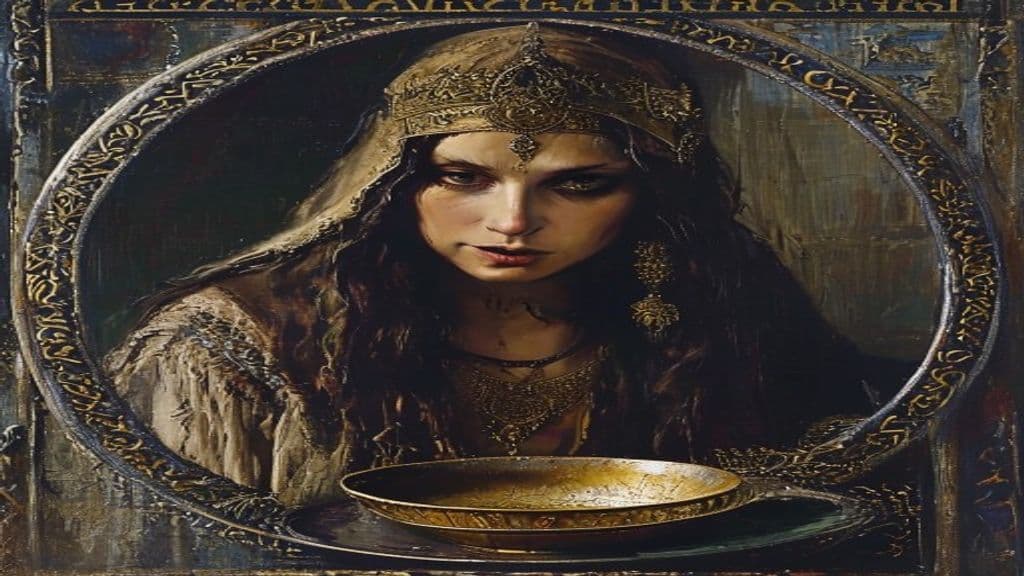
Lilith
Lilith is a feminine night‑spirit in Jewish mythic, magical, and folkloric traditions associated with harmful nocturnal activity, especially threats to sleeping people and infants. The figure appears both as a class of night‑spirits (lilit/lilītu) in Near Eastern demonologies and as an individualized dangerous woman in later medieval Jewish narratives and amulets.

Shedim
In Jewish tradition, Shedim are spirits associated with foreign deities and idolatrous worship, embodying a theological context where monotheistic devotion is threatened by other divine entities. (Note: 1. Factual claim "Primordial" power tier should be adjusted to "Ancient", as Shedim are described as tied to foreign deities and do not appear to possess cosmic-level powers. 2. Remove reference to "m)
'Ain Samiya Goblet
Silver cup from the Middle Bronze Age I, discovered in a tomb at Ain Samiya. (Note: 1. Power tier should be "None", but add a note explaining that historical artifacts don't fit into the typical power tier classification. 2. Add a description of its appearance based on it being a sil)
A'annepada
A'annepada (Sumerian cuneiform 𒀀𒀭𒉌𒅆𒊒𒁕; also romanized Aanépàdda) is attested as a historical ruler of the First Dynasty of Ur, flourishing c. 2350 BC. He is recorded in dedicatory and foundation inscriptions as king of Ur and as son of Mesannepada, credited with temple-building and dedication to deities such as Ninhursag and Inanna.
Aaron
Aaron is a central human figure in Israelite sacred literature: the elder brother of Moses, the first high priest (progenitor of the Aaronide priesthood), and a spokesman/prophet who mediates between Israel and God in Exodus–Deuteronomy narratives. His role in the texts establishes hereditary priestly authority, ritual functions (sacrifices, blessing, use of Urim and Thummim), and institutional norms for Israelite cultic life.
Abaddon
In Hebrew scripture Abaddon is primarily a noun meaning 'destruction' or a section/condition of the underworld paired with Sheol; in the New Testament Book of Revelation Abaddon is personified as an angelic figure (Greek Apollyon) described as the king of an army of locusts released from the abyss during the apocalypse.
Abagtha
Abagtha (Hebrew: אבגתא, ’Ǎḇaḡṯā) is a named human court official in the Hebrew Bible’s Book of Esther, listed among seven chamberlains who ministered before King Ahasuerus and were commanded to bring Queen Vashti before the king. He is attested only in Esther 1:10 and is presented as an institutional palace attendant rather than a supernatural being.
Abdiel
Abdiel (Hebrew עֲבְדִּיאֵל) is primarily a theophoric Hebrew personal name meaning "servant of El/servant of God," attested once in the Hebrew Bible (1 Chronicles 5:15). In later literature—most notably John Milton's Paradise Lost—Abdiel is reimagined as a faithful seraph who opposes Satan's revolt. The provided sources do not treat Abdiel as an autonomous folkloric spirit type or record rituals or wards associated with the name.
Abel
Abel is the second son of Adam and Eve in the Genesis narrative, a shepherd whose accepted offering and subsequent murder by his brother Cain form the biblical account of the first death. Later interpretive traditions expand his role, treating him as an archetypal righteous victim, a postmortem avenging or adjudicating figure, and in some systems (notably Mandaean) identifying him with an angelic lightbeing.
Abiathar
Abiathar (Hebrew: אֶבְיָתָר, ʾEḇyāṯār) is a named human priestly figure in the Hebrew Bible. He is presented as a survivor of the Nob massacre who fled to David with priestly regalia, served as a priest and counselor in David's court, and was later deposed and sent to Anathoth by Solomon for supporting Adonijah.
Abiel
Abiel is attested in the supplied sources only as a male given name — borne by several historical American individuals and listed as two minor biblical figures. The provided materials contain no evidence presenting Abiel as a supernatural, mythological, or folkloric entity.
Abigail
Abigail is a female figure in the Hebrew Bible portrayed in 1 Samuel 25 as the intelligent and beautiful wife of Nabal who intervenes to prevent David from committing violence; later tradition regards her as one of the Tanakh's seven female prophets and as a model of beauty and wisdom.
Abijah of Judah
Abijah (also Abijam or Abiah) is presented in the biblical and later interpretive traditions as a short-reigning human king of Judah from the Davidic line. He is portrayed as a dynastic successor whose military actions (notably the battle at Mount Zemaraim) and moral evaluation in rabbinic literature are interpreted theologically in relation to the Davidic covenant.
Abimelech
Abimelech is a Hebrew personal name and occasionally a regnal title attested in the Hebrew Bible and later traditions. It appears as the name/title of Philistine rulers in the patriarchal narratives (the "king of Gerar" who interacts with Abraham and Isaac) and as the personal name of Abimelech son of Jerubbaal (Gideon) in Judges, a dynastic usurper whose brief rule ends in violent death.
Community Record
- [1]Lilin (Wikipedia). Wikipedia article 'Lilin' (summary of traditions, appearance variants, relation to Lilith, and incantation-bowl references).wiki
- [2]Incantation bowls and bowl inscriptions (compiled examples cited in research notes). Summarized incantation-bowl corpus excerpts as cited in the research notes (Montgomery's Bowl 1; bowl-binding formulas quoting 'Bound are the demons and sealed are the lilis'; 'Divorce Text' passages naming Palḥadad, Palḥas, Elisu(r) Bagdana).academic
- [3]2 Baruch (Syriac Apocalypse of Baruch) — cited lamentation phrase. 2 Baruch 10:8 as cited in the research notes: 'I will call the Sirens from the sea, And you Lilin, come you from the desert...'literary
- [4]Targum Pseudo-Jonathan (expanded Priestly Blessing). Targumic expansion of the Priestly Blessing adding 'keep thee from demons of the night (lilin),' cited in the research notes as evidence of liturgical protection.literary
- [5]Talmud, Eruvin 18b (paraphrase cited). Paraphrase from Eruvin 18b in the research notes describing how Adam's involuntary nocturnal emissions attracted 'female spirits, who coupled with him and bore spirits (ruhin), demons (shedim) and lilin.'literary