
Lucy Pevensie is introduced in The Lion, the Witch and the Wardrobe as the youngest of the four Pevensie children evacuated to the Professor's country house during wartime England. She is the first to discover Narnia by entering a wardrobe and plays a central role in the overthrow of the White Witch alongside her siblings, being crowned at Cair Paravel as Queen Lucy the Valiant. She reappears across the series (notably Prince Caspian and The Voyage of the Dawn Treader) as a returning human who can see and interact with Narnia and its spiritual center, Aslan; in The Last Battle the narrative reports that after dying in a train crash in England the Pevensie children are taken to Aslan's Country, the story's depiction of an afterlife continuation of Narnian reality.
Lewis's sources describe Lucy as fair- or golden-haired and cheerful; a quoted line characterizes her as "always gay and golden-haired," and that all princes desired her as their Queen. Beyond these lines, the prose emphasizes her childlike cheerfulness, friendliness toward animals, and open disposition rather than detailed physical metrics.
Lucy is a mortal child whose distinguishing qualities in the narrative are faith, compassion, courage, and spiritual receptivity—she is repeatedly the sibling closest to Aslan and sometimes perceives Aslan when others do not (e.g., she is the first to see Aslan in Prince Caspian). She receives narrative-gifted items: Father Christmas gives her a small vial of a "magical cordial" capable of healing nearly any injury (intended for sparing, impartial use) and a small dagger for defense; these items are the source of specific supernatural effects in the story rather than Lucy being innately supernatural. Adaptations (for example the archived video-game demo) reframe Lucy as a playable hero with combat skills, but that representation is adaptation-specific and not a depiction from Lewis's original prose.
Weaknesses
- conditionmortality (human limitations)
- otherreliance on others' testimony and persuasion (e.g., needs siblings' acceptance of Narnia)
- otherlimited magical agency (her healing power derives from Father Christmas's cordial rather than innate supernatural ability)
Wards
None recorded.
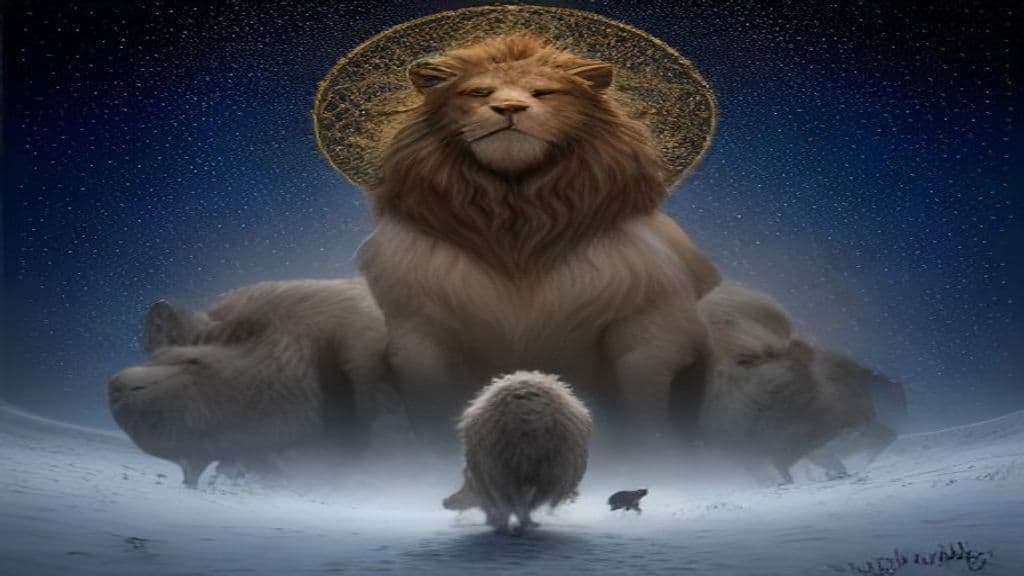
Aslan
Aslan is the singular, talking lion figure at the center of C. S. Lewis's The Chronicles of Narnia, functioning as creator, king, judge, savior, and moral authority within that fictional cosmology. The name also appears in unrelated contexts (personal names, a lion-like alien in Traveller RPG) but those are distinct referents.

Edmund Pevensie
Edmund Pevensie is a fictional English schoolboy created by C. S. Lewis who appears as a principal human character in The Chronicles of Narnia. He begins as a spiteful, selfish child, betrays his siblings under the influence of the White Witch, is redeemed through Aslan's sacrificial intervention, and later reigns as King Edmund the Just in Narnia before returning to England.
3-D Man
3-D Man is a Marvel Comics superhero identity associated with a 1950s-era origin in which the body of Chuck Chandler can materialize in three-dimensional existence when activated by his brother Hal via a pair of glasses. The mantle was later assumed by Delroy Garrett (formerly Triathlon) in modern continuity.
5 Ronin
5 Ronin is a 2011 Marvel Comics five-issue limited series that reimagines five Marvel superhero archetypes as rōnin (masterless samurai) in a fictionalized post‑Sekigahara feudal Japan. The work places Wolverine, Hulk, Punisher, Psylocke, and Deadpool analogues into period roles to explore displacement, revenge, and identity in an era of political upheaval.
A Elbereth Gilthoniel
An Elvish hymn in Sindarin addressed to Elbereth (Varda) from J. R. R. Tolkien's legendarium. Presented in The Lord of the Rings and later musical and dramatic adaptations, the hymn functions as devotional poetic language that evokes Elvish reverence for the star-kindler rather than an independent supernatural agent.
A.R.G.U.S.
A.R.G.U.S. is a fictional clandestine United States government agency in the DC Comics universe that investigates, contains, and manages superhuman, meta-human, and supernatural incidents and assets. Introduced in The New 52 continuity, it functions as an institutional actor providing intelligence, logistical support, covert task forces (notably Task Force X / the Suicide Squad), and a dedicated magic division across comics and media adaptations.
Abaddon
In Hebrew scripture Abaddon is primarily a noun meaning 'destruction' or a section/condition of the underworld paired with Sheol; in the New Testament Book of Revelation Abaddon is personified as an angelic figure (Greek Apollyon) described as the king of an army of locusts released from the abyss during the apocalypse.
Abadir
Abadir is a polysemous name attested in distinct cultural contexts: a legendary founding saint and clan ancestor in eastern Ethiopia (Sheikh Abadir Umar Al‑Rida / Aw Abadir), a term applied to cone‑shaped cult stones in Phoenician religious description, and a personal name of a martyr (Abadir/Apater) in the Coptic Synaxarium. The attestations are independent usages of the same name rather than a single supernatural being.
Abadiu of Antinoe
Abadiu of Antinoe was a fourth‑century bishop of Antinoe (Antinoopolis, in Roman Egypt) commemorated as a martyr and saint in the Coptic Orthodox Church, with a feast day on 26 December. Sources record that he was killed during a theological dispute with Arian opponents and reference him in collections of Egyptian martyrs.
Abagtha
Abagtha (Hebrew: אבגתא, ’Ǎḇaḡṯā) is a named human court official in the Hebrew Bible’s Book of Esther, listed among seven chamberlains who ministered before King Ahasuerus and were commanded to bring Queen Vashti before the king. He is attested only in Esther 1:10 and is presented as an institutional palace attendant rather than a supernatural being.
Abanoub
Abanoub is a 4th‑century Egyptian Christian child martyr venerated in the Coptic tradition. Remembered for his public confession of Christ, miraculous healings associated with his passion, and the translation and veneration of his relics, his feast is observed on July 31 (Epip 24) and his cult centers include Nehisa and Samanoud.
Abaskhiron the Soldier
A Coptic Orthodox martyr venerated for refusing imperial idolatry during the Diocletian persecution; reputedly healed by the Archangel Michael, preserved in monastery relics, and commemorated on 14 June (7 Paoni).
Abdel Messih El-Makari
Abdel Messih El-Makari (1892–1963) was a Coptic Orthodox monk and priest venerated as a 20th‑century Coptic saint. Associated with the Monastery of Saint Samuel the Confessor and the Monastery of Saint Macarius (Scetes/Wadi El‑Natrun), he is remembered for humility, asceticism, charity, and reported spiritual gifts such as prescience, discerning of spirits, and healing.
Abdiel
Abdiel (Hebrew עֲבְדִּיאֵל) is primarily a theophoric Hebrew personal name meaning "servant of El/servant of God," attested once in the Hebrew Bible (1 Chronicles 5:15). In later literature—most notably John Milton's Paradise Lost—Abdiel is reimagined as a faithful seraph who opposes Satan's revolt. The provided sources do not treat Abdiel as an autonomous folkloric spirit type or record rituals or wards associated with the name.
Community Record
- [1]Lucy Pevensie - Wikipedia. Wikipedia contributors. "Lucy Pevensie." Wikipedia, The Free Encyclopedia.wiki
- [2]Lucy Pevensie - Wikidata. Wikidata entry Q1640313, Lucy Pevensie.other
- [3]The Chronicles of Narnia: The Lion, the Witch and the Wardrobe Demo (archive). Archived game demo and materials describing an adaptation of The Chronicles of Narnia.other
- [4]Wunderkind: podfic and cover (archive). Archived adaptation/cover materials referencing the Narnia adaptations.other