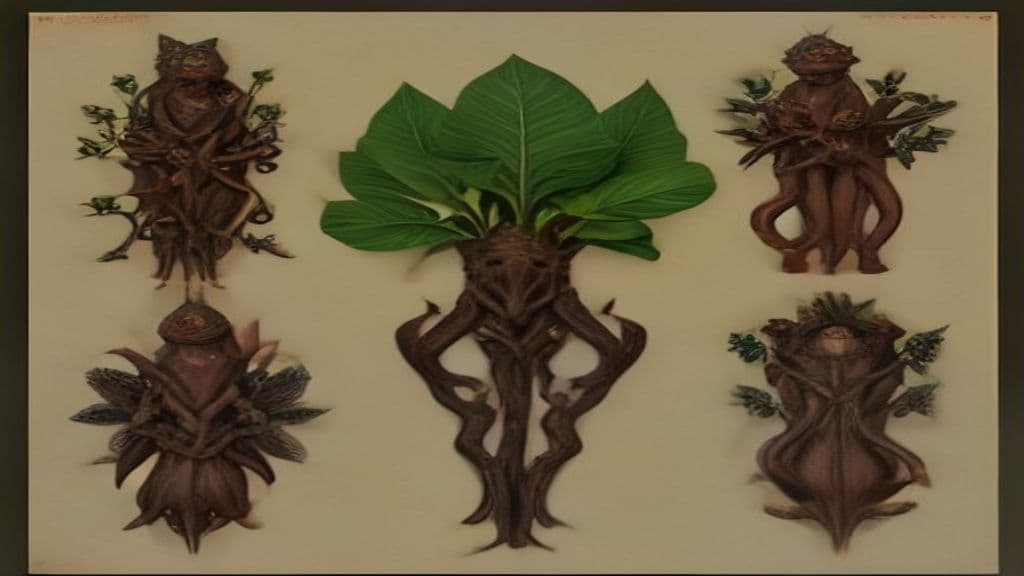
In classical sources the mandrake is treated botanically: Mandragora species native to the Mediterranean produce anthropomorphic roots and are described by authors such as Theophrastus, Dioscorides, and Pliny within materia medica traditions. Later vernacular folk etymologies and popular beliefs attached transgressive origins to the root, claiming it grew from places or substances connected to executed criminals (examples in German and Dutch names like Galgenmännlein and pisdiefje) or from the remains or droppings of hanged thieves (Icelandic þjófarót), reflecting a later folkloric layering atop the classical botanical account.
Botanically the mandrake refers mainly to Mandragora species (Solanaceae) whose roots often take on an anthropomorphic, 'man-shaped' form; classical materia medica also note a strong smell. Ancient authors and summaries cite a popular distinction of 'male' (white) and 'female' (dark) types reported by Pliny. Other unrelated plants with similar humanlike roots (e.g., Bryonia alba, Podophyllum peltatum) are sometimes called 'mandrake' in folk usage and enter the same conceptual space.
Mandrake roots contain tropane alkaloids with anticholinergic, hallucinogenic, narcotic properties; reported physiological effects in clinical summaries include dry mouth, blurred vision, mydriasis, difficulty urinating, dizziness, headache, vomiting, flushing, tachycardia, hyperactivity, and hallucinations, and in sufficient doses can induce unconsciousness—hence historical use as an analgesic and anesthetic. Classical and folk authors attribute magical properties such as use in love potions or aphrodisiac efficacy (e.g., Pliny's notes on phallic roots), but in the provided sources these are presented as folkloric/classical claims rather than empirical proofs. The sources do not describe the mandrake as an independently acting spirit; its potency is located in shape and substance and in ritualized handling.
Weaknesses
- conditionDose-dependent toxicity and variable alkaloid concentration
- otherRequires controlled preparation and dosing by trained practitioners (risk of poisoning if mishandled)
Wards
- ritualClassical harvesting precautions (draw three circles and cut facing west)
- ritualRitualized second-extraction practice (dance around it while speaking lewd sexual talk to obtain a second piece)
*Perkʷūnos
*Perkʷūnos is the reconstructed Proto-Indo-European thunder‑god hypothesized by comparative linguistics and mythology. Scholarly reconstructions portray him as a storm or thunder figure associated with fructifying rain and as the combatant who fights a multi‑headed water‑serpent to release life‑giving waters; no direct attestations from the Proto‑Indo‑European period survive and the figure is inferred from later Indo‑European traditions.
*Péh₂usōn (reconstructed)
Péh₂usōn is a hypothetical Proto‑Indo‑European pastoral guardian reconstructed by comparative scholars from parallels in Greek and Vedic traditions. Proposed as a Graeco‑Aryan ancestor‑figure, the reconstruction describes a protector of flocks, roads, and travellers rather than an attested historical cultic personality.
57 Mnemosyne
57 Mnemosyne is a large main-belt asteroid (S-type) discovered in 1859 and named after the Greek Titaness Mnemosyne. It is a non-sentient astronomical body studied for its orbital and rotational properties and has been used in dynamical measurements related to Jupiter.
Aba (disambiguation / name-form)
Aba is a polyvalent name-form attested across many unrelated contexts (place names, personal names, animal names, and brief mythological listings). The provided sources do not support a single, coherent supernatural entity called "Aba" and offer no descriptive or ritual material for such a being.
Abaddon
In Hebrew scripture Abaddon is primarily a noun meaning 'destruction' or a section/condition of the underworld paired with Sheol; in the New Testament Book of Revelation Abaddon is personified as an angelic figure (Greek Apollyon) described as the king of an army of locusts released from the abyss during the apocalypse.
Aban Yasht
The Aban Yasht is a hymn from the Persian tradition that praises Anahita, a goddess associated with water, fertility, and wisdom. It consists of 132 stanzas and is part of the 21 Yashts collection. (Note: - Power tier should be "Primordial" or possibly "Cosmic", given that it's a hymn of great spiritual significance and associated with a goddess. - The article incorrectly states that Anahita is associa)
Abandinus
Abandinus is a locally attested Romano‑Celtic theonym known from a single inscribed bronze feather (votive object) dedicated at Godmanchester (the Roman fort Durovigutum) in Cambridgeshire. Scholars interpret him as a local god or male spirit tied to a specific place and possibly associated with a nearby spring or stream; this association is tentative and based on etymological readings of the name.
Abarbarea
Abarbarea is a name attested in classical Greek and Roman sources for freshwater nymphs (naiads). The name appears for at least two individual mythic figures — a naiad wife of Bucolion and a naiad counted among ancestors of the Tyrians — and Hesychius records plural forms that may indicate the name was also used as a class-name (Abarbareai / Abarbalaiai).
Abas
Abas (Ancient Greek: Ἄβας, gen.: Ἄβαντος) is not a single mythic being but a recurring personal name borne by multiple mortals and minor mythic figures in Greek epic and genealogical traditions — kings, founders, seers, warriors, attendants, a centaur, and a youth transformed by a goddess. The name is glossed in the sources as 'guileless' or 'good-hearted' and appears across Argive, Theban, Trojan, Euboean, and other local cycles.
Abath
No corroborated folkloric entity named "Abath" is documented in the provided sources. The string appears in the supplied material only as a surname/personal name in Aruban/Dutch-Caribbean archival records and as an unrelated taxonomic or encyclopedic hit; no mythic attributes, origin stories, rituals, or apotropaic practices for an entity called Abath are present in the documents reviewed.
Abatur
Abatur is an uthra (celestial emanation) in Mandaeism described as the 'father of the Uthras' and called the Ancient (ʿattīqā). He resides on the boundary between the World of Light and lower regions, functions as a judge who weighs souls (Abatur Muzania), and supplies instructions and materials to the demiurgic uthra Ptahil in accounts from the Diwan (Scroll) of Abatur.
Abatwa (Twa / Batwa)
Abatwa (also recorded as Twa, Batwa, Mutwa; singular forms Barhwa or Murhwa in some transcriptions) are indigenous hunter‑gatherer peoples of the Great Lakes region of Central Africa, historically identified as some of the earliest inhabitants of the area. The available sources treat them as human ethnic groups whose livelihoods, lands, and populations have been severely affected by conservation policies and modern violence.
Community Record
- [1]Mandrake - Wikipedia. Wikipedia contributors, 'Mandrake', Wikipedia, https://en.wikipedia.org/wiki/Mandrakewiki
- [2]Wikidata: Mandrake (Q1930117). Wikidata entry Q1930117, Mandrake, http://www.wikidata.org/entity/Q1930117other