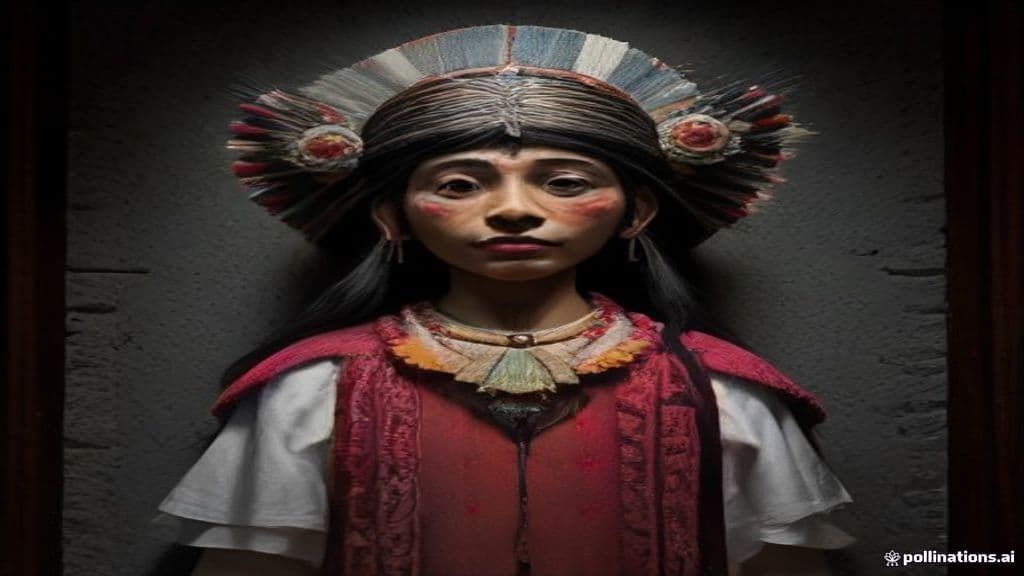
Oral traditions about Maximón's creation and purpose are complex, variable, and rooted in ancient Maya traditions; these indigenous narratives were later overlaid with colonial Christian elements. Sources portray him as a local supernatural figure whose precise origin stories differ by town and community rather than a single canonical biography. Some local accounts and scholarly summaries also note syncretic identifications with Christian figures such as San Simón and, in some narratives, Judas Iscariot.
Maximón is most commonly represented by an effigy or idol kept in household or community shrines; representations vary by town and may be temporary or periodically replaced. Effigies are often clothed in contemporary garments and accessorized with modern items (for example, sunglasses in some depictions) and are habitually presented with cigars and bottles of liquor. He is regularly displayed among offerings such as flowers and bread. Visual details vary across communities (e.g., Santiago Atitlán vs. Zunil), so there is no single standardized iconography recorded in the supplied sources.
Sources frame Maximón primarily as a votive, mediating figure who receives offerings and petitions from devotees rather than listing a standardized set of supernatural powers. He functions as a local recipient of favors and material gifts (cigars, alcohol, flowers, bread) and as a practical mediator in everyday religiosity. Descriptions stress his ambivalent moral character—worldly, indulgent, and approachable—and note connections to pre-Hispanic gods and to Christian figures in local practice. Specific abilities such as standardized healing, cursing, or prophetic acts are not detailed in the supplied material.
Aaron
Aaron is a central human figure in Israelite sacred literature: the elder brother of Moses, the first high priest (progenitor of the Aaronide priesthood), and a spokesman/prophet who mediates between Israel and God in Exodus–Deuteronomy narratives. His role in the texts establishes hereditary priestly authority, ritual functions (sacrifices, blessing, use of Urim and Thummim), and institutional norms for Israelite cultic life.
Abaddon
In Hebrew scripture Abaddon is primarily a noun meaning 'destruction' or a section/condition of the underworld paired with Sheol; in the New Testament Book of Revelation Abaddon is personified as an angelic figure (Greek Apollyon) described as the king of an army of locusts released from the abyss during the apocalypse.
Abagtha
Abagtha (Hebrew: אבגתא, ’Ǎḇaḡṯā) is a named human court official in the Hebrew Bible’s Book of Esther, listed among seven chamberlains who ministered before King Ahasuerus and were commanded to bring Queen Vashti before the king. He is attested only in Esther 1:10 and is presented as an institutional palace attendant rather than a supernatural being.
Abdiel
Abdiel (Hebrew עֲבְדִּיאֵל) is primarily a theophoric Hebrew personal name meaning "servant of El/servant of God," attested once in the Hebrew Bible (1 Chronicles 5:15). In later literature—most notably John Milton's Paradise Lost—Abdiel is reimagined as a faithful seraph who opposes Satan's revolt. The provided sources do not treat Abdiel as an autonomous folkloric spirit type or record rituals or wards associated with the name.
Abel
Abel is the second son of Adam and Eve in the Genesis narrative, a shepherd whose accepted offering and subsequent murder by his brother Cain form the biblical account of the first death. Later interpretive traditions expand his role, treating him as an archetypal righteous victim, a postmortem avenging or adjudicating figure, and in some systems (notably Mandaean) identifying him with an angelic lightbeing.
Abiathar
Abiathar (Hebrew: אֶבְיָתָר, ʾEḇyāṯār) is a named human priestly figure in the Hebrew Bible. He is presented as a survivor of the Nob massacre who fled to David with priestly regalia, served as a priest and counselor in David's court, and was later deposed and sent to Anathoth by Solomon for supporting Adonijah.
Abiel
Abiel is attested in the supplied sources only as a male given name — borne by several historical American individuals and listed as two minor biblical figures. The provided materials contain no evidence presenting Abiel as a supernatural, mythological, or folkloric entity.
Abigail
Abigail is a female figure in the Hebrew Bible portrayed in 1 Samuel 25 as the intelligent and beautiful wife of Nabal who intervenes to prevent David from committing violence; later tradition regards her as one of the Tanakh's seven female prophets and as a model of beauty and wisdom.
Abijah of Judah
Abijah (also Abijam or Abiah) is presented in the biblical and later interpretive traditions as a short-reigning human king of Judah from the Davidic line. He is portrayed as a dynastic successor whose military actions (notably the battle at Mount Zemaraim) and moral evaluation in rabbinic literature are interpreted theologically in relation to the Davidic covenant.
Abimelech
Abimelech is a Hebrew personal name and occasionally a regnal title attested in the Hebrew Bible and later traditions. It appears as the name/title of Philistine rulers in the patriarchal narratives (the "king of Gerar" who interacts with Abraham and Isaac) and as the personal name of Abimelech son of Jerubbaal (Gideon) in Judges, a dynastic usurper whose brief rule ends in violent death.
Abishag
Abishag is a young woman from Shunem described in 1 Kings 1 as chosen to attend the aged King David, brought to lie beside him to provide warmth and serve as a helper/servant; her later status became a political issue in the succession disputes following David's death.
Abishai
Abishai is a personal name attested in several distinct sources: a biblical individual described as the eldest son of Zeruiah (sister of King David); a Semitic chief named in an inscription at Beni-Hasan in Middle Egypt; and modern cultural uses including a named monster in Dungeons & Dragons and as an artist/stage name. The supplied materials do not present Abishai as a supernatural being within a living cosmology.
Community Record
- [1]Maximón. Wikipedia: 'Maximón is a Maya deity and folk saint, represented in various forms by the Maya peoples of several towns in the Guatemalan Highlands. Oral tradition of his creation and purpose... is complex, diverse, and born of the ancient Maya traditions centuries ago.'wiki
- [2]San Simon (Spirit Work). Spirit Work: 'Under the names, El Hermano San Simon, Brother Saint Simon, San Simon Maximon, or Maximin, he is venerated as folk saint...'folk
- [3]Maximón, a Maya Saint in Sunglasses — The Appendix. The Appendix: 'Maximón effigy and shrine in Zunil, Guatemala. He sits among gifts of flowers, bread' and discussion of modern accoutrements and offerings.other
- [4]Maximón - The Mighty Maya God That Smokes & Drinks. The Candy Trail: description of Maximón as 'the cigar-smoking, liquor-drinking idol' and note that many Ladinos know him as San Simon.other
- [5]Maximón - Citizendium. Citizendium: 'Maximón, also known as San Simon, is a widely known folk saint from the highlands of Guatemala. A highly ambivalent figure with connections to pre-Hispanic gods as well as Judas Iscariot...' wiki
- [6]Major religions of Guatemala / Maya Institute. M-Institute: overview noting the presence of folk saint veneration in Guatemalan religious practice and references to Maximón as a local syncretic figure.other