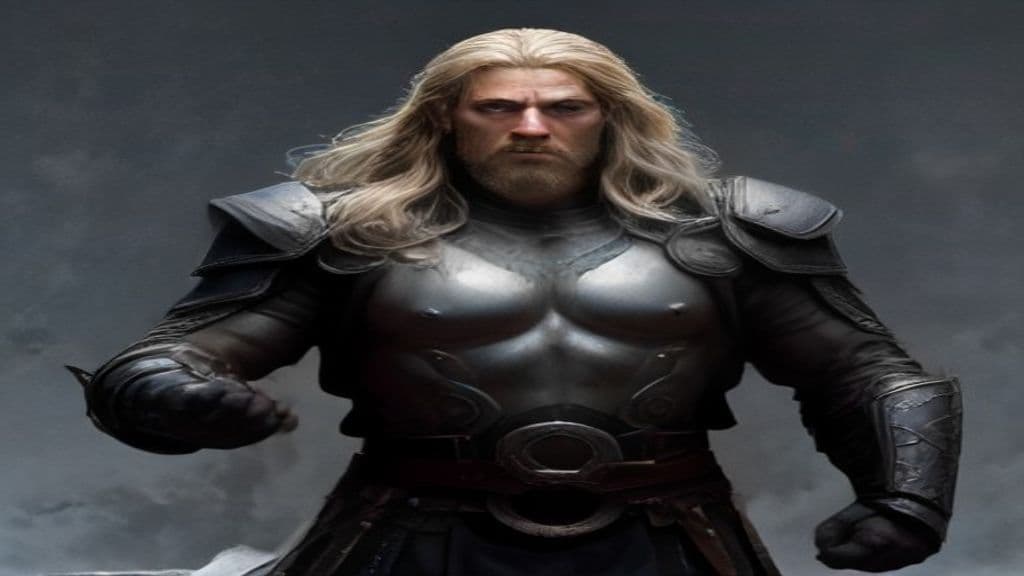
Móði and Magni is a deity in Norse folklore, from Scandinavia. Móði and Magni are the sons of the god Thor in Old Norse sources, named respectively 'Wrath' and 'Strength'. Magni is attested performing a feat of infant strength in Skáldskaparmál; both are listed among the survivors of Ragnarök in the Poetic Edda.
In Old Norse sources Móði and Magni are presented as sons of the god Thor. Skáldskaparmál names Magni explicitly as Thor's son by the jötunn Járnsaxa; Móði is named as Thor's son in the corpus but his mother is not specified in the primary texts cited. Both are treated in later narrative contexts as part of Thor's extended kin among the Æsir and are listed as survivors following the cataclysm of Ragnarök in the Poetic Edda (Vafþrúðnismál).
Primary texts supply no sustained physical descriptions or iconography for either figure. The only age detail recorded in the provided material is that Magni is 'three nights old' during the Hrungnir episode in Skáldskaparmál; otherwise descriptions are limited to narrative action rather than bodily traits.
Magni: In Skáldskaparmál (the Hrungnir episode) the infant Magni removes Hrungnir's foot that had fallen on Thor, an act presented as exceptional strength: 'he was then three nights old; he cast the foot of Hrungnir off Thor...' He speaks boldly afterward and is rewarded by Thor with the horse Gold-Mane (and Odin objects to Thor giving the horse to the son of a giantess). Móði: beyond his naming among the survivors of Ragnarök in Vafþrúðnismál and the semantic sense of his name ('Wrath'), the provided sources record no specific deeds or powers for Móði. Scholarly commentary (e.g., Rudolf Simek) treats the brothers together with Þrúðr as personifications of Thor's attributes rather than as sources do that as an explicit in‑text claim.
Abraun
Abraun is an attested name in German-language plant-legend scholarship (Der abraun, ein beitrag zur pflanzensagenkunde, 1916) and a short database entry (Wikidata) labels it as a spirit from German mythology. Surviving accessible documentation is extremely limited: the principal academic treatment is a 1916 contribution to pflanzensagenkunde (plant-saga studies), but the excerpts available here contain only bibliographic metadata and do not record tales, descriptions, or rituals.
Adils
Adils (Old Norse Aðils; also Eadgils, Adillus, Athisl, Adhel) is a semi‑legendary sixth‑century Swedish king attested in Old Norse saga material and later medieval traditions. He appears in saga episodes as a storied royal figure involved in warfare, court acts, and marriage suits rather than as a supernatural being.
Agilaz (Egil)
Agilaz (reconstructed Proto-Germanic) — commonly recorded in medieval sources as Egil or Ægil — is a legendary archer attested in Germanic heroic tradition. He appears as the brother of Völund (Wayland/Weland) in the Old Norse poem Völundarkviða and in the Thidreks saga, and his name is also inscribed on early medieval objects (Franks Casket, Pforzen buckle). The attested material presents him as a named heroic human archer within saga and inscriptional contexts rather than as a recurrent supernatural species.
Agnarr Geirröðsson
Agnarr Geirröðsson is a mortal prince attested only in the Poetic Edda poem Grímnismál; he aids Odin (disguised as Grímnir) during Geirröðr's torture and, after Odin reveals himself and King Geirröðr dies, Agnarr succeeds as king.
Agne
Agne (also attested Agni, Hogne, Agni Skjálfarbondi) is a semi-legendary king of Sweden in Old Norse saga tradition, preserved in the Ynglingatal corpus and prose expansions such as Snorri Sturluson's Ynglinga saga. He is portrayed as a mighty and famous warrior-king whose campaign in Finland, marriage to Skjalf, and death by hanging form a remembered episode connected to local place-names and a burial mound.
Alaisiagae
A group of Germanic female deities attested in Roman Britain, worshipped by continental auxiliary troops at a shrine near Vercovicium (Housesteads) on Hadrian's Wall. Epigraphic evidence records dedications to named members (Beda, Fimmilena, and in other lists Baudihillia and Friagabis) alongside Mars Thincsus and the numen of the emperor; modern scholarship interprets them variously as war/victory goddesses, as goddesses associated with assembly/justice, or as part of Matronae‑type fertility/ancestor cults.
Alberich
In Germanic heroic legend, Alberich is a dwarf associated with elven qualities and power. (Note: 1. Power tier: Reduce to Ancient as Alberich's abilities are not described beyond being a dwarf with elven qualities. 2. Origin story: Clarify that Alberich is mentioned in multiple Germanic texts, bu)
Alcis
A pair of youthful brother-deities worshipped by the Naharvali, attested only in Tacitus' Germania (c. 98 CE). They were venerated in a sacred grove under the care of a priest in female attire and are compared by Roman ethnography to the Graeco‑Roman Dioscuri (Castor and Pollux).
Ale the Strong
Ale the Strong (Old Norse: Áli hinn frækni; Latin: Olo Vegetus) is a legendary human king in medieval Scandinavian saga and chronicle tradition. Portrayed as a vigorous and fearsome warrior-king, he appears in Heimskringla, Gesta Danorum and the Codex Runicus cycle and is consistently slain by the hero Starkad.
Alf and Alfhild
Alf and Alfhild are legendary human figures from Old Norse/early Scandinavian narrative tradition preserved principally in Saxo Grammaticus' Gesta Danorum. The tale presents Alf as a Danish prince and Alfhild as a Geatish princess who becomes a shieldmaiden and leader of a fleet of female raiders; their story includes combat, recognition, marriage, and later dynastic conflict.
Algaut
Algaut (also rendered Algöt or Algaut Gautreksson) is a semi-legendary Geatish king of West Götaland recorded in Scandinavian saga and genealogical tradition. Saga summaries (via Snorri Sturluson's Heimskringla as reported in later compilations) record that he was the father of Gauthild and was burnt to death by his son-in-law, the Swedish king Ingjald Ill-ruler.
Allerleirauh
Allerleirauh is the eponymous heroine of a Brothers Grimm fairy tale (Grimm no. 65; ATU 510B) who flees an enforced-marriage crisis by disguising herself in a mantle of many furs, takes menial service in another court, and later reveals her identity through three magnificent dresses and token objects to secure recognition and marriage.
Community Record
- [1]Skáldskaparmál (Prose Edda) — Hrungnir episode. Skáldskaparmál, passage describing Thor's fight with Hrungnir and Magni's removal of Hrungnir's foot (Skáldskaparmál, 17).literary
- [2]Vafþrúðnismál (Poetic Edda). Vafþrúðnismál — listing of survivors of Ragnarök including Móði and Magni.literary
- [3]Rudolf Simek — secondary commentary. Simek's commentary grouping Móði and Magni with Þrúðr as embodiments of Thor's features (secondary scholarly summary as cited).academic
- [4]John Lindow — comparative note. Lindow's parallel between Magni and Váli regarding giantess mothers and early feats of strength (secondary scholarly summary as cited).academic
- [5]Wikipedia: Móði and Magni. Overview article summarizing primary and secondary sources on Móði and Magni (used in supplied research notes).wiki