
As a category rather than a single mythic persona, the 'moon god' does not have one universal origin story in the provided sources. Comparative surveys note that many cultures personified the Moon and incorporated it into their celestial hierarchies; Source 1 and Source 7 list numerous local lunar divinities (for example Soma, Aglibol, Almaqah, Saggar, Wadd, Mah) indicating multiple independent origin-narratives attached to particular names. In the monotheistic material cited (Psalm 136), the Moon is described as created by God and assigned to 'rule over the night,' showing how some traditions subsume lunar agency into a creator deity's ordering of the cosmos rather than treating the Moon as an independent origin-mythic god (Sources 3–5).
The supplied sources do not provide a consistent or detailed iconographic description for a generic lunar deity. The comparative and list-oriented materials emphasize names and roles across cultures (Source 1; Source 7) rather than a shared physical form; the biblical source treats the moon as a created 'light' without anthropomorphic detail (Sources 3–5). Consequently, no single appearance can be reliably reconstructed from the provided texts.
Across the surveyed materials, lunar deities are principally associated with rulership or regulation of the night and with calendrical/timekeeping functions: Psalm 136 states God made the moon and stars 'to rule over the night' (Sources 3–5). Comparative treatments note that lunar gods have a range of culturally specific functions — in some traditions they serve calendrical or timekeeping roles, are associated with fertility cycles, serve as omen-bearers, or aid navigation — but these attributions are presented as variable and tied to particular named deities rather than universal powers (Source 1; Source 7). The corpus also includes modern polemical debates concerning whether certain Near Eastern or Arabian figures were lunar cults, which speaks to historical claims about political or cultic prominence in specific regions but does not establish a universal set of supernatural abilities (Sources 6, 8–12).
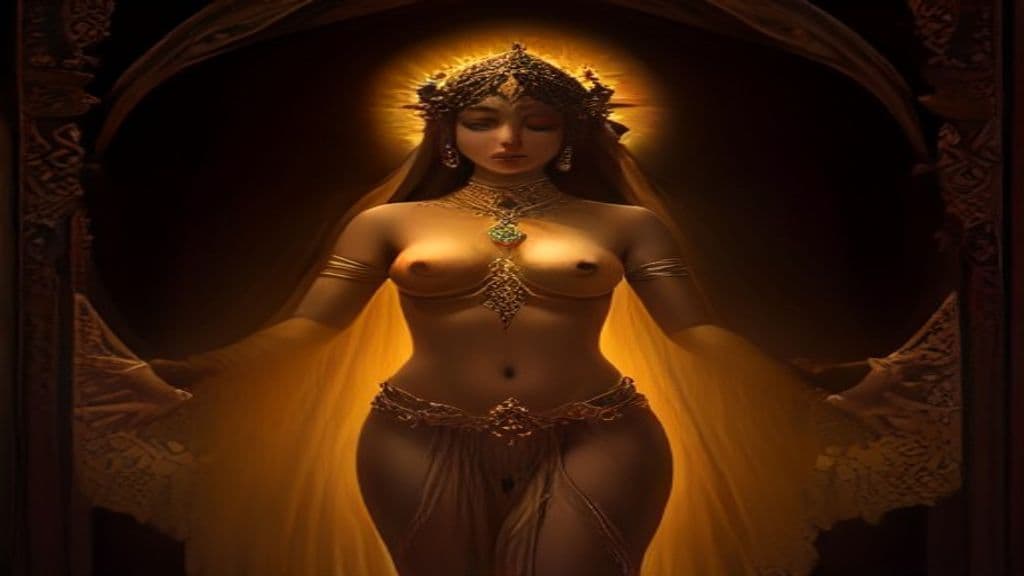
Apsara
Celestial dancers and water nymphs of Hindu cosmology — beautiful semi-divine beings who dance at the court of Indra and, by his command, descend to earth to distract sages from excessive asceticism.

Almaqah
Almaqah was the principal national deity of the ancient Sabaean kingdom (Saba') in southwestern Arabia, venerated as a celestial tutelary god with strong dynastic, oracular, and vegetative associations. His main cultic center was the Awwam Temple near Marib; his worship extended into the northern Horn of Africa (Dʿmt, Aksum). Scholarly treatments debate whether his primary identification is lunar, solar, or syncretic.
'Ain Samiya Goblet
Silver cup from the Middle Bronze Age I, discovered in a tomb at Ain Samiya. (Note: 1. Power tier should be "None", but add a note explaining that historical artifacts don't fit into the typical power tier classification. 2. Add a description of its appearance based on it being a sil)
*Perkʷūnos
*Perkʷūnos is the reconstructed Proto-Indo-European thunder‑god hypothesized by comparative linguistics and mythology. Scholarly reconstructions portray him as a storm or thunder figure associated with fructifying rain and as the combatant who fights a multi‑headed water‑serpent to release life‑giving waters; no direct attestations from the Proto‑Indo‑European period survive and the figure is inferred from later Indo‑European traditions.
*Péh₂usōn (reconstructed)
Péh₂usōn is a hypothetical Proto‑Indo‑European pastoral guardian reconstructed by comparative scholars from parallels in Greek and Vedic traditions. Proposed as a Graeco‑Aryan ancestor‑figure, the reconstruction describes a protector of flocks, roads, and travellers rather than an attested historical cultic personality.
57 Mnemosyne
57 Mnemosyne is a large main-belt asteroid (S-type) discovered in 1859 and named after the Greek Titaness Mnemosyne. It is a non-sentient astronomical body studied for its orbital and rotational properties and has been used in dynamical measurements related to Jupiter.
A'annepada
A'annepada (Sumerian cuneiform 𒀀𒀭𒉌𒅆𒊒𒁕; also romanized Aanépàdda) is attested as a historical ruler of the First Dynasty of Ur, flourishing c. 2350 BC. He is recorded in dedicatory and foundation inscriptions as king of Ur and as son of Mesannepada, credited with temple-building and dedication to deities such as Ninhursag and Inanna.
Abaddon
In Hebrew scripture Abaddon is primarily a noun meaning 'destruction' or a section/condition of the underworld paired with Sheol; in the New Testament Book of Revelation Abaddon is personified as an angelic figure (Greek Apollyon) described as the king of an army of locusts released from the abyss during the apocalypse.
Abadir
Abadir is a polysemous name attested in distinct cultural contexts: a legendary founding saint and clan ancestor in eastern Ethiopia (Sheikh Abadir Umar Al‑Rida / Aw Abadir), a term applied to cone‑shaped cult stones in Phoenician religious description, and a personal name of a martyr (Abadir/Apater) in the Coptic Synaxarium. The attestations are independent usages of the same name rather than a single supernatural being.
Aban Yasht
The Aban Yasht is a hymn from the Persian tradition that praises Anahita, a goddess associated with water, fertility, and wisdom. It consists of 132 stanzas and is part of the 21 Yashts collection. (Note: - Power tier should be "Primordial" or possibly "Cosmic", given that it's a hymn of great spiritual significance and associated with a goddess. - The article incorrectly states that Anahita is associa)
Abath
No corroborated folkloric entity named "Abath" is documented in the provided sources. The string appears in the supplied material only as a surname/personal name in Aruban/Dutch-Caribbean archival records and as an unrelated taxonomic or encyclopedic hit; no mythic attributes, origin stories, rituals, or apotropaic practices for an entity called Abath are present in the documents reviewed.
Abatur
Abatur is an uthra (celestial emanation) in Mandaeism described as the 'father of the Uthras' and called the Ancient (ʿattīqā). He resides on the boundary between the World of Light and lower regions, functions as a judge who weighs souls (Abatur Muzania), and supplies instructions and materials to the demiurgic uthra Ptahil in accounts from the Diwan (Scroll) of Abatur.
Abatwa (Twa / Batwa)
Abatwa (also recorded as Twa, Batwa, Mutwa; singular forms Barhwa or Murhwa in some transcriptions) are indigenous hunter‑gatherer peoples of the Great Lakes region of Central Africa, historically identified as some of the earliest inhabitants of the area. The available sources treat them as human ethnic groups whose livelihoods, lands, and populations have been severely affected by conservation policies and modern violence.
Abellio
Abellio is a theonym attested in Roman‑period inscriptions from the Comminges area of the Pyrenees and reported as worshipped in the Garonne Valley of ancient Gallia Aquitania. Surviving evidence is limited to a small number of inscriptions; scholars have variously hypothesized solar or arboreal associations and compared the name to forms of Apollo or to Celtic Belenus, but the deity's precise role in local cosmology remains uncertain.
Community Record
- [1]Moon god (Wikipedia). Wikipedia, 'Lunar deity' (list and comparative discussion of moon gods)wiki
- [2]Wikidata: lunar deity. Wikidata entry defining 'lunar deity' as 'deity representing the Moon'other
- [3]God Is Good | Psalm 136 (archive recordings). Archive recordings of Psalm 136 which contains the phrase that God 'made the great lights; the sun to rule over the day; the moon and stars to rule over the night'literary
- [4]God Is Good | Psalm 136 (alternate archive). Archive recording of Psalm 136 (same liturgical text cited for moon's role)literary
- [5]God Is Good | Psalm 136 (third archive). Archive recording of Psalm 136 (cited for theological assignment of the moon to rule the night)literary
- [6]List of lunar deities (Wikipedia). Wikipedia list enumerating named lunar deities across cultures (examples: Soma, Aglibol, Almaqah, Saggar, Wadd, Ay Ata, Mah)wiki
- [7]Comparative Index to Islam: MOON GOD (Answering-Islam). Comparative/polemical web essay discussing claims about moon-god origins in Arabian religionother
- [8]Comparative Index to Islam: MOON GOD (alternate mirror). Mirror of the comparative/polemical essay on claims of Arabian moon-god worshipother
- [9]Rebuttals to 'Rahmanan (RHMNN) - An Ancient South Arabian Moon God?'. Response/rebuttal addressing claims that certain Arabic divine names derive from an ancient South Arabian moon godother
- [10]ALLAH MOON GOD? — Proof Islam's 'Allah' Is A Pagan Moon God. Polemical essay asserting a claimed moon-god origin for 'Allah' (present in the corpus as part of the debate)other
- [11]Appendix 5: Is Allah the moon god as claimed by Robert Morey?. Critical appendix addressing claims that 'Allah' derives from a moon god (part of the modern debate present in the sources)other
- [12]Islam: pagan origin and Moon god worship (Bible.ca). Website presenting the thesis that Islam preserved a pre-Islamic Arabian moon god (included among polemical materials in the provided corpus)other