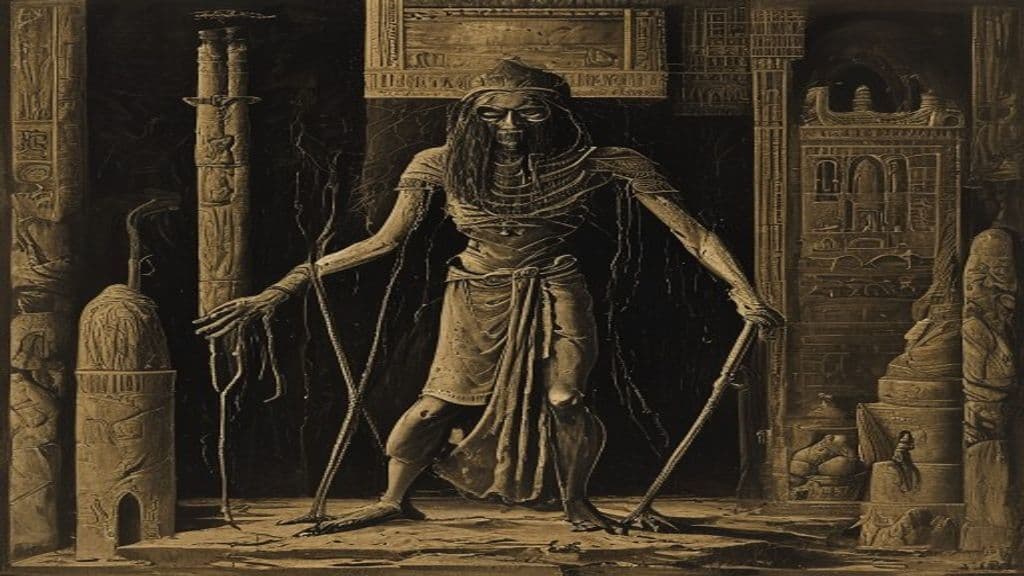
In the Ugaritic mythic corpus Mot is presented as a son of ’El and the personified power of death. In the Baal cycle Mot contests Baal (the storm/rain deity): invited to Baal’s feast, Mot is portrayed as slaying or believing he has slain Baal, after which Anat mutilates Mot and the land falls into drought while Baal is absent; later Mot returns (texts indicate a motif of seven years) seeking vengeance and demanding one of Baal’s brothers as food. A later euhemerizing/philosophical tradition (ascribed to Philo of Byblos/Sanchuniathon in later paraphrase) recasts Mot/Muth in a cosmogonic account and equates him with Greek underworld concepts (Thanatos/Pluto), producing a divergent origin narrative in which Mot figures among primeval forces and is implicated in generation imagery.
Extant texts give no fixed anthropomorphic portrait. Ugaritic summaries locate Mot in a city named hmry ('Mirey'), state that a pit is his throne, and that Filth is the land of his heritage; narrative scenes represent Mot as a corporeal adversary who can be seized and mutilated (Anat seizes, splits, winnows, burns, grinds, and scatters him), which conveys capacity for physical action in myth without supplying consistent visual attributes.
Mot embodies death and an appetite for the living: Ugaritic passages describe his appetite as devouring 'like lions in the wilderness' and as a threat even to Baal. His activity in the Baal–Mot cycle brings about ecological sterility (the land grows dry while Baal is absent). Mot also functions within a divine legal-hierarchical order—he concedes when warned that ’El might overturn his throne—showing he is powerful but not absolute. In later mythographic/philosophical accounts Mot is variously portrayed in generative/cosmogonic roles, a divergent tradition that attributes creative as well as destructive capacities.
Weaknesses
- othersubject to higher divine authority (’El's threat)
- othervulnerable to Anat's violence (mutilation and dispersal in narrative)
Wards
- otherdivine intervention (Anat's attack; Shapash restoring Baal; ’El's authority)
Baal
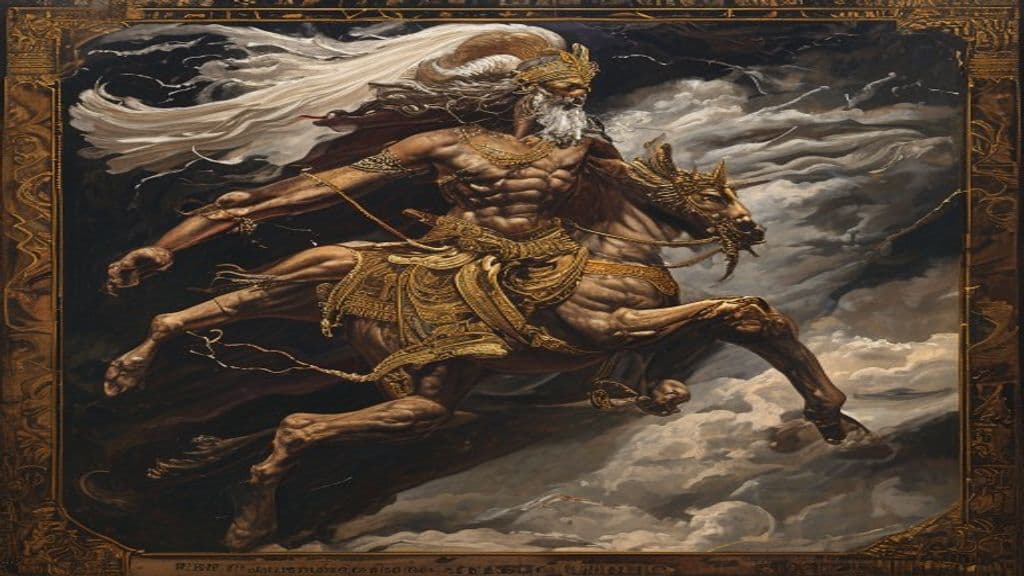
Baal (bāʿal) is a Northwest Semitic title meaning 'owner' or 'lord' that served as a theonym in the ancient Levant; in Ugaritic and Canaanite texts it appears as the name/title of a prominent storm and fertility god (often rendered Baʿal Haddu) who features centrally in the Baal Cycle and in regional cults tied to rain, fertility, and kingship. In later monotheistic literatures the term becomes a polemical label for rival or foreign deities and is reinterpreted in various receptions.
Anat
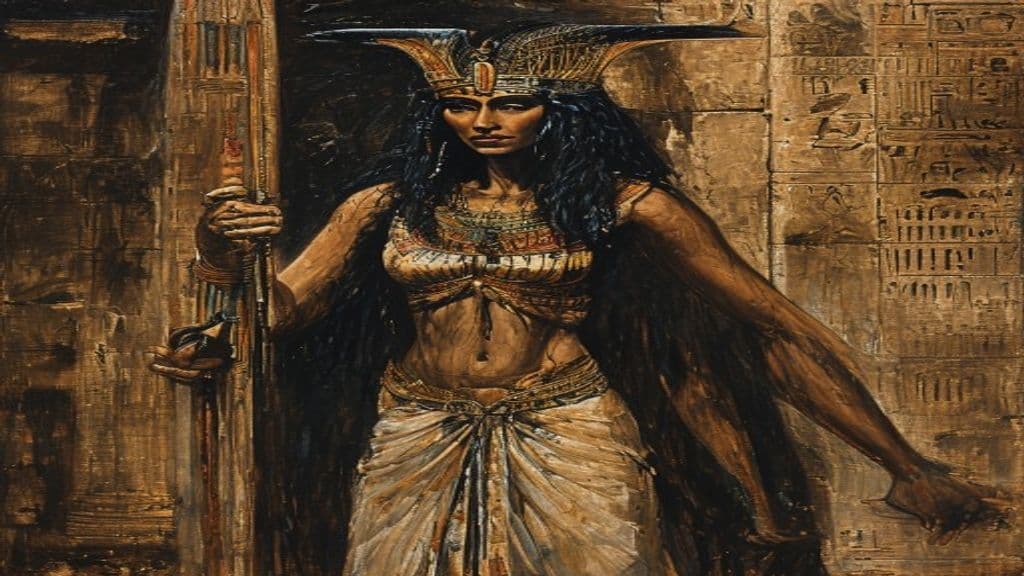
Anat is a Bronze Age Levantine goddess best known from Ugaritic texts, associated primarily with warfare and hunting. She is a major divine figure in the Ugaritic pantheon who regularly received offerings, appears as an active agent in mythic narratives (notably the Baal Cycle), and was attested across the Levant, into Egypt, Cyprus, Hurrian ritual contexts, and later in Suhum.
Abadir
Abadir is a polysemous name attested in distinct cultural contexts: a legendary founding saint and clan ancestor in eastern Ethiopia (Sheikh Abadir Umar Al‑Rida / Aw Abadir), a term applied to cone‑shaped cult stones in Phoenician religious description, and a personal name of a martyr (Abadir/Apater) in the Coptic Synaxarium. The attestations are independent usages of the same name rather than a single supernatural being.
Abī-simtī
Abī-simtī (also rendered Abi-simti, Abisimti) is a named woman attested in third-millennium BCE Mesopotamian documentary and literary texts. She appears in administrative account records as a provider of animals and donor to temple cults and in Sumerian love-song literature as the named beloved/consort addressed by a royal speaker.
Acerbas
Acerbas (also recorded as Sychaeus, Sycharbas, Zacherbas) is a figure in classical Greco‑Roman accounts of Phoenician/Tyrian tradition: a wealthy priest of Melqart (the Tyrian Hercules) whose concealed riches and murder by King Pygmalion precipitate Elissa/Dido's flight from Tyre and the foundation of Carthage. He is presented as a human priestly figure of high social rank rather than as a supernatural being.
Adad
Adad (also Hadad, Haddad; Sumerian Iškur) is the storm- and rain-deity attested in ancient Mesopotamian and Canaanite religious contexts. Sources identify him as a principal weather god whose domain is storms and rainfall and whose name appears across multiple Near Eastern languages and sites, including Ebla (as Hadda, c. 2500 BCE).
Adamma
Adamma is an ancient north‑Syrian goddess attested in Eblaite palace records ca. 2400 BCE and later incorporated into Hurrian and Emar contexts. She functioned as a named cultic deity with an institutional priesthood, a month and festival bearing her name, and documented offerings from the royal palace.
Adonis
Adonis is a mythic mortal youth in ancient Greek tradition, beloved by goddesses (notably Aphrodite and Persephone) whose death and seasonal return are the focus of the women’s midsummer festival Adonia. The cultic practices—planting short-lived 'gardens of Adonis' on rooftops, ritual lamentation, and casting an effigy and withered plants into the sea—symbolically link him to vegetation cycles and Near Eastern dying-and-regenerating god traditions.
Adrammelech
Adrammelech is attested in ancient Semitic textual tradition as a local god of 'Sepharvaim.' The name is commonly glossed as "Magnificent king." In modern times the name has been reused in diverse fictional, musical, and online contexts, but those are creative reworkings rather than continuations of the brief ancient attestation.
Agasaya
Agasaya is presented in modern secondary sources as a little-attested Semitic war goddess who, according to some summaries, was later absorbed as the warrior aspect of the major Mesopotamian goddess Ishtar. The attestation in available materials is sparse and much inferences about her name, attributes, and later influence are explicitly marked speculative in those sources.
Agenor of Argos
Agenor is a mythic royal figure in Greek heroic‑age genealogies who functions as a dynastic ancestor and narrative node. In different traditions he appears as an Argive king in the house of Phoroneus or as a son of Poseidon associated with Phoenicia and Libya; an Agenor also appears as a warrior in Homeric epic.
Aglibol
Aglibol is the moon god of ancient Palmyra, attested in inscriptions and reliefs from the late Hellenistic through Roman Imperial periods. He appears in civic cult contexts, often paired with the solar deity Malakbel and included in Palmyrene triads and public sanctuary imagery such as the Sacred Garden.
Allatum (Allani / Allatu)
Allani (Hurrian) or Allatu/Allatum (Akkadian/Mesopotamian) is a Near Eastern underworld goddess associated with rulership of the land of the dead and with determination of fate. She appears across Hurrian, Mesopotamian and Hittite/Anatolian contexts and is closely linked with other chthonic deities such as Išḫara and Ereshkigal.
Al‑Qaum
Al‑Qaum (Arabic: القوم) is a major Nabataean deity associated with war, the night, and the protection of caravans and clans. Attested in numerous inscriptions and later compared by commentators to Greek/Roman war gods, he functioned as a protector of travelers and as a guardian of souls during nocturnal journeys.
Community Record
- [1]Mot (god) - Wikipedia. Wikipedia, entry 'Mot (god)' (summary of Ugaritic texts and later paraphrase)wiki
- [2]Mot (god) - Wikipedia (duplicate link in notes). Wikipedia, entry 'Mot' (summary drawing on Ugaritic mythic corpus and Philo/Sanchuniathon paraphrase)wiki
- [3]Philo of Byblos / Sanchuniathon material (as preserved by later paraphrase) — summarized in secondary source. Summary of Philo/Sanchuniathon paraphrase as reported in the Wikipedia entry on Motliterary