
Folklorically, the night-hag is not a single origin tale but a recurring explanatory slot: many cultures attribute episodes of sleep paralysis and terrifying nocturnal dreams to an external agent that visits the sleeper at night. In Old English and Norse lore this was personified as the mare/mære, a damned or cursed woman whose nocturnal travels visit and oppress sleepers; in Islamic-influenced contexts the intruder is often identified with a jinn (karabasan), while other traditions treat it as the recently dead returning (Fiji) or use vernacular phrases that describe the pressing or binding sensation (East Asian terms). Scholarly summaries treat these as culturally specific ways of locating agency for a shared physiological experience rather than as a single, unitary mythic origin.
Descriptions vary by culture and do not form a single uniform image. Scandinavian accounts describe a damned woman (mare) whose body is carried in sleep and who visits villagers to sit on their rib cages. Atlantic-diaspora and southern U.S. accounts portray an 'Old Hag'—an old or malevolent female figure who leaves her physical body at night and sits on victims' chests. Albanian accounts describe the Mokthi/Makthi as a male spirit sometimes wearing a golden fez. Turkish tellings may imagine the intruder in a jinn form, sometimes depicted with a wide hat. East Asian idioms (Chinese, Japanese, Korean, Mongolian) focus on action-based descriptions—'ghost pressing' or being bound—rather than detailed anthropomorphic features. Fijian kana tevoro is framed as a demon that 'eats' the sleeper; visual specifics are not emphasized in the summarized sources.
Commonly reported behaviors across traditions include visiting a sleeping person at night, inducing paralysis or the sense of being held down, producing a heavy pressure on the chest or ribs, generating terror and frightening dreams, and in some contexts causing breathlessness or the sensation of strangulation. Particular traditions add culturally specific attributes: Scandinavian lore emphasizes the mare sitting on rib cages; Newfoundland/Atlantic accounts describe the hag leaving her body at night; Turkish karabasan narratives treat the attacker as a jinn that can hold and strangle; Fijian kana tevoro interprets the event as 'eating' and may allow conversation with the dead if prolonged; Albanian Mokthi can be placated or tricked (taking his hat grants a wish but invites repeat visits). Some traditions imply night-travel or bilocation/astral leaving of a physical body. The figure is therefore a folkloric agent attributed with perceptual and interactive powers during sleep rather than a clinically verified being.
Weaknesses
- mantraRecitation of Al‑Falaq and Al‑Nas (Qur'anic chapters)
- otherTaking/removing a spirit's hat (Albanian Mokthi motif — taking the hat compels the spirit to grant a wish but causes repeat visits)
Wards
- mantraRecitation of Al‑Falaq and Al‑Nas to expel jinn (Turkish practice)
- otherPlace husband's hat near the pillow (Albanian talismanic practice against Mokthi/Makthi)
- ritualVerbal expulsion / cursing of the spirit (Fijian post-episode practice)

Jinn
A class of supernatural beings from pre-Islamic Arabian religion later integrated into Islamic theology; jinn are created, morally accountable entities distinct from humans and angels, often unseen but capable of taking visible forms and interacting with people in varied ways.

Incubus (Jewish Tradition)
A male demon that preys on female humans in their dreams, seducing them and leading to physical interactions. (Note: 1. Power tier should be Primordial (cosmic) is too high; a more fitting power tier would be Greater (deity-level), given its ability to manipulate humans' dreams and lead to physical interactions. 2. )
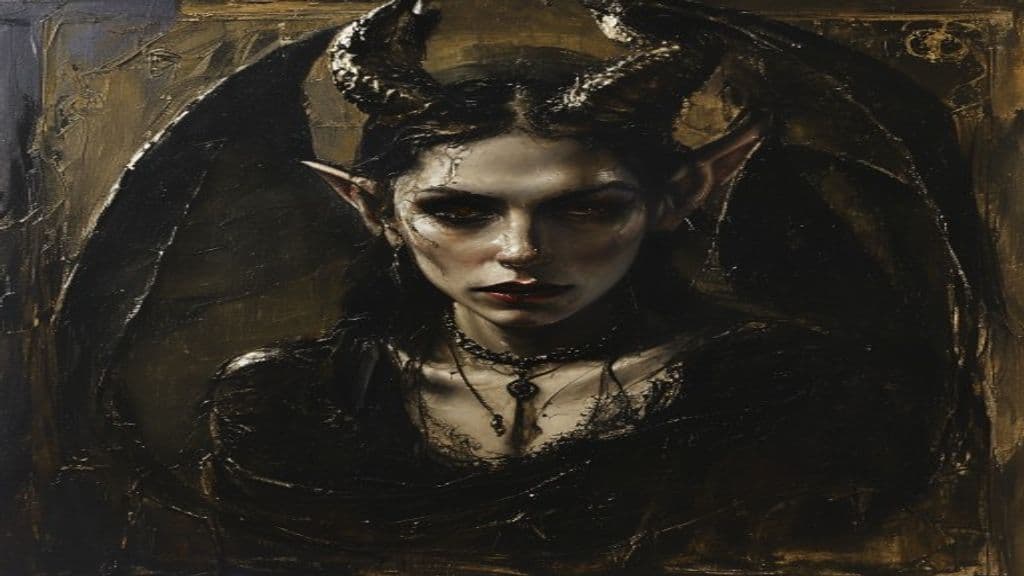
Succubus (Jewish Tradition)
Female demon that seduces male humans through dreams, potentially leading to a hybrid child and the man's decline. (Note: 1. Power tier should be Ancient, not Primordial (Primordial powers are cosmic, while Ancient powers are deity-level). 2. No information on physical appearance is missing because it's simply not mentio)
Abdiel
Abdiel (Hebrew עֲבְדִּיאֵל) is primarily a theophoric Hebrew personal name meaning "servant of El/servant of God," attested once in the Hebrew Bible (1 Chronicles 5:15). In later literature—most notably John Milton's Paradise Lost—Abdiel is reimagined as a faithful seraph who opposes Satan's revolt. The provided sources do not treat Abdiel as an autonomous folkloric spirit type or record rituals or wards associated with the name.
Abiel
Abiel is attested in the supplied sources only as a male given name — borne by several historical American individuals and listed as two minor biblical figures. The provided materials contain no evidence presenting Abiel as a supernatural, mythological, or folkloric entity.
Abigail
Abigail is a female figure in the Hebrew Bible portrayed in 1 Samuel 25 as the intelligent and beautiful wife of Nabal who intervenes to prevent David from committing violence; later tradition regards her as one of the Tanakh's seven female prophets and as a model of beauty and wisdom.
Abraun
Abraun is an attested name in German-language plant-legend scholarship (Der abraun, ein beitrag zur pflanzensagenkunde, 1916) and a short database entry (Wikidata) labels it as a spirit from German mythology. Surviving accessible documentation is extremely limited: the principal academic treatment is a 1916 contribution to pflanzensagenkunde (plant-saga studies), but the excerpts available here contain only bibliographic metadata and do not record tales, descriptions, or rituals.
Accolon
Accolon is a mortal knight of the Arthurian court, presented in the Post-Vulgate Merlin tradition and Malory's Le Morte d'Arthur as Morgan le Fay's paramour and instrument in a plot to supplant King Arthur; his tale centers on enchanted weapons (Excalibur and its scabbard), love-manipulation, and a tragic duel with Arthur.
Adils
Adils (Old Norse Aðils; also Eadgils, Adillus, Athisl, Adhel) is a semi‑legendary sixth‑century Swedish king attested in Old Norse saga material and later medieval traditions. He appears in saga episodes as a storied royal figure involved in warfare, court acts, and marriage suits rather than as a supernatural being.
Adsullata
Adsullata is attested as a Continental Celtic river goddess associated with the River Savus (modern Sava) in the Roman province of Noricum. Later traditions record her presence in Brittany as a goddess of hot springs and present her as an antecedent or origin-form of the Anglo‑Celtic sun goddess Sul.
Afaon fab Taliesin
Afaon fab Taliesin is a medieval Welsh warrior-counsellor, named as a son of the bard Taliesin and recorded among Arthur’s retinue in Welsh tradition. He appears in the Welsh Triads and in the tale Breuddwyd Rhonabwy (The Dream of Rhonabwy) as a notable martial figure and proverb-speaker rather than as a supernatural being.
Agilaz (Egil)
Agilaz (reconstructed Proto-Germanic) — commonly recorded in medieval sources as Egil or Ægil — is a legendary archer attested in Germanic heroic tradition. He appears as the brother of Völund (Wayland/Weland) in the Old Norse poem Völundarkviða and in the Thidreks saga, and his name is also inscribed on early medieval objects (Franks Casket, Pforzen buckle). The attested material presents him as a named heroic human archer within saga and inscriptional contexts rather than as a recurrent supernatural species.
Aglovale
Aglovale (also Agloval, Aglovan, Aglovaus, Acglavael) is a human knight of Arthurian romance, presented as the eldest legitimate son of King Pellinore and a Knight of the Round Table in the Vulgate/Post‑Vulgate cycles, Malory, and later adaptations. He brings his long‑lost brother Perceval to Camelot, takes part in military actions (including slaying Agrippa in one account), and his death is related in varying ways across traditions (accidental at Gawain's hand, deliberate murder by Orkney kin, or killed during Lancelot's rescue of Guinevere).
Agnarr Geirröðsson
Agnarr Geirröðsson is a mortal prince attested only in the Poetic Edda poem Grímnismál; he aids Odin (disguised as Grímnir) during Geirröðr's torture and, after Odin reveals himself and King Geirröðr dies, Agnarr succeeds as king.
Agne
Agne (also attested Agni, Hogne, Agni Skjálfarbondi) is a semi-legendary king of Sweden in Old Norse saga tradition, preserved in the Ynglingatal corpus and prose expansions such as Snorri Sturluson's Ynglinga saga. He is portrayed as a mighty and famous warrior-king whose campaign in Finland, marriage to Skjalf, and death by hanging form a remembered episode connected to local place-names and a burial mound.
Community Record
- [1]Night hag — Wikipedia. Wikipedia, 'Night hag' article (summarizes cross-cultural accounts of night-hag figures and links to sleep paralysis explanations).wiki
- [2]night hag — Wikidata. Wikidata short description: 'name given to a supernatural creature, used to explain the phenomenon of sleep paralysis.'wiki
- [3]CIA Reading Room archive (document collection). Archive.org: CIA Reading Room document referenced in provided materials (catalog entry).other
- [4]Night Hag — 5th Edition SRD (game source noted as modern fantasy use). SRD entry for the Night Hag in role-playing game context; cited as a modern fictional elaboration distinct from folkloric accounts.other