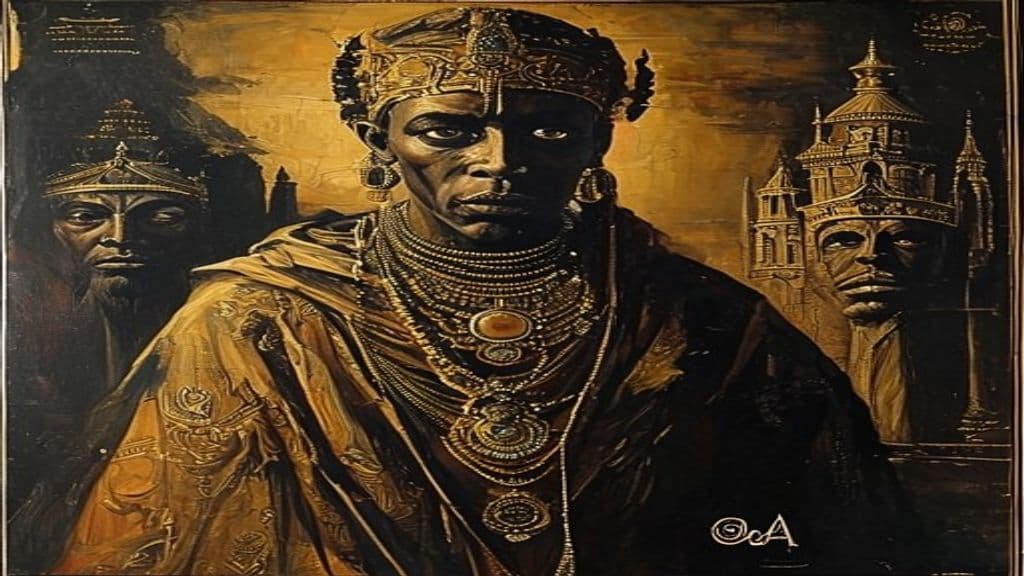
The provided materials do not supply a mythological origin story for an entity named 'Oba'. Instead, they document 'Oba' as a sociopolitical office in Yoruba and Bini contexts whose origins lie in systems of kingship and rulership; the corpus does not present a cosmogonic or supernatural origin narrative for 'Oba' as an autonomous spirit or deity.
No descriptions of a supernatural 'Oba' appearance are present in the consulted sources. 'Oba' appears in the materials only as a human title, place name (e.g., Oba, Anambra), or personal name, and no sensory depiction of a nonhuman Oba is provided.
The sources do not attribute supernatural abilities to an entity called 'Oba'. They note that the office of Oba in Yoruba and Bini societies encompasses both political and religious functions, implying that human holders of the title perform ritual and governance roles; the documents do not describe powers, magical behaviors, or interactions with the unseen world for a nonhuman Oba.
A ƭat Roog
A term attested in the vocabulary surrounding Roog within the Serer religious system; the provided sources do not supply a clear definitional account of an entity by this exact name. Material available situates the term in the wider context of Serer cosmology in which Roog is the universal supreme deity and ancestor cult (pangool) and priestly mediation (o yaal pangool) structure ritual life.
Abena Mansa
A name attested in a single contemporary Ghanaian blog anecdote as a 'mysterious being'; available sources do not establish Abena Mansa as a coherent, traditional supernatural figure or provide corroborating ethnographic detail.
Abiku
In Yoruba tradition, the Abiku is a Primordial entity representing the spirits of children who die young. (Note: - Power tier: Primordial seems plausible but should be supported by additional source material confirming its cosmic or deity-level abilities. - Appearance: While the draft mentions spirits often appe)
Abonsam
Abonsam is a malevolent spirit name used in accounts from the Gold Coast (modern Ghana) to explain community-level misfortune such as accidents and disease. When local ritual specialists diagnose Abonsam as the cause, communities perform a prolonged communal expulsion ritual intended to drive the spirit into the sea.
Adze
A vampiric firefly of the Ewe people of West Africa — a spirit that takes the form of a firefly by night and a malicious possessing being by day, drinking the blood of sleeping children and spreading disease.
Adze (Folklore)
Vampiric being in Ewe folklore, transforming into human shape upon capture. (Note: 1. Power tier should be Greater, as "deity-level" powers are implied by the ability to possess humans. 2. Add sensory cues (e.g., glowing lights) based on its firefly form. 3. Add weaknesses and wards)
Aganjú
Primordial Orisha associated with the sun, fire, and the untamed wilderness in Yoruba tradition. (Note: - Remove "untamed wilderness" from Power tier description as it's a trait associated with Lesser entities, not Primordial. - Add Appearance section based on source material (e.g., no specific descript)
Agbọghọ Mmụọ Masquerade
An Igbo masquerade category—literally 'Maiden Spirits'—in which masked (traditionally male) dancers embody the spirits of deceased unmarried girls, performing idealized adolescent feminine comportment and beauty in annual dry‑season civic ceremonies and at funerals and initiation rites in the Nri–Awka region.
Aje (Iyami Aje)
Aje appears in the supplied sources only as part of the compound term "Iyami Aje," which the referenced Wikipedia disambiguation entry labels as a Yoruba concept of feminine power. No further details about its nature, practices, appearance, or rituals are present in the provided materials.
Ajogun
Ajogun are a class of malevolent spiritual forces in the Yoruba religious worldview that regularly interfere with human lives, responsible for death, disease, curses, loss, conflict and related misfortunes. They are described as the polar opposite of the benevolent Oriṣa, led by Iku (Death), and can be warded off or appeased through intercession by Eṣu and by observing Ifá divinatory counsel.
Alusi
Alusi (also spelled arusi) are spirit-agents or divinities in the traditional religion of the Igbo people, each responsible for specific domains such as health, agriculture, rivers, justice, and the sky. They are worshipped and served through localized cults with priests and devotees and are distinct from clan ancestors (Ndichie).
Anansi
The spider trickster god of Akan folklore — cunning, mischievous, and wise. Keeper of stories and teacher of human beings, brought through the slave trade into Caribbean and African-American tradition.
Community Record
- [1]Oba - GargWiki. "The title of Oba translates as 'ruler' in both Yoruba and Bini, and the office has both political and religious functions."wiki
- [2]Oba, Anambra. Oba is a town in Nigeria. Its postal code is 434112. It is a suburb of Onitsha...wiki
- [3]Charles Obas. Charles Obas was an early-twentieth-century painter of Haitian art.wiki
- [4]Antonio Obá : Rituals of Care - Les presses du réel. Reference to contemporary artist Antonio Obá (title/name usage).other
- [5]Oba (disambiguation) - Wikipedia. Disambiguation page listing multiple modern uses of 'Oba' as title, acronym, and proper name.wiki
- [6]Oba Seward-Evans Favorites. Archive item referencing a named individual 'Oba Seward-Evans' (name usage in archives).other
- [7]Oba Pack Limited (Farmlandgrab article). Reference to Ghanaian company Oba Pack Limited (proper-name usage).other