
Para Brahman is presented in Upaniṣadic and Vedantic sources as the eternal causative ground of reality — sat‑cit‑ānanda (existence, consciousness, bliss) — from which manifestation issues. In some tantric cosmological summaries Para Brahman (the Unlimited) becomes Apara Brahman (the Limited) in the process of manifestation; in Vedanta schools the concept is developed philosophically rather than as a mythic biography. Different sampradāyas identify a particular deity as Para Brahman to assert theological primacy (e.g., Viṣṇu, Śiva, Devī), but the core designation originates as an ontological category in Upaniṣads and Vedantic commentary.
As a metaphysical principle, Para Brahman is not ascribed a determinate physical appearance in doctrinal sources. In Advaita it is explicitly nirguṇa — attributeless and formless, beyond all descriptions. Where sectarian traditions identify a personal Para Brahman, the iconography and appearance are those of the identified deity (for example Viṣṇu/Nārāyaṇa, Śiva/Paraśiva, Adi Parāśakti, Mahāganapati, Kartikeya) rather than a distinct, uniform form of Para Brahman itself. Sources stress that the term can refer either to the formless Absolute or to a supreme personal deity depending on context.
Doctrinally Para Brahman is credited with ontological attributes such as eternality, omniscience, infinitude and being the ground of bliss (sat‑cit‑ānanda). In Advaita realization of Para Brahman effects non‑dual knowledge in which distinctions between self (ātman) and Brahman are obliterated; in devotional schools the Para Brahman is the supreme object of worship whose grace is the means of deliverance. Tantric summaries present Para Brahman as the Unlimited that issues a limited manifestation (Apara Brahman). Para Brahman is not described as an agent with hostile intentions; rather it is the ultimate reality to be known (Para Vidyā), realized through practices like sravana (listening), manana (reflection) and nididhyāsana (meditation), or approached through bhakti in sectarian practice.
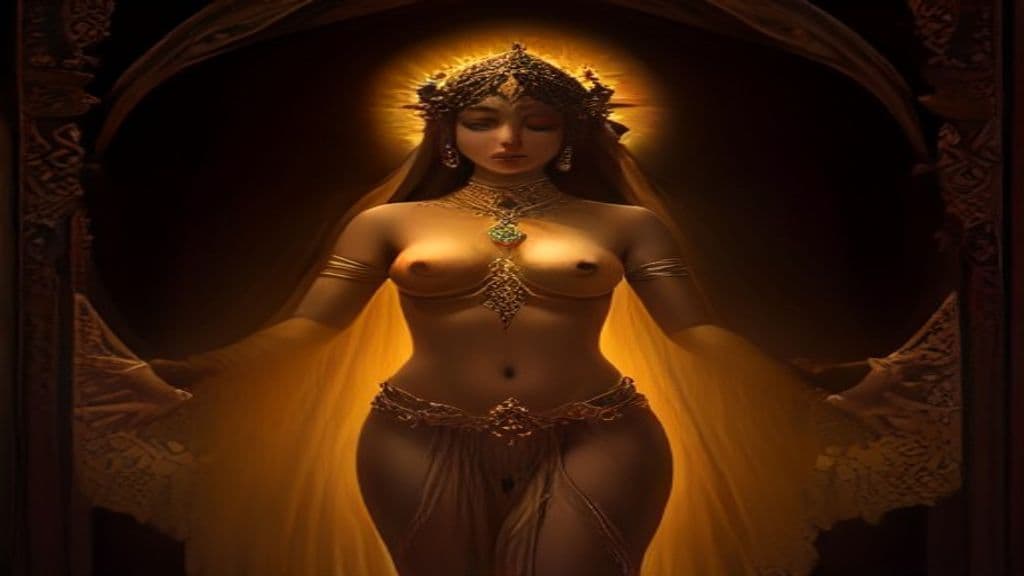
Apsara
Celestial dancers and water nymphs of Hindu cosmology — beautiful semi-divine beings who dance at the court of Indra and, by his command, descend to earth to distract sages from excessive asceticism.

Naga
Divine serpent beings of Hindu, Buddhist, and Jain cosmology — powerful guardians of water, earth, and underground treasures. Revered as deities in South and Southeast Asia.
*Perkʷūnos
*Perkʷūnos is the reconstructed Proto-Indo-European thunder‑god hypothesized by comparative linguistics and mythology. Scholarly reconstructions portray him as a storm or thunder figure associated with fructifying rain and as the combatant who fights a multi‑headed water‑serpent to release life‑giving waters; no direct attestations from the Proto‑Indo‑European period survive and the figure is inferred from later Indo‑European traditions.
*Péh₂usōn (reconstructed)
Péh₂usōn is a hypothetical Proto‑Indo‑European pastoral guardian reconstructed by comparative scholars from parallels in Greek and Vedic traditions. Proposed as a Graeco‑Aryan ancestor‑figure, the reconstruction describes a protector of flocks, roads, and travellers rather than an attested historical cultic personality.
57 Mnemosyne
57 Mnemosyne is a large main-belt asteroid (S-type) discovered in 1859 and named after the Greek Titaness Mnemosyne. It is a non-sentient astronomical body studied for its orbital and rotational properties and has been used in dynamical measurements related to Jupiter.
Abaddon
In Hebrew scripture Abaddon is primarily a noun meaning 'destruction' or a section/condition of the underworld paired with Sheol; in the New Testament Book of Revelation Abaddon is personified as an angelic figure (Greek Apollyon) described as the king of an army of locusts released from the abyss during the apocalypse.
Aban Yasht
The Aban Yasht is a hymn from the Persian tradition that praises Anahita, a goddess associated with water, fertility, and wisdom. It consists of 132 stanzas and is part of the 21 Yashts collection. (Note: - Power tier should be "Primordial" or possibly "Cosmic", given that it's a hymn of great spiritual significance and associated with a goddess. - The article incorrectly states that Anahita is associa)
Abath
No corroborated folkloric entity named "Abath" is documented in the provided sources. The string appears in the supplied material only as a surname/personal name in Aruban/Dutch-Caribbean archival records and as an unrelated taxonomic or encyclopedic hit; no mythic attributes, origin stories, rituals, or apotropaic practices for an entity called Abath are present in the documents reviewed.
Abatur
Abatur is an uthra (celestial emanation) in Mandaeism described as the 'father of the Uthras' and called the Ancient (ʿattīqā). He resides on the boundary between the World of Light and lower regions, functions as a judge who weighs souls (Abatur Muzania), and supplies instructions and materials to the demiurgic uthra Ptahil in accounts from the Diwan (Scroll) of Abatur.
Abatwa (Twa / Batwa)
Abatwa (also recorded as Twa, Batwa, Mutwa; singular forms Barhwa or Murhwa in some transcriptions) are indigenous hunter‑gatherer peoples of the Great Lakes region of Central Africa, historically identified as some of the earliest inhabitants of the area. The available sources treat them as human ethnic groups whose livelihoods, lands, and populations have been severely affected by conservation policies and modern violence.
Abellio
Abellio is a theonym attested in Roman‑period inscriptions from the Comminges area of the Pyrenees and reported as worshipped in the Garonne Valley of ancient Gallia Aquitania. Surviving evidence is limited to a small number of inscriptions; scholars have variously hypothesized solar or arboreal associations and compared the name to forms of Apollo or to Celtic Belenus, but the deity's precise role in local cosmology remains uncertain.
Abhimanyu
Abhimanyu is a youthful Kuru/Pandava warrior-hero in the Sanskrit epic Mahābhārata. Son of Arjuna and Subhadra, he is famed for entering the Chakravyuha battle formation on the thirteenth day of the Kurukshetra War and dying at age sixteen; his posthumous son Parikshit continues the Kuru line.
Abraham
Abraham (originally Abram) is the foundational patriarchal ancestor in the Hebrew Bible whose life establishes a covenantal relationship between his family/people and God. He functions as an exemplar of faith, the progenitor of promised descendants, and a narrative anchor for claims of land, blessing, and communal identity in later religious traditions.
Abraun
Abraun is an attested name in German-language plant-legend scholarship (Der abraun, ein beitrag zur pflanzensagenkunde, 1916) and a short database entry (Wikidata) labels it as a spirit from German mythology. Surviving accessible documentation is extremely limited: the principal academic treatment is a 1916 contribution to pflanzensagenkunde (plant-saga studies), but the excerpts available here contain only bibliographic metadata and do not record tales, descriptions, or rituals.
Community Record
- [1]Para Brahman — Wikipedia. Wikipedia: Para Brahman (summary of philosophical uses and sectarian identifications).wiki
- [2]Para Vidyā — Wikipedia. Wikipedia: Para Vidyā (description of higher knowledge and method: sravana, manana, nididhyāsana).wiki
- [3]Wikidata: Para Brahman. Wikidata entry labeling Para Brahman as a metaphysical concept.wiki
- [4]Tantra Cosmology (House of the Sun). Secondary summary describing Para→Apara cosmological formulation in tantric outlines.other
- [5]Tantra Cosmology (PDF). Secondary PDF summarizing cosmogonic use of Para Brahman as 'Unlimited' transforming into 'Limited'.other
- [6]Akshar Purushottam Upasana — Wikipedia. Example of sectarian identifications of supreme categories (used in sources to illustrate sectarian claims about Para Brahman).wiki
- [7]Archive: Los cimientos de la espiritualidad - Quien es Sri Diksa Guru. Audio/archive referencing the role of an initiating guru in spiritual perfection (used to contextualize the role of guru in realization practices).other
- [8]Taittiriya Upanishad summary (as cited). Summarized Upanishadic claim: the Supreme Brahma is Eternal, Conscious, and Blissful (sat‑cit‑ānanda) as cited in the source notes.other