
The supplied sources do not provide a creation myth or single origin narrative. Within the folkloric record summarized in the available material, the púca appears as a longstanding element of rural and coastal folk belief across Celtic, English, and Channel Islands communities. It is transmitted through regional oral tradition and local naming variants (púca, puca, pwca, pooka, pookah, phouka, puck), and functions within those traditions as an animate supernatural agent embedded in everyday life rather than as a deity with a specific cosmogonic origin. The creature's presence in multiple neighbouring traditions and its many local name-forms point to diffusion and local adaptation of a common folkloric type across these cultural areas.
Accounts consistently describe the púca as a shape‑changing spirit that most often assumes animal forms—particularly that of a wild horse—but also goats, cats, dogs, and hares. Pelage is variously described as dark or white; some summaries explicitly note dark or white fur or hair. The púca may also appear in human guise, but such human forms can retain animal features like ears or a tail, producing a hybrid or uncanny appearance. In some tellings the púca is described in ghost‑like or spectral terms, while in others it is more corporeal; local variations determine whether an account emphasizes physical solidity or an eerie spirit quality.
The primary ability attributed to the púca in the sources is shape‑changing: taking multiple animal shapes and occasional human‑like guises. Folklore emphasizes its ambivalent disposition—capable of bringing both good and bad fortune—and describes it as able to help or hinder rural and maritime communities. Accounts and summaries note capricious interventions in human affairs often involving animals and transport (for example tales of giving wild rides appear in broader folkloric tradition), while some descriptions highlight a ghost‑like presence rather than purely physical acts. The sources do not provide detailed lists of supernatural feats beyond these shape‑changing and fortune‑affecting behaviors.
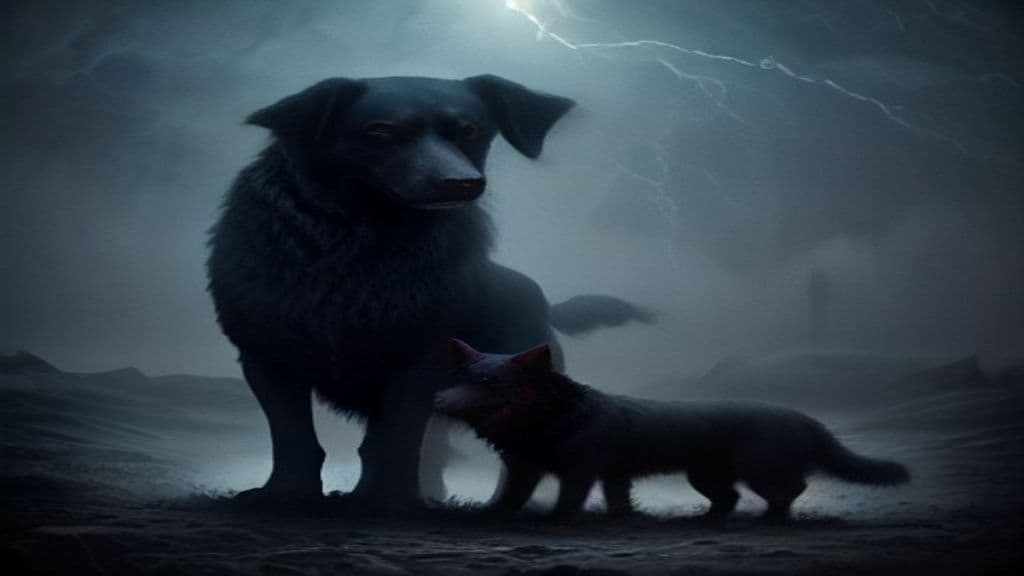
Black Shuck
A spectral black dog of East Anglian legend, with glowing red or green eyes. Its appearance is an omen of death. Its howl has been heard on clifftops during storms for centuries.

Puck
Puck is a northwest European liminal spirit occupying a space between household sprite and wild fairy trickster. Portrayed as a domestic helper who expects food offerings and as a nocturnal jester of the fairy court, Puck performs both useful chores and mischievous pranks in folklore and literature.
Abandinus
Abandinus is a locally attested Romano‑Celtic theonym known from a single inscribed bronze feather (votive object) dedicated at Godmanchester (the Roman fort Durovigutum) in Cambridgeshire. Scholars interpret him as a local god or male spirit tied to a specific place and possibly associated with a nearby spring or stream; this association is tentative and based on etymological readings of the name.
Abarta (Ábartach)
Abarta (also Ábartach) is a figure of Irish myth who, in surviving accounts, tricks Fionn mac Cumhaill's warriors by giving them a supernatural grey horse that bears them into the Otherworld. Sources variably identify him as a member of the Tuatha Dé Danann or as a Fomorian; after the incident he is compelled to release the captured warriors and is refused entry to the Fianna.
Abcán (Abhcán)
Abcán (modern spelling Abhcán) is a named dwarf poet and musician of the Tuatha Dé Danann in Irish myth. He appears in a small number of narratives as a musician whose art has soporific power and as the ferryman who brings the goddess Ruad from the Otherworld to the human world.
Abdiel
Abdiel (Hebrew עֲבְדִּיאֵל) is primarily a theophoric Hebrew personal name meaning "servant of El/servant of God," attested once in the Hebrew Bible (1 Chronicles 5:15). In later literature—most notably John Milton's Paradise Lost—Abdiel is reimagined as a faithful seraph who opposes Satan's revolt. The provided sources do not treat Abdiel as an autonomous folkloric spirit type or record rituals or wards associated with the name.
Abhean
Abhean is a named poet of the Tuatha Dé Danann in medieval Irish literature, described as a poet in particular of Lugh and recorded as having been killed by Óengus before Midir in a poem by Fland Mainistreach preserved in the Lebor Gabála Érenn.
Abiel
Abiel is attested in the supplied sources only as a male given name — borne by several historical American individuals and listed as two minor biblical figures. The provided materials contain no evidence presenting Abiel as a supernatural, mythological, or folkloric entity.
Abigail
Abigail is a female figure in the Hebrew Bible portrayed in 1 Samuel 25 as the intelligent and beautiful wife of Nabal who intervenes to prevent David from committing violence; later tradition regards her as one of the Tanakh's seven female prophets and as a model of beauty and wisdom.
Abnoba
Abnoba is a Gaulish theonym and toponym attested in Roman-era sources and inscriptions: a localized deity associated with woods, springs and the sources of rivers (notably the Danube) and simultaneously the name applied to a mountain or mountain range in the Black Forest/Baar/Odenwald region. Roman altars equate her with Diana, reflecting syncretic cult practice in frontier provinces.
Accolon
Accolon is a mortal knight of the Arthurian court, presented in the Post-Vulgate Merlin tradition and Malory's Le Morte d'Arthur as Morgan le Fay's paramour and instrument in a plot to supplant King Arthur; his tale centers on enchanted weapons (Excalibur and its scabbard), love-manipulation, and a tragic duel with Arthur.
Achall
Achall is an eponymous mortal woman in the Ulster Cycle of early Irish literature whose grief-induced death is given as the origin of the hill-name Achall (identified with the modern Hill of Skryne). She appears as a genealogical and etiological figure tied to Tara and later legendary events at the hill, rather than as a recurring supernatural agent.
Achtland
Achtland is a figure from Irish tradition who, according to the surviving account, was a mortal woman famed for rejecting mortal suitors who married a member of the Tuatha Dé Danann and crossed into the síde to become immortal as his wife.
Acionna
Acionna is a local Gallo-Roman water goddess attested by a single votive inscription found at a spring in the Orléanais region. The inscription, discovered by Jollois in 1822 and datable by style to the 2nd century CE, dedicates a portico and ornaments "AUG(ustae) ACIONNAE" and was recovered from the Fontaine de l'Étuvée in Orléans; archaeological work in 2007 uncovered remains of a Gallo-Roman temple and a section of an aqueduct at the site.
Community Record
- [1]Púca. Wikipedia: Púca (accessed via provided research notes)wiki
- [2]Pooka (Thingiverse / Archive summary). Thingiverse / Archive summary quoting Wikipedia and related entries (provided research notes)other
- [3]The Pooka | Emerald Isle. Emerald Isle: The Pooka (excerpted material provided in research notes)folk
- [4]Humours of Irish Life (archive). Archive: Humours of Irish Life (listed among provided sources; general folkloric compilation)folk
- [5]Celtic Mythology (archive). Archive: Celtic Mythology (listed among provided sources; general compilation)folk
- [6]Puca / Pooka Legend (The Irish Road Trip). The Irish Road Trip: summary of the Púca in local storytelling (provided research notes)folk
- [7]Pookas, Pucas, and Pucks (Eric Edwards blog). Eric Edwards: collected commentary on pookas/pucas/pucks (listed among provided sources)other
- [8]Pooka (disambiguation). Wikipedia disambiguation page (listed among provided sources)wiki
- [9]Archive: The Rachel Lindsay Interview (advertising copy reference). Archive.org item noted in research notes (contains commercial use of the name 'Pooka Pure and Simple')other
- [10]Archive: nawiedzony299_pooka_lives (podcast episode reference). Archive.org item referenced in research notes (contemporary media use of the name 'Pooka Lives!')other