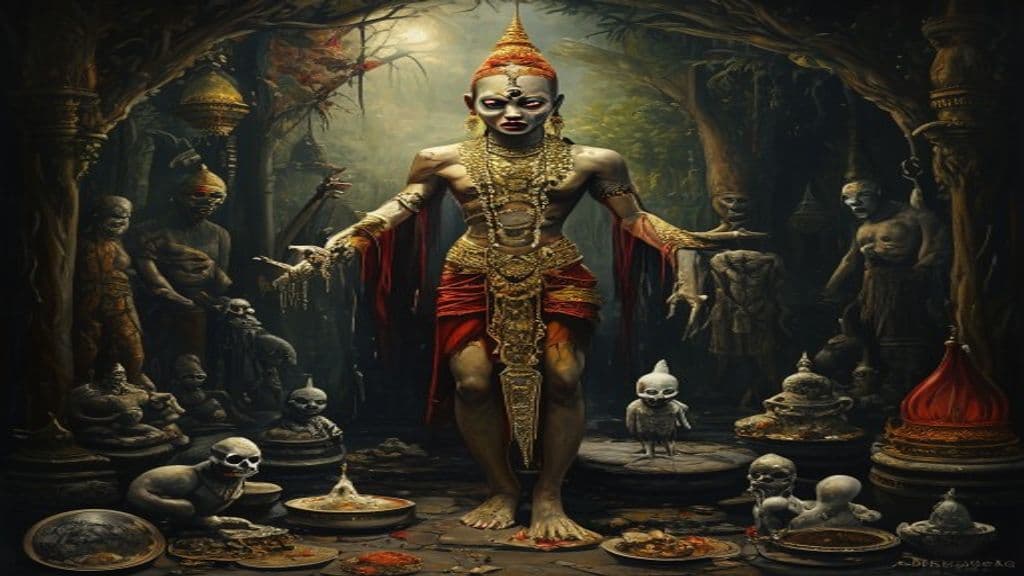
According to Thai usage recorded by the Royal Institute Dictionary and summarized in ethnographic accounts, Phi Tai Hong arises when a person dies an unnatural, violent, or sudden death (tai hong) — for example murder or drowning — and thus cannot prepare for death or complete obligations. The suddenness/unexpectedness component is emphasized in the Thai term: victims are unable to fulfill desires or proper funerary observances, producing a lingering, vengeful spirit. Historical writings also record concerns about pregnant women who die with their unborn children; such deaths are classed as Tai Thang/Tai Thong Klom and regarded as embodying the power of two lost lives (van Vliet as cited in modern summaries). The sources note exclusions and distinctions in Thai usage: deaths by slow illness or socially anticipated deaths are not the paradigmatic condition for Phi Tai Hong (Royal Institute Dictionary summary as reported).
The supplied sources do not offer a single, consistent physical description; rather they emphasize behavior and danger. Modern popular culture (films, soap operas) frequently depicts Phi Tai Hong in visual media—often in the form of a frightening, vengeful apparition and in narratives focused on women who died in childbirth (for example the Nang Nak tradition) — but the academic and reference sources stress that the category is defined by sudden violent death and resultant malevolence more than by a fixed corporeal appearance.
Phi Tai Hong are described as vengeful and restless spirits whose anger and sorrow manifest as active malice toward the living. They are said to haunt the location of their death, can be especially dangerous and aggressive because of unfulfilled desires at death, and are often believed to attempt to kill living people in the same manner in which they themselves died. They are considered among the most feared ghosts in Thai culture and particularly difficult to exorcise; exorcisms can be very complicated and involve arcane ceremonies (all statements summarized from cited reference material).
Weaknesses
- ritualproper funerary rites (prevention through correct observance)
- ritualhistorical practice recorded by Jeremias van Vliet: interment of pregnant women under fortifications/buildings (reported as transforming potential Tai Thang/Tai Thong Klom into protective spirits rather than destructive ones) — historical context and ethical implications noted in sources
Wards
- ritualarcane exorcism ceremonies (sources state exorcisms are complex and required to remove Phi Tai Hong; no specific formula provided in the supplied materials)
- conditionavoidance of the death site during the first seven days after death (advice recorded in sources as protective behavior)
Avalokiteshvara of Chaiya (Padmapānī torso)
A Srivijaya-era bronze torso identified as a pratimā of Avalokiteshvara (Padmapānī), discovered at Chaiya in southern Thailand and now in the Bangkok National Museum. It functions in its sources as a consecrated devotional image whose visage has been used in modern practice to calm and inspire compassion in viewers.
Khun Borom
Legendary ancestor and cultural founder of the Southwestern Tai-speaking peoples, revered for establishing the foundations of Thai culture. (Note: * Power tier: Should be "Ancient" as there's no mention of cosmic or deity-level powers. * Abilities and sensory cues: Since they're not described in the source, it would be best to rephrase these sec)
Kinnaree
A benevolent hybrid figure from Hindu-Buddhist myth, presented in Thai tradition as a part-human, part-bird being closely associated with music, love, beauty, and the protection of humans. The motif persists in modern Thai cultural life as decorative and symbolic imagery.
Krasue
A nocturnal Southeast Asian female spirit typically depicted as a floating, disembodied woman's head with internal organs trailing beneath the neck. The figure forms part of a regional cluster of related body-detaching female spirits and is presented in local traditions as a transformed or cursed human who leaves the living body by night to seek food.
Mae Nak Phra Khanong
Mae Nak Phra Khanong is a well-known Thai folktale spirit of a woman named Nak who died in childbirth and remained attached to the living world out of devotion to her husband Mak. The legend places her at Phra Khanong (along Khlong Phra Khanong) and presents her both as a terrifying haunting figure and as an object of local devotion at the Wat Mahabut shrine.
Naga fireball (Bang Fai Phaya Nak)
A seasonal luminous phenomenon observed along the Mekong River, locally attributed to phaya nak (giant river serpents, Nāga) and described as glowing reddish balls that rise from the water and disappear after ascent. Scientific and skeptical commentators characterize it as an atmospheric/visual phenomenon and advance alternative explanations such as tracer rounds, flare guns, marsh gases, or plasma-like effects.
Nang Mai (Tree Spirits)
Nang Mai are female tree spirits in Thai folklore inhabiting individual large trees or tree clumps. They are localized tutelary/ghostly presences tied to the well‑being of particular trees and are said to punish those who cut or harm their trees.
Nang Ta-khian
A female tree spirit in Thai folklore who inhabits large ta-khian (Hopea) trees. She is part of the class of Nang Mai (tree spirits) and is venerated locally with offerings such as colored cloth or traditional Thai silk dresses placed at the foot of the tree.
Nang Tani
Nang Tani is a Thai female tree spirit (one form of the Nang Mai class) associated with clumps of wild banana trees called Kluai Tani. In folklore she appears as a green-clad young woman who can be benevolent—giving food to monks and receiving offerings—but may also punish men who have wronged women; popular culture adapts her image in films and amulets.
Phaya Naga
A regional form of the nāga in Lao and Thai Mekong riverine culture: large serpent/dragon-like semi-divine water beings associated with the Mekong, implicated in local ritual calendars and popular explanations for luminous river phenomena (the 'Naga fireballs').
Phi Phong
A ghostly spirit of northern Thai folklore described as the result of black magic gone awry; in modern media a related variant is depicted as a blood‑feeding nocturnal entity. It is framed in sources as arising from failed dark sorcery and appears in contemporary regional horror films.
Phi Pop
A Thai possessing spirit that inhabits a living person and compels them to consume raw entrails at night — the possessed victim may be unaware, accused by their community, and driven out.
Community Record
- [1]Phi Tai Hong — Wikipedia. Wikipedia: 'Phi Tai Hong (Thai: ผีตายโหง) is a ghost of Thai folklore...'; includes Royal Institute Dictionary summary, behavior, timing (first seven days), Tai Thang/Tai Thong Klom, van Vliet account, and statements on exorcisms.wiki
- [2]Phi Tai Hong — Wikidata entry Q6888955. Wikidata entry summarizing Phi Tai Hong as a ghost of Thai folklore; corroborates basic identity and categorization.other
- [3]Nang Nak Phrakhanong — Thaifolk (example of pregnant‑woman ghost tradition). Thaifolk entry on Nang Nak cited in supplied materials as a popularly narrated example connected to the pregnant‑woman ghost tradition related to Tai Thang/Tai Thong Klom.folk
- [4]Phi Tai Hong — Pantheon/Facts fragments. Short reference descriptions corroborating that Phi Tai Hong are ghosts of those who died violent deaths and that the pregnant‑woman variant is especially powerful.other
- [5]Facts.net — 30 Types of Ghosts From All Around the World. Popular reference list included among supplied sources that mentions Phi Tai Hong in summary form; used only as corroboration of broad folkloric classification.other