
In the common legend Mae Nak is a woman named Nak who died while pregnant or in childbirth while her husband Mak was conscripted/away at war. When Mak returned he initially lived with Nak and their infant without perceiving that she was dead; neighbours eventually warned him and Nak revealed her ghostly nature (for example by stretching her arm to an impossible length to retrieve an object). Various versions conclude with monastic intervention–a powerful monk either confines her in an earthen jar and disposes of it in the canal, removes and binds a bone from her forehead as a relic, or persuades her to leave by promising reunion in a future life. Scholarly and popular retellings record multiple variants and some historical-critical claims that the tale was later shaped in print and performance.
Legendary descriptions present Nak as a beautiful young woman who, in the ghost story, appears as if alive and nursing an infant. Shrine iconography at Wat Mahabut centers on a statue or images of Mae Nak with her child; devotees also offer fine dresses, toys, and portraits. A notable folkloric episode describes Nak stretching her arm to an impossible length, signaling her supernatural state.
Folklore attributes to Nak postmortem persistence and agency: she can appear indistinguishable from living persons (deceiving her husband), perform remarkable physical feats in stories (the elongated arm episode), pursue and terrorize those who oppose her, and inflict fear or harm on a local community when enraged or jealous. Her motivation in most tellings is intense attachment to her husband and child; responses to her haunting center on monastic ritual containment, negotiation, or shrine-based petitions.
Weaknesses
- conditionBuddhist holy ground (wat/temple precincts) — temples are presented as places a ghost cannot enter
- substanceBlumea balsamifera (nat) — traditional motif states ghosts are afraid of sticky nat leaves and people use nat bushes in the legend to hide from or repel her
- ritualmonastic containment or relic-binding — variants describe a monk confining the spirit in an earthen jar or removing and binding a forehead bone
Wards
- conditionSeek refuge in a temple (wat) — entering temple precincts is presented as protective
- substanceHide behind or use Blumea balsamifera (nat) — legend uses nat bushes as a means to avoid detection
- ritualMonastic capture and containment (earthen jar) — a powerful monk is said in some versions to have confined her in an earthen jar and thrown it into the canal
- ritualCranial-bone relic binding — in other variants a high-ranking monk (Somdet Phra Phutthachan [To Phrommarangsi]) is said to have removed a bone from her forehead and bound it, holding the relic to control the spirit

Petni
The female equivalent of the Bengali bhoot — the ghost of a young woman who died unmarried or before fulfilling her expected life. The Petni is more volatile and less predictable than the Shakchunni (married woman's ghost), driven by the particular bitterness of a life foreclosed rather than interrupted.

Naga
Divine serpent beings of Hindu, Buddhist, and Jain cosmology — powerful guardians of water, earth, and underground treasures. Revered as deities in South and Southeast Asia.

Bhoot (bhoota)
A bhoot (also bhoota, bhoot, bhut) is the culturally specific term across parts of the Indian subcontinent for a perturbed, restless spirit generally understood to be the ghost of a deceased person. Sources describe bhoots as arising when a person's death or post-death circumstances prevent them from moving on — for example violent death, unresolved affairs, or failures in funerary rites — and the term appears frequently in modern South Asian media and discussions.
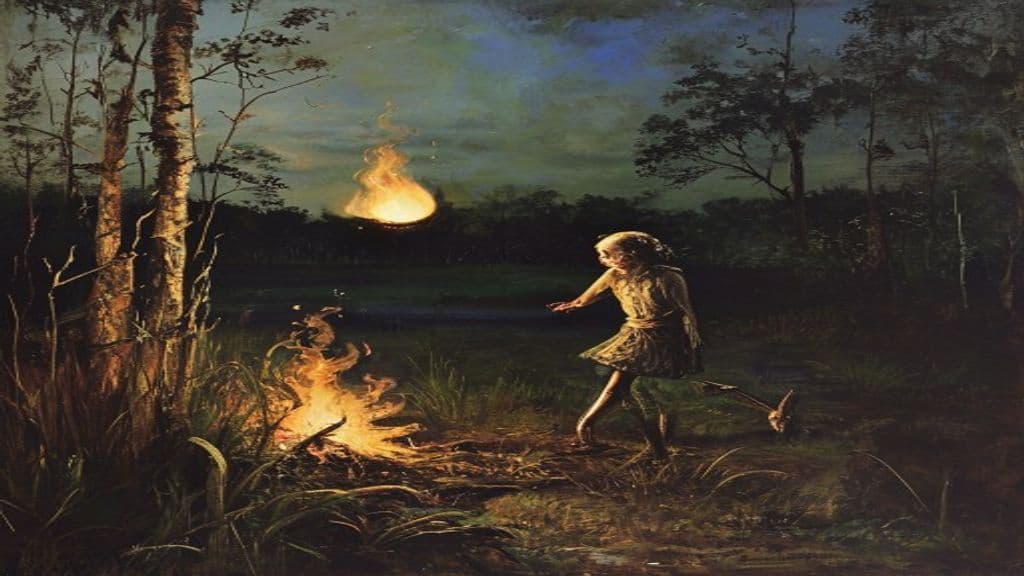
Will-o'-the-wisp
An atmospheric 'ghost light' — a small, mobile, lamp-like light seen at night over marshes, bogs, wet ground, or graveyards. In many cultures the phenomenon is interpreted as a supernatural being or manifestation (wandering nature-spirit, soul of the dead, transformed witch, or treasure-indicator); modern science offers chemiluminescent explanations for some occurrences.
Avalokiteshvara of Chaiya (Padmapānī torso)
A Srivijaya-era bronze torso identified as a pratimā of Avalokiteshvara (Padmapānī), discovered at Chaiya in southern Thailand and now in the Bangkok National Museum. It functions in its sources as a consecrated devotional image whose visage has been used in modern practice to calm and inspire compassion in viewers.
Khun Borom
Legendary ancestor and cultural founder of the Southwestern Tai-speaking peoples, revered for establishing the foundations of Thai culture. (Note: * Power tier: Should be "Ancient" as there's no mention of cosmic or deity-level powers. * Abilities and sensory cues: Since they're not described in the source, it would be best to rephrase these sec)
Kinnaree
A benevolent hybrid figure from Hindu-Buddhist myth, presented in Thai tradition as a part-human, part-bird being closely associated with music, love, beauty, and the protection of humans. The motif persists in modern Thai cultural life as decorative and symbolic imagery.
Krasue
A nocturnal Southeast Asian female spirit typically depicted as a floating, disembodied woman's head with internal organs trailing beneath the neck. The figure forms part of a regional cluster of related body-detaching female spirits and is presented in local traditions as a transformed or cursed human who leaves the living body by night to seek food.
Naga fireball (Bang Fai Phaya Nak)
A seasonal luminous phenomenon observed along the Mekong River, locally attributed to phaya nak (giant river serpents, Nāga) and described as glowing reddish balls that rise from the water and disappear after ascent. Scientific and skeptical commentators characterize it as an atmospheric/visual phenomenon and advance alternative explanations such as tracer rounds, flare guns, marsh gases, or plasma-like effects.
Nang Mai (Tree Spirits)
Nang Mai are female tree spirits in Thai folklore inhabiting individual large trees or tree clumps. They are localized tutelary/ghostly presences tied to the well‑being of particular trees and are said to punish those who cut or harm their trees.
Nang Ta-khian
A female tree spirit in Thai folklore who inhabits large ta-khian (Hopea) trees. She is part of the class of Nang Mai (tree spirits) and is venerated locally with offerings such as colored cloth or traditional Thai silk dresses placed at the foot of the tree.
Nang Tani
Nang Tani is a Thai female tree spirit (one form of the Nang Mai class) associated with clumps of wild banana trees called Kluai Tani. In folklore she appears as a green-clad young woman who can be benevolent—giving food to monks and receiving offerings—but may also punish men who have wronged women; popular culture adapts her image in films and amulets.
Phaya Naga
A regional form of the nāga in Lao and Thai Mekong riverine culture: large serpent/dragon-like semi-divine water beings associated with the Mekong, implicated in local ritual calendars and popular explanations for luminous river phenomena (the 'Naga fireballs').
Phi Phong
A ghostly spirit of northern Thai folklore described as the result of black magic gone awry; in modern media a related variant is depicted as a blood‑feeding nocturnal entity. It is framed in sources as arising from failed dark sorcery and appears in contemporary regional horror films.
Phi Pop
A Thai possessing spirit that inhabits a living person and compels them to consume raw entrails at night — the possessed victim may be unaware, accused by their community, and driven out.
Phi Tai Hong
Phi Tai Hong (ผีตายโหง) are vengeful, restless spirits in Thai folklore arising from people who die suddenly and violently. They are feared as especially dangerous and difficult to exorcise; the pregnant-woman variant (Tai Thang/Tai Thong Klom) is regarded as particularly malevolent.
Community Record
- [1]Mae Nak Phra Khanong. Wikipedia entry 'Mae Nak Phra Khanong' (accessed online)wiki
- [2]Wikidata: Mae Nak Phra Khanong. Wikidata item for Mae Nak Phra Khanongwiki
- [3]Ghost of Mae Nak shrine, Bangkok (Travelfish). Travelfish guide entry on the Mae Nak shrine at Wat Mahabutfolk
- [4]Archive: Episode 248 - Keep Your Spirit Entertained (Mae Nak). Archive.org episode referencing Mae Nak folkloreother
- [5]Mae Nak Phra Khanong - Midnight Muse. Midnight Muse summary and discussion of Mae Nakother
- [6]Bangkok's haunted temple: the ghost story of Mae Nak. Travel/cultural blog retelling the Mae Nak story and the Wat Mahabut shrineother