Classical Vedic and Purāṇic accounts locate the pitṛs in the earliest layers of religious literature. The Rigveda treats ancestral and divine realms in overlapping terms; later texts and Purāṇas (e.g., Vayu, Brahmanda, Vishnu Purāṇas as summarized in the sources) elaborate classes of pitṛs and genealogies that trace some pitṛs to the Prajapatis (progenitors). Manuṣruti and Purāṇic summaries describe manuṣyāḥ pitaraḥ (human forefathers) who by righteousness may attain the status of divine pitṛs (devāḥ pitaraḥ) and dwell in Svarga or Devaloka; other scriptural narratives (e.g., stories of Jaratkaru, Pururavas, Bhagiratha) present rites, procreation, or austerities as remedial acts that restore ancestral welfare. These accounts frame pitṛs as an enduring cultic category in Hindu cosmology rather than a single origin myth.
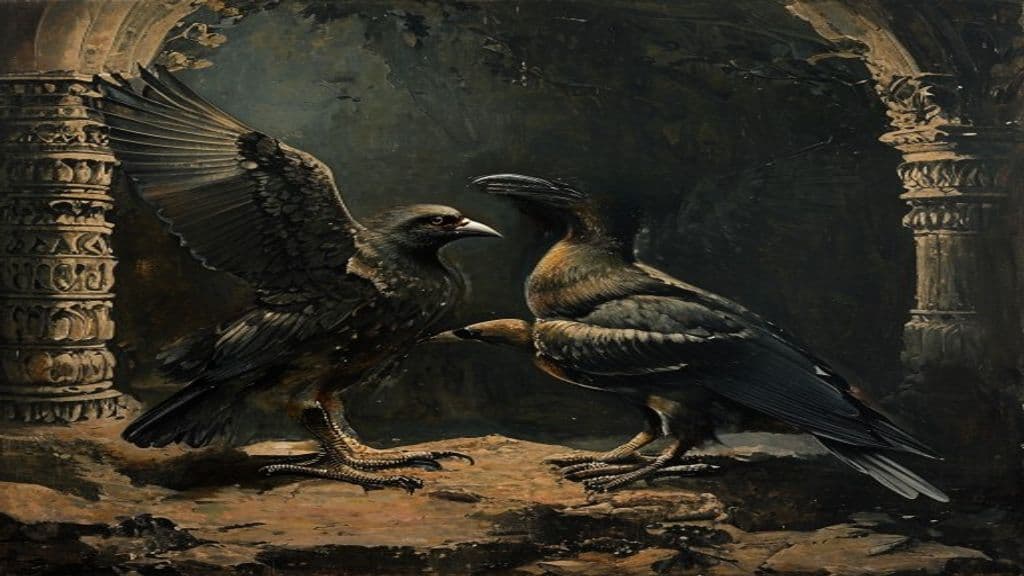
Classical sources do not give a single uniform physical description of pitṛs. Some ritual and legal texts liken pitṛs to birds—the Baudhayana tradition explicitly states pitṛs assume bird-like forms and this imagery underlies practices such as feeding birds during funeral rites. Purāṇic and Brāhmaṇa summaries recognize different classes or origins (divine pitṛs, human ancestors, primordial progenitors) implying variable forms or stations, but the excerpts do not provide a systematic anthropomorphic typology.
In Hindu traditional accounts pitṛs occupy an ontological role rather than functioning chiefly as hostile monsters: they are the recipients of ritual sustenance (piṇḍa, śrāddha) and are believed to influence the fortunes of living descendants. Texts such as the Mahābhārata describe performance of rites for pitṛs producing merit and worldly returns (offspring, wealth, longevity) for the living; conversely, failure to perform antyesti or śrāddha is said to leave the deceased wandering as a preta or cause ancestral suffering (hunger, thirst) as in Skanda Purāṇa summaries. Purāṇic and Smṛti material attribute to some pitṛs the possibility of dwelling in Devaloka or Pitrloka and of elevation to divine status by righteousness—descriptions presented as traditional belief in scripture rather than empirical claims.
Weaknesses
- conditionfailure of sustaining rites (leads to preta-state rather than pitṛ status)
Wards
- ritualantyesti (funeral rites)
- ritualśrāddha (ancestor rites)
- ritualpiṇḍa offerings (balls of rice) / feeding birds
- time-markerobservances on amāvásya and Pitri Paksha

*Péh₂usōn (reconstructed)
Péh₂usōn is a hypothetical Proto‑Indo‑European pastoral guardian reconstructed by comparative scholars from parallels in Greek and Vedic traditions. Proposed as a Graeco‑Aryan ancestor‑figure, the reconstruction describes a protector of flocks, roads, and travellers rather than an attested historical cultic personality.
Abhimanyu
Abhimanyu is a youthful Kuru/Pandava warrior-hero in the Sanskrit epic Mahābhārata. Son of Arjuna and Subhadra, he is famed for entering the Chakravyuha battle formation on the thirteenth day of the Kurukshetra War and dying at age sixteen; his posthumous son Parikshit continues the Kuru line.
Achyuta
Achyuta (Sanskrit: अच्युत, acyuta) is primarily an epithet/theonym in Vaishnava Hindu tradition applied to Vishnu and Krishna, signifying the divine quality of being 'not fallen' — immutable, infallible, and imperishable. It functions as a devotional name in scripture, liturgy, and Pancharatra lists of divine emanations rather than as an autonomous folkloric spirit.
Acintya
Acintya is an Indonesian Hindu theological-symbolic representation of the ineffable supreme divine principle. In Balinese and Javanese practice it functions as a way to make ultimate reality present in ritual and art—often aniconically as an empty throne (padmasana) or anthropomorphically as a naked, flame-surrounded figure—rather than as a narrative, intervening deity.
Adi (asura)
Adi is attested in modern reference works as the name of an Asura who 'appears in the Matsya Purāṇa.' Beyond this single-line citation in secondary sources, no descriptive material about the figure is provided in the supplied research notes.
Adi Shakti
Adi Shakti (also Adi Parashakti, Mahadevi, Adya Shakti) is the primordial feminine power in Hindu/Shakta theology, regarded as the ultimate reality (Para Brahman) and the source from which all goddesses and gods manifest. She is both an impersonal cosmic principle (Mulaprakriti) and a focus of devotional invocation in temples, mantras, and pilgrimage sites such as Shakti Peethas.
Adi Vinayaka
Adi Vinayaka (Ādi Vināyaka; also called Nara Mukha Vinayaka) is a named iconographic and devotional form of the Hindu god Ganesha portraying the deity with a human head, described in sources as the form before the episode of decapitation by Shiva. It is rarely worshipped and appears in a small number of South Indian shrines and in devotional/musical repertoires.
Aditi
Aditi is a major Vedic goddess in Hindu tradition who personifies the boundless, infinite cosmic principle and functions as the maternal matrix from which many celestial deities (the Ādityas and other groups) are born. In the Vedic hymns she is invoked as a protective liberator who guards petitioners, provides wealth and safety, and frees devotees from hindrances such as sin and sickness.
Agastya
Agastya (also Agathiyar/Agasti) is a revered Vedic and later-period Indian rishi (sage) figure credited in textual traditions as an inspired seer, ascetic, teacher, culture-founder, and attributed author of Vedic, Puranic and Tamil works; in South Indian tradition he is associated with origins of Tamil grammar and Siddha medicine and is identified astronomically with the star Canopus.
Aghasura
Aghasura is an asura from the Vaishnava/Hindu narrative tradition (notably the Srimad‑Bhāgavatam) who, at the command of Kamsa, assumed the form of a vast serpent to ambush Kṛṣṇa and the cowherd boys in Vṛndāvana. The episode demonstrates Kṛṣṇa’s protective, divine power as he enters and destroys the demon from within.
Agiya Baital
The fire-form of the Vetala — a cremation ground spirit of UP and Bihar that manifests as a wandering flame rather than a corpse-inhabitor, leading night travellers off roads and into marshland or flames with a dancing fire that seems always just ahead.
Agneya / Āgneyī
Āgneyī (feminine) or Āgneya (masculine adjective) is a Vedic–Puranic divine figure and ritual principle tied to the fire-god Agni and the southeastern direction. In textual traditions she appears both as a personified daughter/shakti of Agni and as an adjectival/technical term applied to fire-consecrated things (direction, astra, etc.). She also occurs as the name Agneya (or Anala) among items revealed in a Shaiva-Agamic list associated with the Aghora face of Sadashiva.
Community Record
- [1]Pitri. Wikipedia article 'Pitri' (summarizing Vedic, Smṛti, Purāṇic, and epic accounts)wiki
- [2]Wikidata: Pitri (Q112801005). Wikidata entry summarizing identifier data related to Pitriother
- [3]Matri Pitri Poojan 2012 Edition (Hindi). Archive catalogue entry for a devotional/practical booklet on ancestor veneration (listed among provided materials; excerpts do not add detailed liturgical formulas in the supplied notes)other
- [4]Girishchadra Banga-natyashalar Itihas Sambalito. Archive catalogue item included among provided materials; cited in research notes as not contributing ritual specificity in the excerpts providedother
- [5]Pitrs (Wikidata). Wikidata entry Q2076136 for Pitrs. Accessed source provided in research notes.other