
Within Ukrainian lower mythology the povitrulya are presented as beings linked to the element of air and to mountain winds; sources describe them as coming from the Carpathian region and call them, in folkloric terms, 'daughters of mountain winds.' They are classed alongside other local female liminal spirits such as rusalki and mavky in a persistent layer of popular belief.
Povitrulya are described as light, able to move in the air without touching the ground, often depicted with wings and dressed in flowers from head to toe. They are mostly fair‑haired beauties but in accounts can change appearance from young to old and back. In literary reworking (V. Pachovsky) they are sometimes pictured as 'airy mermaids with wings,' a poetic hybridization rather than a strict folkloric description.
Folkloric material attributes to povitrulya an elemental affinity with wind and aerial locomotion (flight, movement through the air). Narratives record that they help lovers in love affairs and that shepherds who 'refuse them nothing' may be rewarded (keeping their sheep). Tale motifs show them gathering in groups (sisters, a mother) and forming intimate ties with humans — including marriage and bearing a child — while retaining the ability to return to aerial life by reclaiming their wings. In one tale motif the povitrulya's kin threaten violence (sisters and mother would 'tear you to shreds') if angered; this is reported as a narrative element in that story.
Weaknesses
- conditionloss or removal of wings (binding to human world)
Wards
- ritualburning the wings on a pyre

Rusalka
Water spirits in Slavic folklore — the spirits of young women who died by drowning or suicide, bound to rivers and lakes. Beautiful and dangerous, they can bewitch men to their deaths.

Mavka (Nyavka)
A female forest spirit in Ukrainian folklore, the mavka (also nyavka) represents the soul of a girl who died prematurely or unnaturally. Mavkas are ambivalent: various accounts portray them as alluring, dangerous seductresses who may lure men to death, while other local beliefs credit them with tending cattle and protecting flocks.
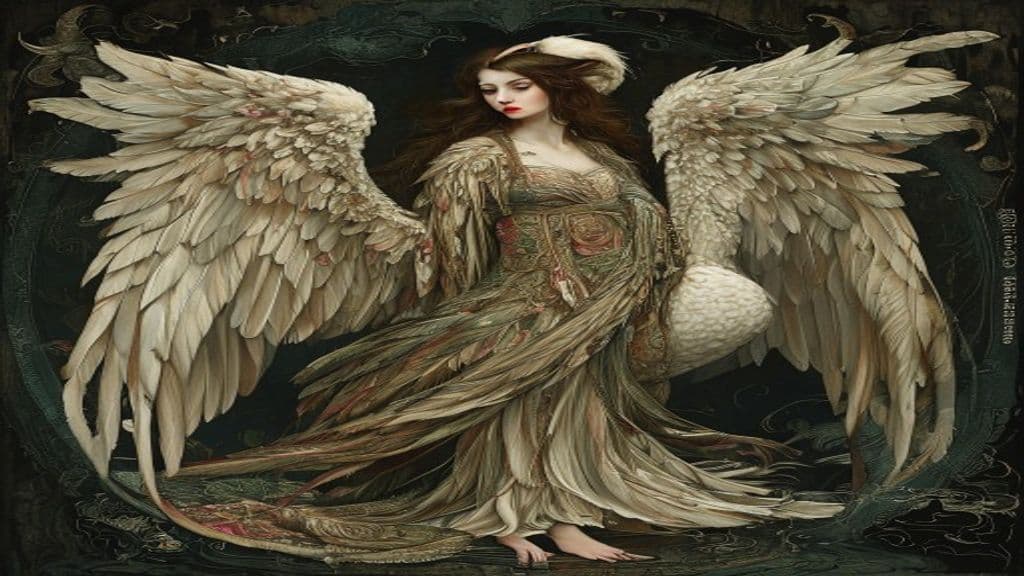
Swan maiden
A widespread folktale and mythic figure: a female being who changes between human form and a bird via a feathered garment (feather cloak, swan‑shirt, hagoromo). The motif appears across many cultures and is classed in folktale catalogues under ATU 400 and related 'magic wife' narratives.
Adže / Adze
No folkloric entity named 'Adže' is documented in the provided sources. The string appears in heterogeneous, non-folkloric contexts (a Bosnian village name, an English woodworking tool entry, a performer pen name, a CIA document fragment) and one modern podcast episode list that mentions 'the Adze' among other vampire-like beings; none of these supply an ethnographic description of a supernatural being called 'Adže'.
Ala
A female weather-being in South Slavic folk cosmology (Bulgaria, Serbia, North Macedonia) associated with hail, destructive storms, and voracious appetite; she is said to lead hail-producing clouds to destroy crops and is sometimes blamed for eclipses by attempting to devour the Sun or Moon.
Alatyr
A sacred world-stone in East Slavic and wider Slavic folklore, described as the "father to all stones" and the "navel of the earth." Located at the world's center (often on Buyan island), it is associated with a miraculous spring, sacred letters, healing properties, and liminality between the human world and other realms.
Alkonost
The Alkonost is a legendary woman-headed bird of East Slavic folklore, depicted as an individual mythic avian figure who lives in the underworld alongside her counterpart Sirin. Her song enchants listeners into forgetfulness or bliss, she is said to bless fruit during the Apple Feast of the Saviour, and her reproductive actions are causally linked in lore to sudden storms at sea.
Alyosha Popovich
Alyosha Popovich (Алёша Попович / Олешко Попович) is a named human hero (bogatyr) of the East Slavic byliny tradition, remembered as the youngest member of the canonical trio of Kievan Rus' warriors. He is chiefly characterized by slyness, mockery, and trickery, and defeats foes by craft often aided by pious petition rather than mere brute strength.
Andrew the Apostle
Andrew the Apostle (Greek Ἀνδρέας, Latin Andreas) is one of the Twelve Apostles in the New Testament, a fisherman from Bethsaida, the brother of Simon Peter, described as the “first-called” who introduced others to Jesus. Post-biblical traditions depict him as an early missionary and founder of Christian communities (notably claims of missions to Thrace, Scythia, and founding the see of Byzantium) and as a martyr crucified at Patras.
Aq Bars
Aq Bars (Tatar: Ак Барс, 'White Leopard') is an ancient Bulgar tribal totem and heraldic emblem historically used in Volga Bulgaria and the Khanate of Kazan and adopted in the modern era as the official symbol of the Republic of Tatarstan (formally since 7 February 1992). It functions as a dynastic/tribal mark of identity (derived from the Barsil tribe) and as a political-state emblem rather than a personal supernatural being.
August curse
A modern cultural concept in Russia describing a perceived clustering of severe disasters, attacks, and adverse events during the month of August. Treated in sources as an explanatory frame combining statistical observation, seasonal and political factors, and occasional astrological or supernatural interpretation.
Azovka (Azov Girl)
Azovka, often called the Azov Girl in English summaries, is a female supernatural figure named in Pavel Bazhov’s Ural skaz tale "Beloved Name." The supplied sources identify her as a character from Ural-region folklore as represented in Bazhov’s miners’ tales but provide no detailed description or independent folkloric tradition beyond that tale reference.
Baba Marta
Baba Marta (Bulgarian: Баба Марта, 'Granny March') is a Bulgarian folkloric personification of the transition from winter to spring. Celebrated on March 1, she is pictured as a feisty grandmother whose mood is said to affect late-winter weather; communal customs (martenitsi) exchanged on her day symbolize health and good fortune.
Baba Yaga
Baba Yaga is an ambivalent female figure of East Slavic folktale tradition, depicted variously as a fearsome, child-eating crone or as a helpful, maternal donor. She is associated with the deep forest, a hut described as standing on chicken legs, and the motific accoutrements of a mortar and pestle.
Babay (Slavic folklore)
A Slavic night spirit that abducts misbehaving children who stay awake at night, embodying societal values of discipline and conformity. (Note: 1. Power tier: Given the ability to abduct and punish misbehaving children, Babay's power level should be at least Greater Spirit. 2. Appearance: Since no physical description is provided in the sourc)
Community Record
- [1]Povitrulya. Wikipedia: Povitrulyawiki
- [2]Povitrulya (Wikidata). Wikidata: Q12141293wiki
- [3]V. Pachovsky — literary depiction summarized. Summary of Pachovsky's poetic reworking as cited in the Wikipedia articleliterary